


The three major science parks are likely to see their revenue grow to surpass NT$4 trillion (US$132.3 billion) this year, unfazed by a recession in the global technology industry, the National Science and Technology Council said yesterday.
Revenue from companies with operations at the Hsinchu Science Park (新竹科學園區), Central Taiwan Science Park (中部科學園區) and Southern Taiwan Science Park (南部科學園區) was estimated to have risen 10 percent year-on-year to a historical high of NT$4 trillion last year, Minister of Science and Technology Wu Tsung-tsong (吳政忠) said.
There is a good chance of further growth in revenue this year, due to resilient demand for high-end semiconductors, he said, adding that the chances of a recession look slim.
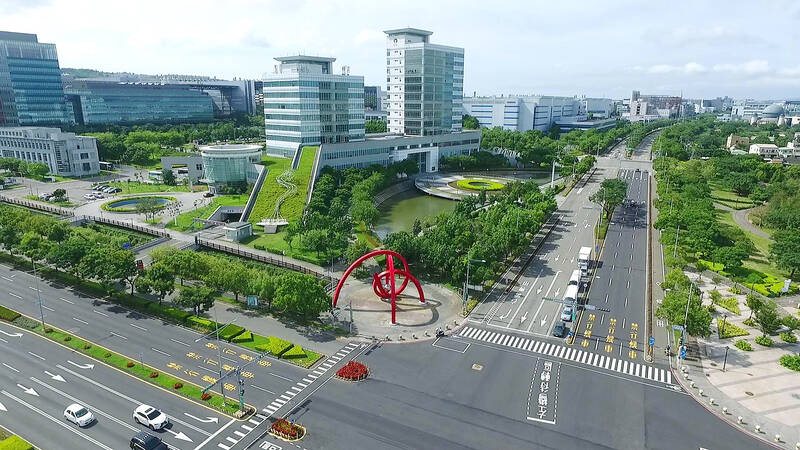
Photo: CNA
That goes against a downtrend affecting the world’s major technology companies, he added.
“Semiconductor supply remains the focus of the world. I believe Taiwan’s semiconductor industry has the cutting-edge technologies to meet that demand,” Wu said. “It is still too early to make a revenue forecast. It’s just February, but I think there is a good chance [to see growth].”
Micron Technology Inc has made the case.
The US memorychip maker in December last year announced a plan to cut 10 percent of its headcount this year, to suspend the distribution of bonuses and cut executive pay due to flagging demand for its chips.
Micron yesterday confirmed that it is reducing global headcount through a combination of voluntary attrition, workforce reductions and reduced external hiring.
“Micron has now started meeting with some of the employees affected by Micron’s plans to reduce its workforce in the face of the severe downturn that is affecting the entire industry,” the company said in a statement.
Micron did not say how many people it aims to lay off, but the council expects less than 10 percent of Micron’s local employees to be affected, Wu said.
The science parks have not yet received notification of large-scale layoff plans, the council said.
Micron has about 10,000 local employees.
Despite the world technology industry entering period of correction, local corporate executives have been calling for more land to be made available to build new production lines to meet customers’ requests for more diversified and resilient supply-chain management, given escalating geopolitical tensions.
The Cabinet has approved seven new expansion projects in the three science parks and allocated 693 hectares of land in Hsinchu, Taichung, Tainan, Chiayi, Kaohsiung and Pingtung, the council said.
Those new expansion plans would add NT$1.2 trillion in new revenue and create about 30,000 jobs, it said.
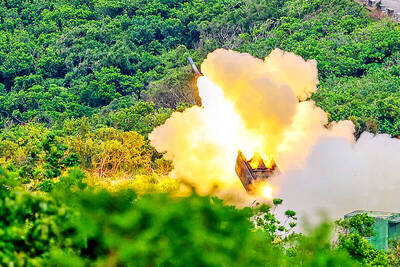
PRECISION STRIKES: The most significant reason to deploy HIMARS to outlying islands is to establish a ‘dead zone’ that the PLA would not dare enter, a source said A High Mobility Artillery Rocket System (HIMARS) would be deployed to Penghu County and Dongyin Island (東引) in Lienchiang County (Matsu) to force the Chinese military to retreat at least 100km from the coastline, a military source said yesterday. Taiwan has been procuring HIMARS and Army Tactical Missile Systems (ATACMS) from the US in batches. Once all batches have been delivered, Taiwan would possess 111 HIMARS units and 504 ATACMS, which have a range of 300km. Considering that “offense is the best defense,” the military plans to forward-deploy the systems to outlying islands such as Penghu and Dongyin so that
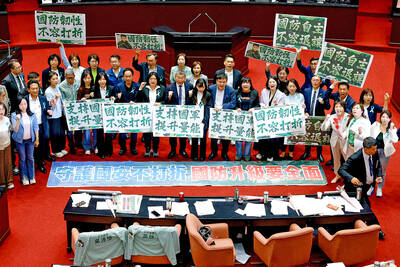
WHAT WAS ALL THAT FOR? Jaw Shaw-kong said that Cheng Li-wen had pushed for more drastic cuts and attacked him, just for the outcome to be nearly identical to his bill The legislature yesterday passed a supplementary budget bill to fund the purchase of separate packages of US military equipment, with the combined amount of spending capped at NT$780 billion (US$24.8 billion). The Chinese Nationalist Party (KMT) and Taiwan People’s Party (TPP) used their legislative majority to pass the bill, which runs until 2033 and has two main funding provisions. One was for NT$300 billion of arms sales already approved by the US for Taiwan on Dec. 17 last year, the other was for NT$480 billion for another arms package expected to be announced by Washington. The bill, which fell short of the NT$1.25
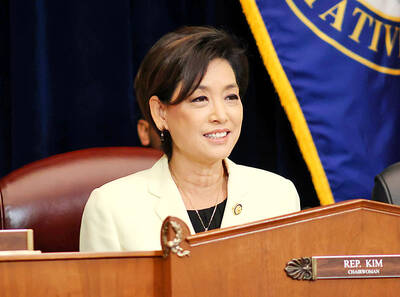
‘CLEAR MESSAGE’: The bill would set up an interagency ‘tiger team’ to review sanctions tools and other economic options to help deter any Chinese aggression toward Taiwan US Representative Young Kim has introduced a bill to deter Chinese aggression against Taiwan, calling for an interagency “tiger team” to preplan coordinated sanctions and economic measures in response to possible Chinese military or political action against Taiwan. “[Chinese President] Xi Jinping [習近平] has directed the People’s Liberation Army to be ready to invade Taiwan by 2027. China has a plan. America should have one too,” Kim said in a news release on Thursday last week. She introduced the “Deter PRC [People’s Republic of China] aggression against Taiwan act” to “ensure the US has a coordinated sanctions strategy ready should

A former television news host and six military personnel — active and retired — have been indicted on espionage charges, Kaohsiung prosecutors said yesterday. Lin Chen-you (林宸佑), a former CTi News host and YouTuber, last year allegedly made videos at the direction of a Chinese agent criticizing the Democratic Progressive Party’s recall campaign, the Ciaotou District Prosecutors’ Office told a news conference in Kaohsiung. He allegedly received 4,325 tether coins for the videos from an unidentified person surnamed Huang (黃), believed to be an agent of a hostile foreign power, they said. Lin, also known as Ma Te (馬德), has a show named


 RSS
RSS