


President Tsai Ing-wen (蔡英文) yesterday announced a wide range of subsidies to build a resilient economy and secure Taiwan’s advantage in the information technology and semiconductor industries.
Taiwan must retain its key role in the global supply chain, maintain its industries’ competitiveness and support the economy’s continued stability, she said after a meeting with senior officials on the economy.
The government plans to spend NT$100 billion (US$3.26 billion) of about NT$380 billion in surplus tax revenue raised last year on projects to bolster economic resilience, National Development Council Minister Kung Ming-hsin (龔明鑫) said.
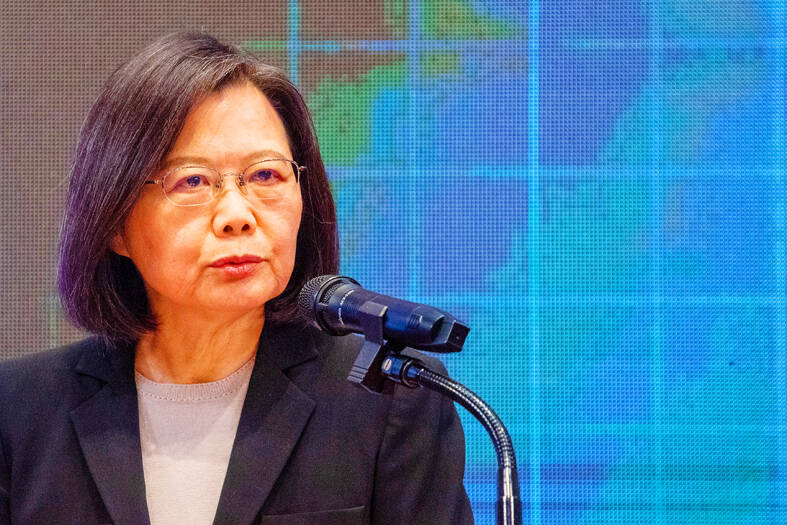
Photo: EPA-EFE
Another NT$100 billion would be invested in the National Health Insurance system and be used to cover Taiwan Power Co’s (Taipower, 台電) costs related to energy subsidies, he said.
Taipower lost NT$220.4 billion in the first 11 months of last year with costs and expenses exceeding revenues by 36 percent, its latest condensed income statement showed.
The government would also find ways to redistribute the remaining NT$180 billion to the public, which could include cash or stimulus vouchers, he said.
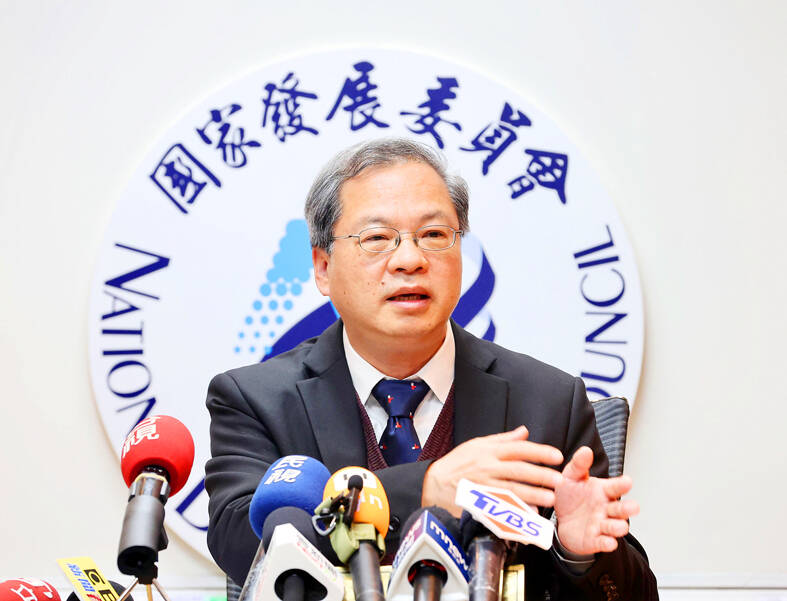
Photo: CNA
Executive Yuan spokesman Lo Ping-cheng (羅秉成) said the surplus was created by conservative government budgeting and the economy performing well during the COVID-19 pandemic.
The Presidential Office said that the government would pursue amendments to the Equalization of Land Rights Act (平均地權條例) to build social housing, expand rental subsidies, implement housing loan subsidies, simplify and hasten urban renewal, and prevent land speculation.
The government would also implement transportation subsidies in the Taipei, New Taipei City, Keelung and Taoyuan area; the Taichung, and Chunghua and Nantou counties region; and the Tainan, Kaohsiung and Pingtung County area, it said.
It would also work with local governments in Hualien, Kinmen, Lienchiang, Penghu and Taitung counties on improving transportation for residents and tourism, it said.
It plans to encourage more mass public transportation to help achieve the government’s 2050 net zero emissions goal, it said.
Starting this year, the government would increase subsidies for long-term healthcare facilities servicing people with Category 4 disabilities, including with the expansion of meal services and setting up a system to sell goods at fixed rates to people from economically disadvantaged households.
The government would also offer loans, interest subsidies and support for the fundamental restructuring of Taiwan’s small and medium-sized enterprises amid a global economic slowdown, the Presidential Office said.
The subsidies are designed to help them achieve automation and modularization, and lower their carbon emissions, it said.
In agriculture, the government plans to improve infrastructure, such as by modernizing equipment and upgrading facilities, while increasing subsidies focused on the environment, such as insurance payouts to mitigate the environmental impacts of projects, it said.
The government also seeks to attract up to 6 million international tourists this year, it said.
It would offer subsidies for cruises and charter flights, businesses abroad that encourage employees to travel to Taiwan for leisure, students seeking to study in Taiwan and travel agencies that promote tourism packages focused on foreign travelers to Taiwan
The government would maintain subsidies for gas and electricity, extend decreased tariffs for commodities into March and step up investigations into monopolization, hoarding and other activities that drive up prices, it said.
Additional reporting by CNA

A signaling system malfunction disrupted high-speed rail (HSR) services beginning at 8am today, with trains temporarily reduced to three northbound and three southbound trains per hour as authorities conduct inspections. The malfunction occurred on a section of track in Miaoli County during pre-operation checks early this morning, forcing northbound and southbound trains to use a single track, the HSR operator said. The regular schedule has been replaced with three hourly trains offering only nonreserved seating in each direction, stopping at every station, it said, adding that business class cars would still have reserved seating. Departures from terminal stations are scheduled at the top
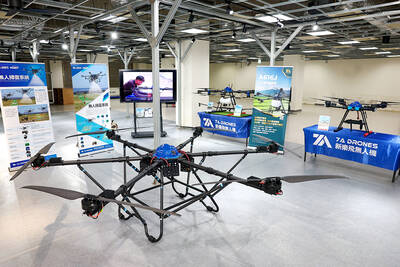
DRONE CENTRAL: Taiwan aims to become Asia’s democratic hub for drones, with most exports focused on high-quality military-grade models, an official said Taiwan’s drone industry is expected to expand significantly by 2030, producing 100,000 units per month and exporting half of them, the Ministry of Economic Affairs said yesterday. Current drone production capacity is about 15,000 units per month, but the industry can quickly scale up as demand increases, Industrial Development Administration Director-General Chiou Chyou-huey (邱求慧) told a news conference in Taipei. Taiwan’s drone output grew 2.5-fold last year to NT$12.9 billion (US$408.3 million) under a government program to develop the uncrewed vehicle sector, he said. The Executive Yuan in October last year approved plans to invest NT$44.2 billion into domestic production of uncrewed aerial

Taiwan is still in the process of assessing the possibility of recruiting workers from Eswatini, the Ministry of Foreign Affairs said yesterday, adding that its goal is to help Eswatini upgrade its vocational training centers. If there are plans to recruit workers from Eswatini, safeguarding national security, protecting public health and ensuring the employment rights of Taiwanese would be prerequisites, Department of West Asian and African Affairs Director-General Yen Chia-liang (顏嘉良) told a news conference. Key considerations would also include filling labor shortages in specific industries, and fostering bilateral professional and technical exchanges, he said. Yen was asked about the progress of labor

VERBOSE VESSELS: A CGA cutter and a China Coast Guard exchanged verbal barbs for more than a day in Taiwanese-controlled waters before the Chinese vessel left The Taiwanese and Chinese coast guards had a standoff near the strategically located Pratas Islands (Dongsha Islands, 東沙群島) in the north of the South China Sea, the Coast Guard Administration (CGA) said yesterday. The two sides engaged in intense radio exchanges over sovereignty claims during the 33-hour standoff. China Coast Guard vessel 3501 eventually left the restricted waters, 26.6 nautical miles (49.2km) west of the Pratas Islands, at 5pm yesterday, the CGA said. Lying approximately between southern Taiwan and Hong Kong, the Taiwan-controlled Pratas are seen by some security experts as vulnerable to Chinese attack due to their distance — more than


 RSS
RSS