

China’s military said it staged “strike drills” in the sea and airspace around Taiwan yesterday in response to an unspecified “provocation” by Taipei and Washington.
China staged war games around Taiwan in August following a visit to Taipei by US House of Representatives Speaker Nancy Pelosi, and on Saturday it condemned the US for a new defense authorization law that boosts military assistance for Taiwan.
In a brief statement, the Eastern Theater Command of China’s People’s Liberation Army said it had carried out “joint combat readiness patrols and joint firepower strike drills” around Taiwan, although it did not specify the exact location.
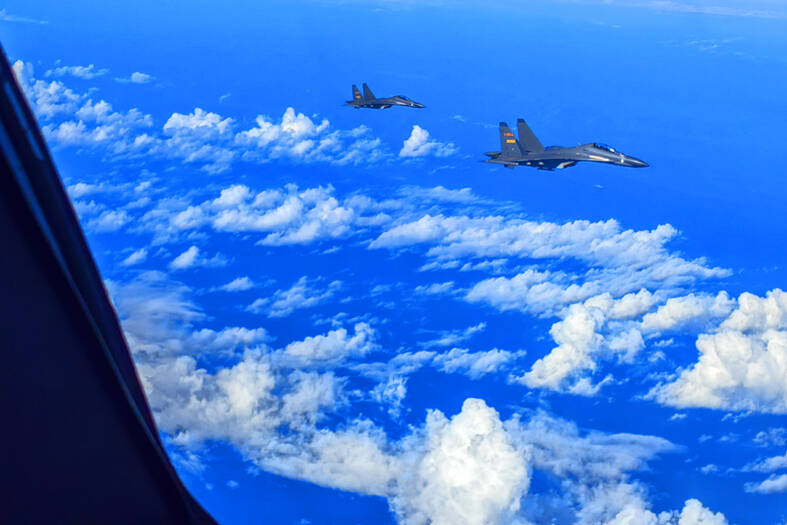
Photo: AP
“This is a resolute response to the current escalation of collusion and provocation from the United States and Taiwan,” it said, without giving details.
“Theater forces will take all necessary measures to resolutely defend national sovereignty and territorial integrity,” it added.
The Ministry of National Defense reported that eight Chinese military aircraft and three naval ships had been detected near Taiwan between 6am on Saturday and 6am yesterday.
Taiwanese fighter jets were deployed to warn the Chinese aircraft, and air defense missile systems were deployed to monitor the activities, it said.
The US is Taiwan’s most important international backer and arms supplier, despite the absence of formal diplomatic ties. US arms sales to Taiwan are a constant irritant in Beijing’s relations with Washington.
The Chinese drills coincided with newly elected city mayors and county leaders in Taiwan taking up their positions following last month’s local elections, in which the ruling Democratic Progressive Party was trounced.
China has never renounced the use of force to bring Taiwan under its control.
Additional reporting by staff writer

‘GLOBAL WARNING’: The infiltration is not just a local problem, as Beijing has been deploying the same tactics worldwide against Western democracies, a report said Between 50,000 and 100,000 Chinese spies are operating in Taiwan, far more than the National Security Bureau’s previous estimate of 5,000, German journalist and author Jurgen Kremb said on Monday. Kremb presented his research, titled “The War of Spies: How China’s Intelligence Services Are Infiltrating Taiwan — and What Europe Must Learn from It,” at a joint event held by the Taiwan offices of the Friedrich Naumann Foundation and the European Values Center for Security Policy. The report was published in June in the Ministry of Justice Investigation Bureau’s Prospect & Exploration Monthly (展望與探索月刊). By spies, he said he was referring to informants,

PRICE STABILIZATION: The Ministry of Economic Affairs has urged the legislature to support the Cabinet’s supplementary budget for state-owned energy companies State-owned oil supplier CPC Corp, Taiwan (CPC, 台灣中油) on Saturday announced that it would raise domestic gasoline prices by NT$0.7 (US$0.02) per liter and diesel prices by NT$0.6 per liter this week after international crude oil prices rose above US$100 per barrel last week. Formosa Petrochemical Corp (台塑石化) yesterday said that it matched CPC’s price adjustments for this week. The decisions end a six-week period during which CPC and Formosa kept fuel prices in Taiwan unchanged. Retail gasoline prices this week would rise to NT$31.2, NT$32.7 and NT$34.7 per liter for 92, 95 and 98-octane unleaded gasoline respectively at CPC
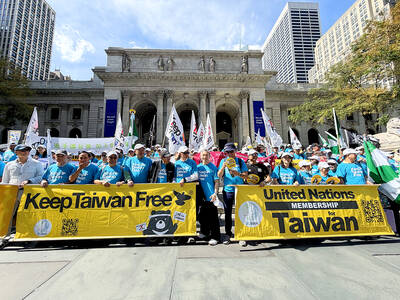
More than 100 Taiwanese-Americans, Taiwanese lawmakers and members of civic groups on Saturday marched through New York City to call for Taiwan’s participation in the UN, with Marshall Island Permanent Representative to the UN John Silk joining the event to show support. Participants chanted: “UN for Taiwan” and “Keep Taiwan Free” as they marched through central Manhattan, passing Times Square and Bryant Park before ending near the New York Public Library. The annual march brought together Taiwanese community groups from across the US East Coast. Silk expressed hope that Taiwan would one day be able to participate in UN meetings
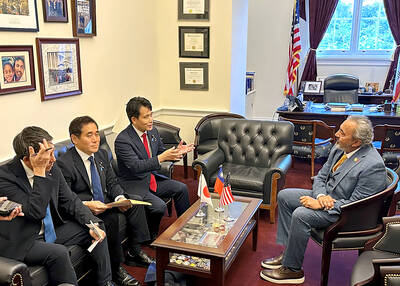
WASHINGTON MEETING: Japan’s Hirofumi Takinami said participants rejected the idea that the US should limit its defensive perimeter to the Second Island Chain US and Japanese lawmakers agree that the US must defend the First Island Chain, including Taiwan, and should not fall back to the Second Island Chain, while “a Taiwan contingency is a Japan contingency and therefore a US-Japan alliance contingency,” media reported after a meeting between officials of the two nations in Washington on Tuesday. A delegation of Japanese lawmakers from the Liberal Democratic Party met with US Senator Thom Tillis, co-chair of the Senate Taiwan Caucus, and US Representative Ami Bera, co-chair of the US Congressional Taiwan caucus, to discuss issues concerning East Asia and the Taiwan Strait. The Japanese and


 RSS
RSS