

President Tsai Ing-wen (蔡英文) is expected to call a high-level national security meeting on Tuesday during which she would order the expansion of conscription from four months to one year, a source familiar with the matter said.
On Dec. 7, Minister of National Defense Chiu Kuo-cheng (邱國正) told lawmakers that a decision on the length of military service would be announced before the end of the year.
With one week left before New Year’s Eve, the only option remaining for the Tsai administration to prolong conscription is through an executive order — an avenue that the government is willing to take, the source said, speaking on condition of anonymity.
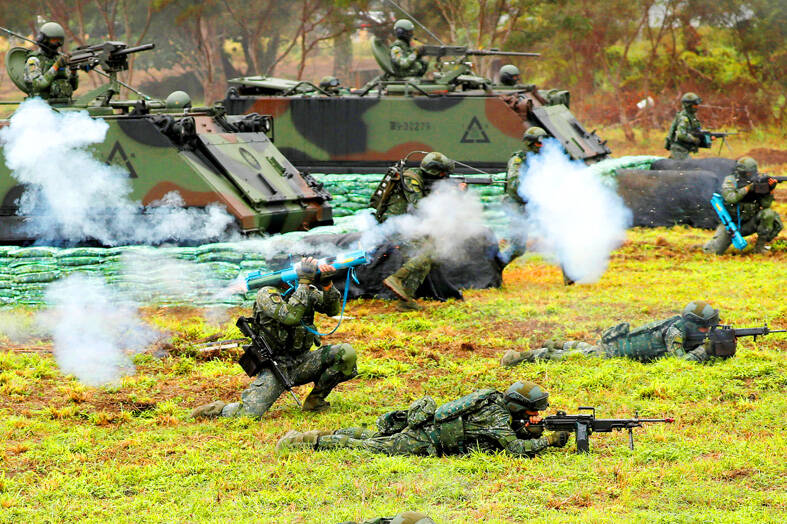
Photo: Tyrone Siu, REUTERS
Assuming the order is promulgated on Saturday, the implementation of the policy would begin no earlier than Jan. 1 and affect conscripts born in 2006, they said.
Military-aged men performing alternative civil service would also have their service terms extended to a year, up from six months, the source said.
The salary for military conscripts is to be increased to NT$15,000 per month, they added.
Leading Democratic Progressive Party lawmakers in the party’s caucus and the legislature’s Foreign Affairs and National Defense Committee have been briefed on these developments by the Presidential Office and the Ministry of National Defense, the source said.
Tsai is expected to personally announce the change and leave it to the Executive Yuan to finalize the policies, while the Legislative Yuan would receive a notification as soon as Friday, they said.
As the legislature is extending its current session to Jan. 13, there should be enough time for lawmakers to take receipt of the executive order, the source said.
A decline in population and the rising threat posed by China means Taiwan must fall back on conscription to have the necessary number of troops to defend itself, the Central News Agency cited an internal report by the ministry as saying.
Although a professional military comprised of five-year volunteers would be the most efficient force, such goals could be unobtainable due to the nation’s changing demographics and China’s increasingly formidable amphibious capabilities, the report said.
The military recruited 70,495 volunteers from 2016 to last year, which was equivalent to enlisting 0.3 percent of the population each year, matching the enlistment rates in other democracies, it said.
While Taiwan could before 2016 draw volunteers from a pool of about 110,000 military-aged males per year, the number of men available to the military has declined every year since 2019, it said.
By 2025, the military would not be able to recruit more than 9,305 new volunteers, a decrease of 4,709 compared with the current levels and insufficient for meeting national defense needs, it said.
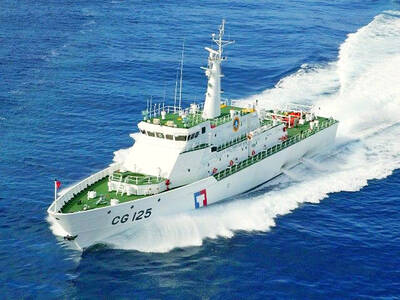
GEOPOLITICAL SIGNIFICANCE: The CGA’s nonmilitary role makes it a tool to avert diplomatic issues, an official said, while confirming the donation of a ship to Manila Coast Guard Administration (CGA) ships are scheduled to sail to the Philippines bearing the words “Taiwan Coast Guard” in a high-profile visit in October next year, the first such visit by a Taiwanese maritime law enforcement vessel to the Southeast Asian nation, the agency said yesterday. The CGA also confirmed that it had donated one of its decommissioned patrol vessels to the Philippines in a rare transfer of a retired ship to a nondiplomatic ally. The Republic of China (ROC) Navy last made such a visit in 1974, shortly before the Philippines switched diplomatic recognition to the People’s Republic of China in

‘GLOBAL WARNING’: The infiltration is not just a local problem, as Beijing has been deploying the same tactics worldwide against Western democracies, a report said Between 50,000 and 100,000 Chinese spies are operating in Taiwan, far more than the National Security Bureau’s previous estimate of 5,000, German journalist and author Jurgen Kremb said on Monday. Kremb presented his research, titled “The War of Spies: How China’s Intelligence Services Are Infiltrating Taiwan — and What Europe Must Learn from It,” at a joint event held by the Taiwan offices of the Friedrich Naumann Foundation and the European Values Center for Security Policy. The report was published in June in the Ministry of Justice Investigation Bureau’s Prospect & Exploration Monthly (展望與探索月刊). By spies, he said he was referring to informants,

PRICE STABILIZATION: The Ministry of Economic Affairs has urged the legislature to support the Cabinet’s supplementary budget for state-owned energy companies State-owned oil supplier CPC Corp, Taiwan (CPC, 台灣中油) on Saturday announced that it would raise domestic gasoline prices by NT$0.7 (US$0.02) per liter and diesel prices by NT$0.6 per liter this week after international crude oil prices rose above US$100 per barrel last week. Formosa Petrochemical Corp (台塑石化) yesterday said that it matched CPC’s price adjustments for this week. The decisions end a six-week period during which CPC and Formosa kept fuel prices in Taiwan unchanged. Retail gasoline prices this week would rise to NT$31.2, NT$32.7 and NT$34.7 per liter for 92, 95 and 98-octane unleaded gasoline respectively at CPC
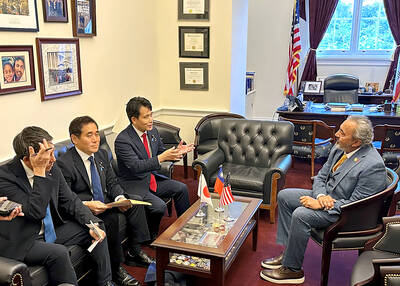
WASHINGTON MEETING: Japan’s Hirofumi Takinami said participants rejected the idea that the US should limit its defensive perimeter to the Second Island Chain US and Japanese lawmakers agree that the US must defend the First Island Chain, including Taiwan, and should not fall back to the Second Island Chain, while “a Taiwan contingency is a Japan contingency and therefore a US-Japan alliance contingency,” media reported after a meeting between officials of the two nations in Washington on Tuesday. A delegation of Japanese lawmakers from the Liberal Democratic Party met with US Senator Thom Tillis, co-chair of the Senate Taiwan Caucus, and US Representative Ami Bera, co-chair of the US Congressional Taiwan caucus, to discuss issues concerning East Asia and the Taiwan Strait. The Japanese and


 RSS
RSS