


Waves of explosive-laden suicide drones yesterday struck Ukraine’s capital, setting buildings ablaze and tearing a hole in one while sending people scurrying for shelter or attempting to shoot down the kamikazes.
The concentrated use of drones was the second barrage in as many weeks — after months in whcich air attacks had become a rarity in central Kyiv. The assault sowed terror and frayed nerves as blasts echoed across the city. Energy facilities were struck, and one drone slammed into a residential building, killing three people, authorities said.
The attack drones appeared to include Iranian-made Shaheds. Intense, sustained bursts of gunfire rang out as soldiers tried to shoot them down. Some headed for shelter, nervously scanning the skies.
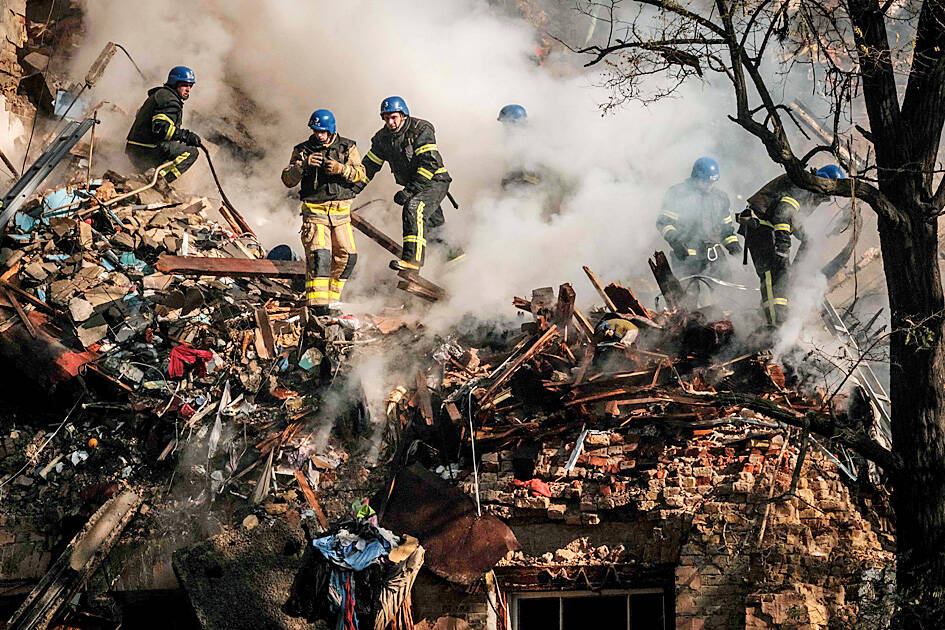
Photo: AFP
However, Ukraine has become grimly accustomed to attacks nearly eight months into the Russian invasion and city life resumed as rescuers picked through the debris.
Previous Russian airstrikes on Kyiv were mostly with missiles. Kyiv Mayor Vitali Klitschko said yesterday’s barrage came in successive waves of 28 drones — in what many fear could become a more common mode of attack as Russia seeks to avoid depleting its stockpiles of long-range precision missiles.
Five drones plunged into Kyiv itself, Ukrainian Prime Minister Denys Shmyhal said.
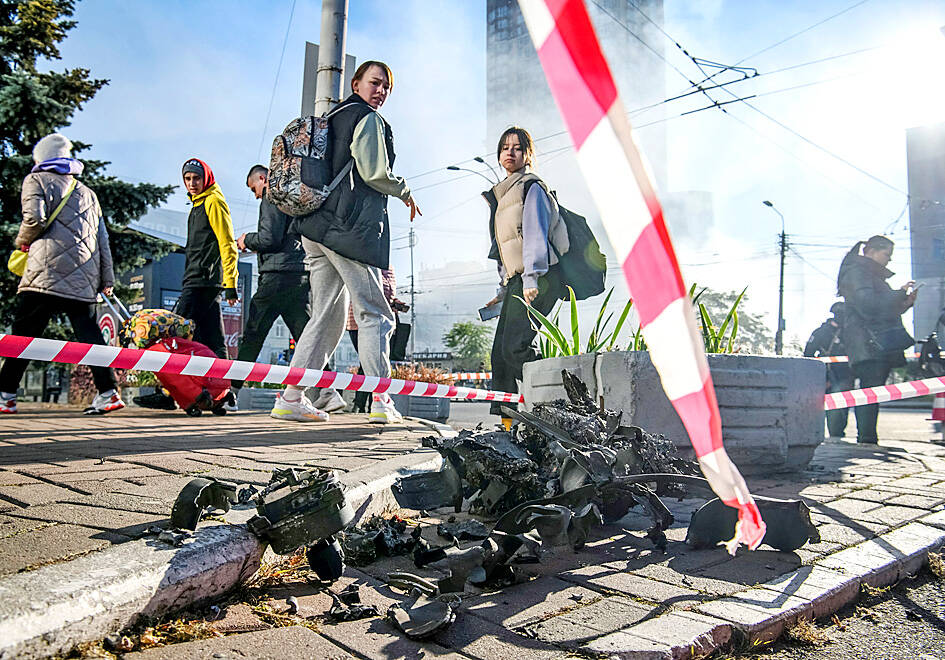
Photo: Reuters
In the Kyiv region, at least 13 were shot down, all of them flying in from the south, Ukrainian Air Force spokesman Yurii Ihnat said.
One strike appeared to target the city’s heating network, hitting an operations center. Another slammed into a four-story residential building, ripping a large hole in it and collapsing at least three apartments on top of each other. Three bodies were recovered from the rubble, including those of a woman who was six months pregnant and her husband, Klitschko said.
The other person killed was an older woman.
An Associated Press photographer who was out shooting morning scenes of Kyiv caught one of the drones on camera, its triangle-shaped wing and pointed warhead clearly visible against the blue sky.
“The whole night, and the whole morning, the enemy terrorizes the civilian population,” Ukrainian President Volodymyr Zelenskiy said in a social media post. “Kamikaze drones and missiles are attacking all of Ukraine.”
“The enemy can attack our cities, but it won’t be able to break us,” he wrote.
Andrii Yermak, head of the Ukrainian president’s office, said in a social media post that Shahed drones were among those used in the strike.
Zelenskiy, citing Ukrainian intelligence services, has previously alleged that Russia has ordered 2,400 of the Shahed drones from Iran. Russia has rebranded them as Geran-2 drones — meaning geranium in Russian.
A photograph of debris from one of yesterday’s strikes, posted by Klitschko, showed the word Geran-2 marked on a mangled tail fin.
Iran has previously denied providing Russia with weapons, although its Revolutionary Guard head has boasted about providing arms to the world’s top powers, without elaborating.

PROVOCATIVE: Chinese Deputy Ambassador to the UN Sun Lei accused Japan of sending military vessels to deliberately provoke tensions in the Taiwan Strait China denounced remarks by Japan and the EU about the South China Sea at a UN Security Council meeting on Monday, and accused Tokyo of provocative behavior in the Taiwan Strait and planning military expansion. Ayano Kunimitsu, a Japanese vice foreign minister, told the Council meeting on maritime security that Tokyo was seriously concerned about the situation in the East China and South China seas, and reiterated Japan’s opposition to any attempt to change the “status quo” by force, and obstruction of freedom of navigation and overflight. Stavros Lambrinidis, head of the EU delegation to the UN, also highlighted South China Sea
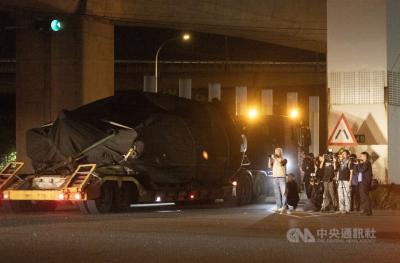
The final batch of 28 M1A2T Abrams tanks purchased from the US arrived at Taipei Port last night and were transported to the Armor Training Command in Hsinchu County’s Hukou Township (湖口), completing the military’s multi-year procurement of 108 of the tanks. Starting at 12:10am today, reporters observed more than a dozen civilian flatbed trailers departing from Taipei Port, each carrying an M1A2T tank covered with black waterproof tarps. Escorted by military vehicles, the convoy traveled via the West Coast Expressway to the Armor Training Command, with police implementing traffic control. The army operates about 1,000 tanks, including CM-11 Brave Tiger

Taiwan Semiconductor Manufacturing Co (TSMC, 台積電), the world’s largest contract chipmaker, said it expects its 2-nanometer (2nm) chip capacity to grow at a compound annual rate of 70 percent from this year to 2028. The projection comes as five fabs begin volume production of 2-nanometer chips this year — two in Hsinchu and three in Kaohsiung — TSMC senior vice president and deputy cochief operating officer Cliff Hou (侯永清) said at the company’s annual technology symposium in Silicon Valley, California, last week. Output in the first year of 2-nanometer production, which began in the fourth quarter of last year, is expected to
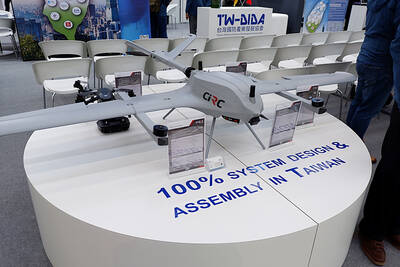
Taiwan’s drone exports surged past US$100 million in the first quarter, exceeding last year’s full-year total, with the Czech Republic emerging as the largest buyer, the Ministry of Economic Affairs said. Exports of complete drones reached US$115.85 million in the period, about 1.2 times the total recorded for all of last year, the ministry said in a report. Exports to the Czech Republic accounted for about US$100 million, far outpacing other markets. Poland, last year’s top destination, recorded about US$11.75 million in the first quarter. Taiwan’s drone exports have expanded rapidly in the past few years, with last year’s total


 RSS
RSS