


Paraguay’s relationship with Taiwan is not based on a “quid pro quo,” Ministry of Foreign Affairs spokeswoman Joanne Ou (歐江安) yesterday cited the country’s foreign minister as telling Ambassador to Paraguay Jose Han (韓志正).
The statement came hours after the Financial Times reported that Paraguayan President Mario Abdo Benitez had asked Taipei to invest US$1 billion in his country to maintain diplomatic ties.
Paraguayan Minister of Foreign Affairs Julio Cesar Arriola had clarified the remarks and told the ambassador that the ties between the countries are based on shared values and close bilateral cooperation, Ou said.
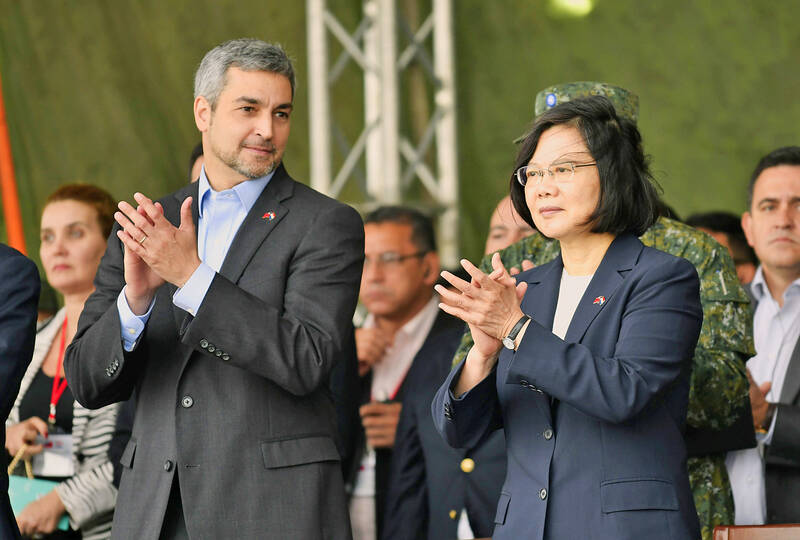
Photo: SAM YEH, AFP
The Financial Times reported that Abdo asked for the investment as it would help him resist “enormous” pressure from Beijing to switch diplomatic recognition to China.
“We are working with the president of Taiwan ... so that the Paraguayan people feel the real benefits of the strategic alliance,” the newspaper cited him as saying during a trip to the US.
“There is Taiwanese investment of more than US$6 billion in countries which don’t have diplomatic relations with Taiwan, we want from that US$1 billion to be put in Paraguay,” he is cited as saying. “That will help us to build the argument about the importance of this strategic alliance with Taiwan... Imagine what the [agricultural] producers say when meat prices fall and they don’t have access to China. They ask you: ‘Please, we have to open up to the Chinese market. What does Taiwan give us when we are a country which could sell its entire soy and meat output to China?’”
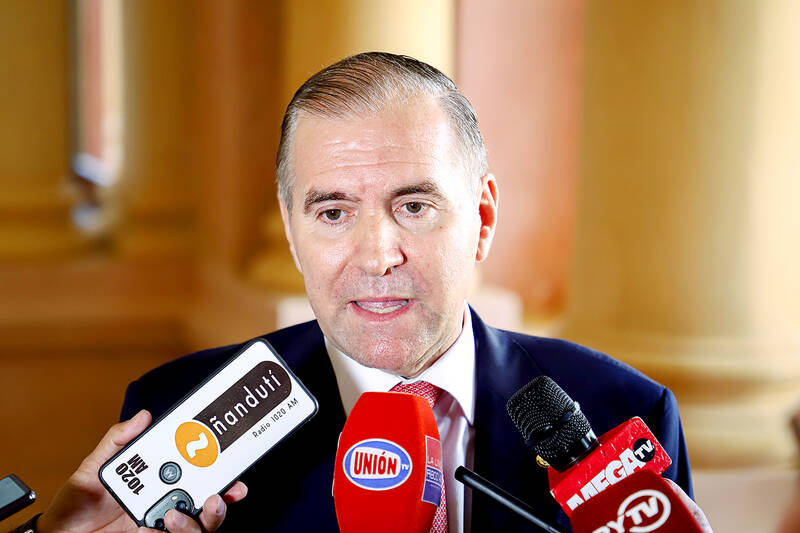
Photo: EPA-EFE
Cesar told Han that the Paraguayan president merely meant to say that his country would be the perfect location for Taiwanese investment, Ou said.
Abdo has been a staunch supporter of Taiwan over the past few years and has repeatedly reaffirmed that Taiwan-Paraguay ties would remain unchanged as long as he is in office, Ou said.
As for investment opportunities, Ou said that Taiwan had sent two delegations to Paraguay this year and the government continues to encourage Taiwanese investment in Paraguay, which has one of the most stable political and economic systems in Latin America.
More Taiwanese investment in Paraguay would have profound significance for the two countries’ strategic partnership, the ministry told the Financial Times by e-mail in response to Abdo’s remarks.
Ou said Abdo on Wednesday attended a signing ceremony between Taiwan’s International Cooperation and Development Fund (ICDF) and the Paraguayan Development Finance Agency, showing that he has maintained close relations with Taiwan.
The development fund donated US$5 million for the creation of the Paraguayan Guarantee Fund for Women, which seeks to empower the country’s women in the post-COVID-19 pandemic era, the ICDF said.
Taiwan has 14 diplomatic allies. Paraguay is the only country in South America that recognizes Taipei instead of Beijing.
Since President Tsai Ing-wen (蔡英文) took office in May 2016, Taiwan has lost eight diplomatic allies: Burkina Faso, the Dominican Republic, El Salvador, Kiribati, Nicaragua, Panama, Sao Tome and Principe, and the Solomon Islands.

PROVOCATIVE: Chinese Deputy Ambassador to the UN Sun Lei accused Japan of sending military vessels to deliberately provoke tensions in the Taiwan Strait China denounced remarks by Japan and the EU about the South China Sea at a UN Security Council meeting on Monday, and accused Tokyo of provocative behavior in the Taiwan Strait and planning military expansion. Ayano Kunimitsu, a Japanese vice foreign minister, told the Council meeting on maritime security that Tokyo was seriously concerned about the situation in the East China and South China seas, and reiterated Japan’s opposition to any attempt to change the “status quo” by force, and obstruction of freedom of navigation and overflight. Stavros Lambrinidis, head of the EU delegation to the UN, also highlighted South China Sea

SILENCING CRITICS: In addition to blocking Taiwan, China aimed to prevent rights activists from speaking out against authoritarian states, a Cabinet department said The Ministry of Foreign Affairs (MOFA) yesterday condemned transnational repression by Beijing after RightsCon, a major digital human rights conference scheduled to be held in Zambia this week, was abruptly canceled due to Chinese pressure over Taiwanese participation. This year’s RightsCon, the world’s largest conference discussing issues “at the intersection of human rights and technology,” was scheduled to take place from tomorrow to Friday in Lusaka, and expected to draw 2,600 in-person attendees from 150 countries, along with 1,100 online participants. However, organizers were forced to cancel the event due to behind-the-scenes pressure from China, the ministry said, expressing its “strongest condemnation”
Taiwan Semiconductor Manufacturing Co (TSMC, 台積電), the world’s largest contract chipmaker, said it expects its 2-nanometer (2nm) chip capacity to grow at a compound annual rate of 70 percent from this year to 2028. The projection comes as five fabs begin volume production of 2-nanometer chips this year — two in Hsinchu and three in Kaohsiung — TSMC senior vice president and deputy cochief operating officer Cliff Hou (侯永清) said at the company’s annual technology symposium in Silicon Valley, California, last week. Output in the first year of 2-nanometer production, which began in the fourth quarter of last year, is expected to
Taiwan’s economy grew far faster than expected in the first quarter, as booming demand for artificial intelligence (AI) applications drove a surge in exports, spilling over into investment and consumption, the Directorate-General of Budget, Accounting and Statistics (DGBAS) said yesterday. GDP growth was 13.69 percent year-on-year during the January-to-March period, beating the DGBAS’ February forecast by 2.23 percentage points and marking the most robust growth in nearly four decades, DGBAS senior official Chiang Hsin-yi (江心怡) told a news conference in Taipei. The result was powered by exports, which remain the backbone of Taiwan’s economy, Chiang said. Outbound shipments jumped 51.12 percent year-on-year to


 RSS
RSS