


President William Lai (賴清德) yesterday marked the 15th anniversary of the Tohoku earthquake and tsunami, urging continued cooperation between Taiwan and Japan on disaster prevention and humanitarian assistance.
Lai wrote on social media that Taiwan and Japan have always helped each other in the aftermath of major disasters.
The magnitude 9 earthquake struck northeastern Japan on March 11, 2011, triggering a massive tsunami that claimed more than 19,000 lives, according to data from Japanese authorities.
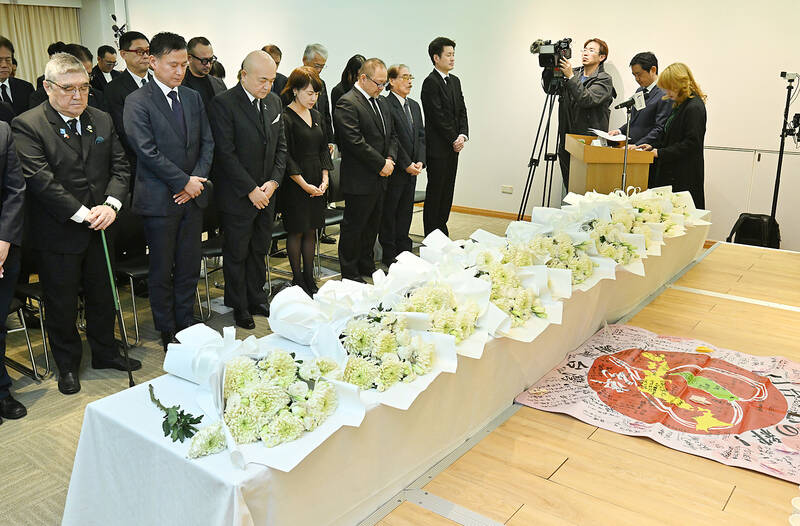
Photo: Tien Yu-hua, Taipei Times
Following the disaster, Taiwan donated more than US$240 million in aid, making it one of the largest contributors of financial assistance to Japan.
In addition to cash donations and relief supplies, Taipei and the private sector assembled rescue teams to help the affected areas within 72 hours of the disaster, Lai said.
Meanwhile, Japan sent a preliminary assessment team within 14 hours to assist with disaster relief after a magnitude 6.4 earthquake hit southern Taiwan in 2016, he said.
These reciprocal acts of kindness have continued to bind the Taiwanese and Japanese people, Lai said.
“These efforts allow bilateral ties to continue to deepen and make the two countries even closer regional partners,” he said.
Separately, Japan’s top representative in Taiwan expressed his gratitude for Taiwan’s support following the 2011 disaster.
Speaking at a memorial ceremony in Taipei yesterday, Japan-Taiwan Exchange Association Representative Kazuyuki Katayama said that Japanese remain deeply grateful for Taiwan’s generosity after the disaster.
Since then, people in Taiwan have continued to offer Japanese “warmth, support and comfort” whenever Japan faces similar hardships, Katayama said.
“Natural disasters might still occur, but no matter what difficulties we face, I am confident that the relationship of mutual support between Japan and Taiwan will continue,” he said in a speech delivered in Japanese.
The memorial once again reaffirmed the “unwavering friendship and bond” between the two sides, he said, adding that the relationship between the peoples of Taiwan and Japan continues to deepen even 15 years after the tragedy.
Also at the event, Isao Ueda, a representative of an overseas Japanese group in Taiwan that co-organized the memorial, talked about the kindness Taiwanese showed following the disaster.
“At that time, whenever I walked down the street in Taiwan and people learned that I was Japanese, they would ask with deep concern: ‘Is your home in Japan alright? Are your family members safe?’” he said.
“Today, on the 15th anniversary of the Great East Japan Earthquake, we mourn the victims of the disaster with heavy hearts. At the same time, we hope never to forget the kindness shown to us by Taiwan,” he said.
During the event, organized by several Japanese expatriate groups in Taiwan and held at the association’s Taipei office, participants observed a moment of silence and laid flowers to commemorate the victims.
Lin Yu-hui (林郁慧), deputy head of the Ministry of Foreign Affairs’ Taiwan-Japan Relations Association, attended the ceremony on behalf of Taipei.

‘NO SECURITY RISK’: The Railway Bureau reassured the public that the technicians’ activities were limited to technical guidance and did not involve sensitive systems The Railway Bureau yesterday said it had invited eight Chinese technicians to assist with an airport MRT construction project. The bureau issued the confirmation after an Internet user said Chinese nationals had entered the construction zone of Taiwan Taoyuan International Airport’s Terminal 3 project. They asked why “individuals from an enemy state” were allowed access to such a major national infrastructure project, which raised serious concerns over Taiwan’s industrial safety, sensitive systems and information security. The bureau’s Northern Region Engineering Branch Office said subcontractor Taiwan Handle Industrial Co (台灣手把工業) of the Taoyuan airport MRT’s “Contract No. CU05 Project A14 Station Civil, MEP &

A US uncrewed surface vessel (USV) encountered multiple Chinese warships during an autonomous transit of the Taiwan Strait, US defense company Seasats said in a statement on Wednesday. Seasats announced that a Lightfish USV had completed the first autonomous transit of the Taiwan Strait. Over five days, the USV traversed the entire length of the Strait while constantly monitoring surface vessel traffic, the company said. The Lightfish encountered multiple Chinese warships, one of which was a Chinese People’s Liberation Army Navy (PLAN) Type 056 corvette, it said. The Chinese vessels were operating “well within Taiwan’s exclusive economic zone without transmitting their identity via the
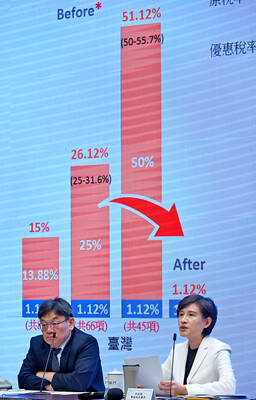
GREATER REACH? Auto parts and wood products would face tariffs of up to 15%, matching those targeting the EU, Japan and South Korea, Vice Premier said The US has announced that preferential tariff treatment for Taiwan’s non-semiconductor Section 232 goods would take effect retroactively from May 1, the Executive Yuan said yesterday. The US government yesterday posted a notice on the Federal Register’s public inspection Web site previewing tariff concessions for Taiwan under a memorandum of understanding (MOU) on Taiwan-US investment after two months of negotiations. The MOU signed on Jan. 15 stipulated three major preferential tariff arrangements: a 15 percent “reciprocal” tariff rate for Taiwan without stacking most-favored nation (MFN) rates; preferential Section 232 treatment for semiconductors and related products; and preferential Section 232 treatment for non-semiconductor

The National Chungshan Institute of Science and Technology yesterday showcased its locally developed variants of the Vision 60 robotic patrol dog, which it plans to deploy on the nation’s outlying territories in the South China Sea. The variants were produced under the Joint Lab project — created by the institute and domestic companies — and assembled with domestically produced motors, lenses and artificial intelligence (AI) systems alongside licensed tech from the US, Missile and Rocket Systems Research Division deputy director Jen Kuo-kang (任國光) told the media event at a military base in Taipei’s Dazhi (大直) area. Taiwan has built up its strengths


 RSS
RSS