

India and Japan yesterday said that they would deepen defense cooperation, with New Delhi inviting investment by Japanese industries and both countries planning a joint military drill involving their air force fighters.
Indian Minister of Defense Rajnath Singh held talks in Tokyo with Japanese Minister of Defense Yasukazu Hamada ahead of “two-plus-two” talks between defense and foreign ministers from the two countries.
“He invited Japanese industries to invest in India’s defense corridors,” the Indian Ministry of Defense said in a statement, referring to Singh.
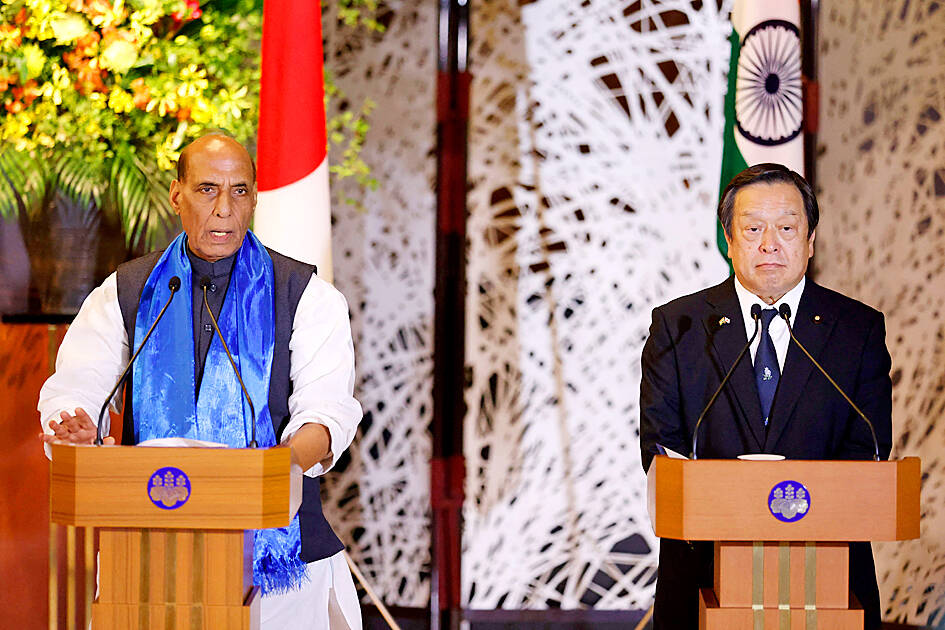
Photo: AFP
“The two ministers agreed that the early conduct of the inaugural fighter exercise will pave the way for much greater cooperation and interoperability between the air forces of the two countries,” it said.
India, like Japan, is bolstering its military to tackle what it sees as increased security threats, including from China.
In Japan, Prime Minister Fumio Kishida has promised a “substantial” defense spending increase.
His ruling Liberal Democratic Party wants to double Japan’s military budget to 2 percent of GDP over the next five years amid worry Russia’s invasion of Ukraine could embolden China to act against Taiwan.
New Delhi, which last week commissioned its first home-built aircraft carrier, is expanding its security ties with Tokyo as both Asian nations grow wary of China’s growing military might in the region.
At the outset of the two-plus-two meeting, Japanese Minister of Foreign Affairs Yoshimasa Hayashi underscored the growing importance of the ties between the two countries as the international community faces various challenges.
“If you take a look at the international community, unilateral attempts to change the status quo with force are continuing in the East and South China seas, let alone Russia’s invasion of Ukraine,” Hayashi said.
China claims almost all the energy-rich waters of the South China Sea, where it has established military outposts on artificial islands. In the East China Sea, Beijing claims a group of uninhabited Japanese-administered islets, which Taiwan also claims.
Japan and India, along with Australia and the US, are members of the Quadrilateral Security Dialogue group of nations and hold annual naval exercises across the Indo-Pacific region to demonstrate interoperability.
PLEA: How the UN addresses Taiwan’s security issue would be a test of its strength and relevance, Marshall Islands President Hilda Heine told the UN General Assembly Only Taiwan’s elected government can represent the people of Taiwan, Marshall Islands President Hilda Heine said on Friday at the UN General Assembly, calling for the nation’s inclusion in the UN. Taiwan and its 23 million people are a reality, and only its democratically elected government can represent it, Heine said when addressing the 81st session of the UN General Assembly General Debate. Appropriate ways must be found for Taiwan’s substantive participation in UN meetings if the UN is to be truly inclusive and effective in years to come, she said. UN member states would experience pressure to accept a
FACTS DISTORTION: The MAC rejected Xi’s remarks that the US and ‘China’ fought side-by-side during WWII, saying the ROC was Washington’s true ally during the war Taiwan yesterday denounced Chinese President Xi Jinping’s (習近平) comments to US President Donald Trump on the nation’s future, after Xi appeared to push Trump for a subtle change in stance that could erode US support for Taiwan. Xi told Trump in Washington on Thursday that he hoped the US would adhere to the “correct position” of opposing Taiwanese independence, according to a Chinese readout of the talks. That would be a tougher version of Washington’s long-standing formulation that it does not “support” independence. There was no immediate White House readout of the exchange. Xi’s remarks represent “the consistent Chinese approach of distorting facts
RESILIENCE: Keeping the defense industry’s assembly lines open would prove essential should the nation be involved in a prolonged conflict, a source said The Ministry of National Defense has prepared a NT$22 billion (US$692.3 million) program to acquire about 200 improved Hsiung Feng anti-ship missiles from next year to 2035, a source said. Commenting on condition of anonymity, a high-ranking defense official said the ministry’s plan for enhanced-capability Hsiung Feng II and Hsiung Feng III missiles would be funded as part of the regular defense budget. The 200 missiles would be added on top of the 1,400 missiles being funded via the Sea-Air Combat Power Improvement Plan, they said. The program is not about padding missile numbers, but expanding the capability to defeat

DEFENSE: The US House speaker dismissed speculation that Trump is using arms sales as a negotiating tactic with Beijing amid concern over delayed deliveries Taiwan is a partner whose “stability and independence” are important to US national security and the economy, US House of Representatives Speaker Mike Johnson said on Monday when asked about arms sales to Taipei in an interview with Fox Business. Asked whether US President Donald Trump was using a long-delayed US$14 billion arms deal as a negotiating tactic for trade with Beijing, Johnson said that he “wouldn’t read too much into that.” The delayed arms package is “related to the Iran conflict” and the need for missile stocks in the Middle East, he said. “If you look over [Trump’s] two terms, he will


 RSS
RSS