


Ukrainian forces pressed their counteroffensive to retake the Russian-occupied southern region of Kherson, while a team of UN experts were en route to inspect the Zaporizhzhia nuclear plant, which was targeted by fresh shelling over the weekend.
The coastal region of Kherson and its capital city of the same name have been contested by Russian troops since the war broke out six months ago.
“Ukrainian armed forces have launched their offensive in several areas in the south,” said Yaroslav Yanushevych, the head of the regional administration, on the Telegram messaging app.
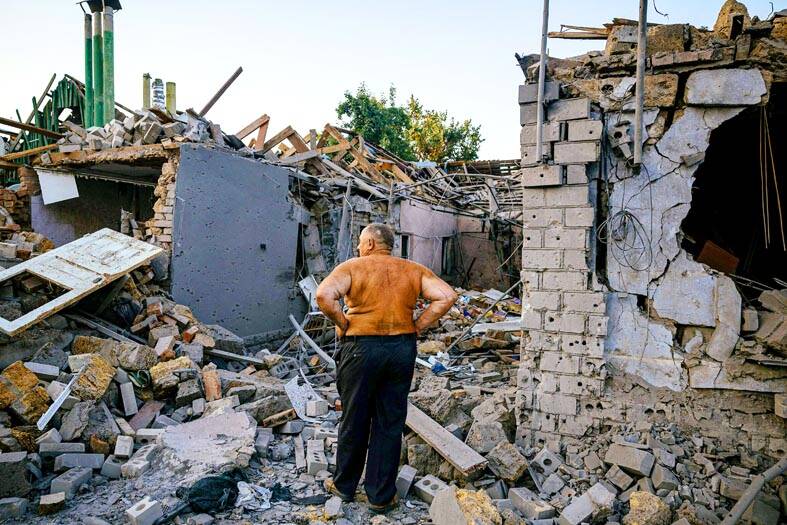
Photo: AFP
In his daily address on Monday, Ukrainian President Volodymyr Zelenskiy did not specifically mention the counteroffensive, but said the nation would oust the occupying forces “to the border.”
“If they want to survive, it is time for the Russian military to flee. Go home,” Zelenskiy said.
Russian forces seized Kherson town on March 3.
It was the first major city to fall following Moscow’s invasion of Ukraine on Feb. 24.
“Today there was a powerful artillery attack on enemy positions in ... the occupied Kherson region,” local government official Sergey Khlan told Ukraine’s Pryamyi TV channel. “This is what we have been waiting for since the spring — it is the beginning of the de-occupation of Kherson region.”
US National Security Council spokesman John Kirby said that Ukraine’s move was already having an impact on Russian military capabilities, as it forced them to reposition forces and deplete some units in the east.
“Because the Russians have had to pull resources from the east simply because of reports that the Ukrainians might be going more on the offense in the south,” Kirby told reporters on Monday, CNN reported.
A senior Pentagon official said that Russia was struggling to find soldiers to fight in Ukraine and that many new recruits were older, in poor shape and lacking training.
Meanwhile, the Russian Ministry of Defense said that it had repulsed attacks in the Kherson and Mykolaiv regions, and inflicted “heavy losses” on Ukrainian forces.
Nataliya Gumenyuk, spokeswoman for the Ukrainian military’s Southern Command, had said Kyiv’s forces were attacking from many directions to push the Russians back to the other bank of the Dnipro River.
The Southern Command wrote on Facebook yesterday that the situation remained “tense” in its area of operations.
“The enemy attacked our positions five times, but was unsuccessful,” it said.

The Tourism Administration yesterday announced that it would reward repeat international visitors with incentives of up to NT$8,000 to boost inbound tourism. The incentives are available to all international tourists, it said, adding that repeat visitors would be rewarded with NT$5,000 and would receive an additional NT$3,000 if they bring travel companions. The nation received 2,990,657 inbound visitors during the first quarter, marking a 3.8 percent increase from the same period last year, agency data showed. Japanese nationals are among groups visiting Taiwan the most. About 1.48 million Japanese tourists arrived last year, a year-on-year increase of more than 12
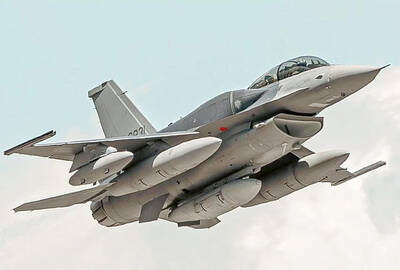
66 FIGHTER JETS: The aircraft is likely undergoing preparations for its transfer to Taiwan — a significant step forward in the nation’s modernization program, a lawmaker said The first of Taiwan’s order of F-16V Block 70 aircraft has been sighted in Texas ahead of delivery, Democratic Progressive Party (DPP) Legislator Wang Ting-yu (王定宇) said. Taiwan’s first F-16V Block 70 two-seat aircraft, tail number 6831, was seen flying from Lockheed Martin’s production facility in Greenville, South Carolina, to Naval Air Station Joint Reserve Base Fort Worth in Texas, Wang wrote on Facebook yesterday. The plane is likely undergoing preparations for its transfer to Taiwan, marking a significant step forward in the Republic of China Air Force’s modernization program, Wang said, citing military analysts. The F-16V Block 70 is a new-build version

‘BRAZEN’: The holiday did not stop China from activities that infringe on Taiwan’s maritime jurisdiction, but the CGA is ready to defend the nation, Kuan Bi-ling said Beijing is intensifying maritime pressure on Taiwan, but the nation will never yield, Ocean Affairs Council Deputy Minister Sung Chen-en (宋承恩) said. The Coast Guard Administration (CGA) has adopted a “shadowing and monitoring” approach to avoid falling into a Chinese trap to escalate tensions and deepen the conflict, Sung said in an interview published yesterday in the Chinese-language Liberty Times (the Taipei Times’ sister newspaper). China Coast Guard formations patrolling waters east of Taiwan, as well as official Chinese vessels entering areas around Itu Aba Island (Taiping Island, 太平島) and Pratas Islands (Dongsha Islands, 東沙群島) show Beijing’s attempts to significantly step up
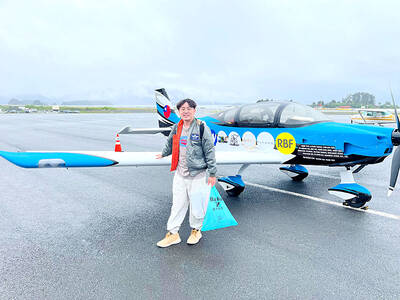
Taiwanese aviator Roger Lin (林睿哲) returned to Taiwan on Saturday after completing a nine-day round-the-world journey in a single-engine aircraft, becoming the first Taiwanese pilot to achieve the feat. Lin departed on June 5 from Los Angeles, California, and continued through Alaska, Japan, Taiwan, the Philippines, Indonesia, Malaysia, Thailand, Nepal, Jordan, Norway, Iceland and Canada before landing at the Taipei International Airport (Songshan) via Los Angeles and Japan. Lin shared numerous photos and videos of his journey on a Facebook page titled “Pilot Roger’s Around the World Flight,” including a video showing his aircraft flying over the Danjiang Bridge and


 RSS
RSS