


US House of Representatives Speaker Nancy Pelosi’s reported plans to travel to Taiwan have upended Washington’s political divide, with a rift emerging with US President Joe Biden over the visit, while prominent Republicans offer encouragement to a political opponent they normally scorn.
Pelosi’s supporters include a conservative Republican senator, at least two former officials from the administration of former US president Donald Trump and the last speaker of the House to make the trip to Taiwan, also a Republican. They are urging Biden to back the trip even as China threatens a forceful response if she does travel.
Pelosi, a Democrat, has not confirmed the trip publicly. The White House and the speaker’s office have yet to challenge each other directly, and Biden has not said publicly that Pelosi should not go.
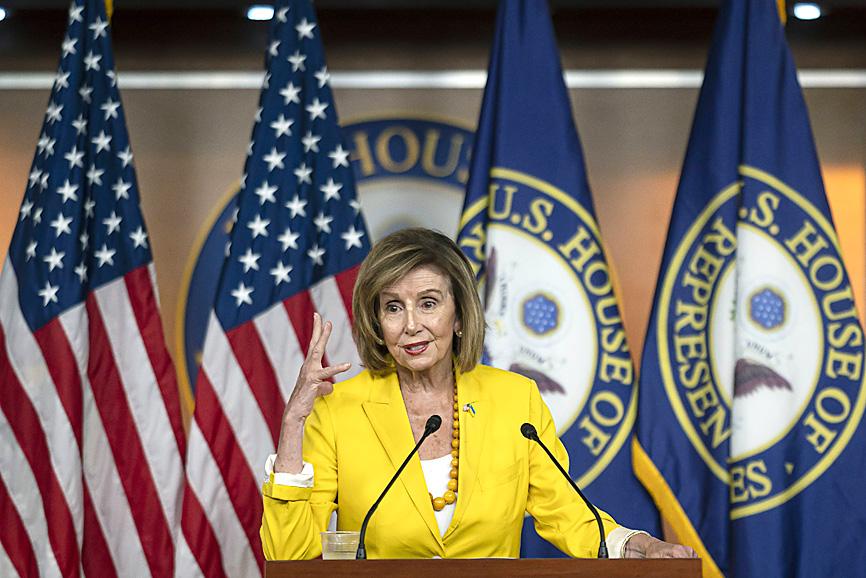
Photo: AFP
Biden has made blunting China’s rising influence a core part of his foreign policy ethos, but the Biden-China relationship is complicated and he has sought to avoid unnecessarily aggravating tensions.
The White House is preparing for another call between Biden and Chinese President Xi Jinping (習近平), a conversation the US president said he expects this week, despite his COVID-19 diagnosis.
The growing chorus pushing Biden to support Pelosi publicly is also raising the risk that the president could be perceived as insufficiently tough on China.
“Speaker Pelosi should go to Taiwan and President Biden should make it abundantly clear to Chairman Xi that there’s not a damn thing the Chinese Communist Party [CCP] can do about it,” US Senator Ben Sasse, a Republican, said on Monday. “No more feebleness and self-deterrence. This is very simple: Taiwan is an ally and the speaker of the House of Representatives should meet with the Taiwanese men and women who stare down the threat of communist China.”
The White House on Monday declined to weigh in directly on Pelosi’s trip — including whether the speaker has Biden’s blessing — considering she has not confirmed it.
“The administration routinely provides members of Congress with information and context for potential travel, including geopolitical and security considerations,” White House press secretary Karine Jean-Pierre said, without responding directly to Pelosi’s possible plans. “Members of Congress will make their own decisions.”
US Department of State spokesman Ned Price also declined to discuss any concerns.
“I will just restate our policy, and that is that we remain committed to maintaining cross-strait peace and stability and our ‘one China’ policy,” said Price, referring to the US position that recognizes Beijing as the government of China, but allows for informal relations and defense ties with Taipei.
Newt Gingrich, the last House speaker to visit Taiwan, offered support for Pelosi on Monday, posting on Twitter: “What is the Pentagon thinking when it publicly warns against Speaker Pelosi going to Taiwan? If we are so intimidated by the Chinese Communists we can’t even protect an American Speaker of the House why should Beijing believe we can help Taiwan survive. Timidity is dangerous.”
In private, the administration is particularly concerned that a convergence of upcoming events could make a Chinese response to a Pelosi visit even stronger and more animated than it might otherwise be, officials said.
The CCP congress, expected in November, at which Xi intends to further cement his hold on power, is one of those events.
International events in the coming months also could prompt China to react more forcefully than it has in the past if it believes its concerns are being ignored or its president is being disrespected, the officials said.
Those include the annual UN General Assembly in September and several summits in Asia — the G20 in Indonesia, the East Asia Summit in Cambodia and the Asia-Pacific Economic Cooperation forum in Thailand — set for October and November.
The officials spoke on condition of anonymity to discuss the administration’s perspective.
The US officials said the administration doubts that China would take action against Pelosi herself or try to sabotage or otherwise interfere with a visit, but they said the administration does not rule out the possibility that China could escalate provocative overflights of military aircraft in or near Taiwanese airspace and naval patrols in the Taiwan Strait should the trip take place.
The officials also said the administration does not preclude that China might also step up its actions outside the immediate area of Taiwan as a show of strength, thus possibly expanding military operations in contested areas of the South China Sea.

The nation’s fastest supercomputer, Nano 4 (晶創26), is scheduled to be launched in the third quarter, and would be used to train large language models in finance and national defense sectors, the National Center for High-Performance Computing (NCHC) said. The supercomputer, which would operate at about 86.05 petaflops, is being tested at a new cloud computing center in the Southern Taiwan Science Park in Tainan. The exterior of the server cabinet features chip circuitry patterns overlaid with a map of Taiwan, highlighting the nation’s central position in the semiconductor industry. The center also houses Taiwania 2, Taiwania 3, Forerunner 1 and

FIRST TRIAL: Ko’s lawyers sought reduced bail and other concessions, as did other defendants, but the bail judge denied their requests, citing the severity of the sentences Former Taipei mayor Ko Wen-je (柯文哲) was yesterday sentenced to 17 years in prison and had his civil rights suspended for six years over corruption, embezzlement and other charges. Taipei prosecutors in December last year asked the Taipei District Court for a combined 28-year, six-month sentence for the four cases against Ko, who founded the Taiwan People’s Party (TPP). The cases were linked to the Core Pacific City (京華城購物中心) redevelopment project and the mismanagement of political donations. Other defendants convicted on separate charges included Chinese Nationalist Party (KMT) Taipei City Councilor Angela Ying (應曉薇), who was handed a 15-year, six-month sentence; Core Pacific

J-6 REMODEL: The converted drones are part of Beijing’s expanding mix of airpower weapons, including bombers with stand-off missiles and UAV swarms, the report said China has stationed obsolete supersonic fighters converted to attack drones at six air bases close to the Taiwan Strait, a report published this month by the Arlington, Virginia-based Mitchell Institute for Aerospace Studies said. Satellite imagery of the airfields from the institute’s “China Airpower Tracker” shows what appear to be lines of stubby, swept-winged aircraft matching the shape of J-6 fighters that first flew with the Chinese People’s Liberation Army (PLA) Air Force in the 1960s. Since their conversion to drones, the aircraft have been identified at five bases in China’s Fujian Province and one in Guangdong Province, the report said. J.

MORE POPULAR: Taiwan Pass sales increased by 59 percent during the first quarter compared with the same period last year, the Tourism Administration said The Tourism Administration yesterday said that it has streamlined the Taiwan Pass, with two versions available for purchase beginning today. The tourism agency has made the pass available to international tourists since 2024, allowing them to access the high-speed rail, Taiwan Railway Corp services, four MRT systems and four Taiwan Tourist Shuttles. Previously, five types of Taiwan Pass were available, but some tourists have said that the offerings were too complicated. The agency said only two types of Taiwan Pass would be available, starting from a three-day pass with the high-speed rail and a three-day pass with Taiwan Railway Corp. The former costs NT$2,800


 RSS
RSS