


Hong Kong Chief Executive John Lee (李家超) yesterday said at his first news conference since taking office that he would work on easing restrictions on travelers while balancing the risks of a COVID-19 outbreak overwhelming the healthcare system.
Most travelers visiting Hong Kong are required to serve a seven-day mandatory quarantine at designated hotels.
Lee, a former security official who was the only candidate in the election for Hong Kong’s chief executive, took office on Friday, succeeding Carrie Lam (林鄭月娥).
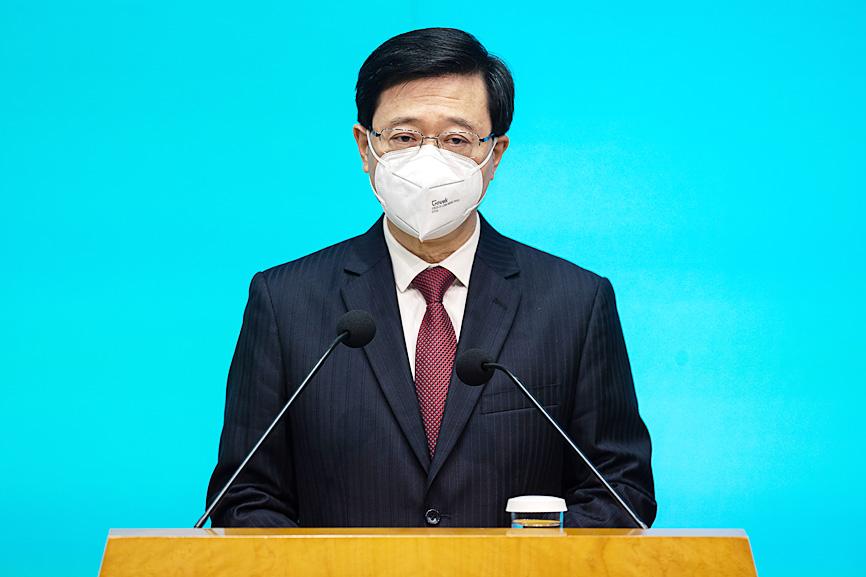
Photo: EPA-EFE
Speaking at his first news conference ahead of an Executive Council meeting, Lee said Hong Kong is an “international city” and that he was “conscious” of the need for Hong Kong to remain open and convenient to travelers.
“But it is also important that we address the risks at the same time so that we will maintain good balance,” he said.
Lee said that the territory’s health minister was evaluating data to determine how the quarantine duration could be adjusted and would formulate options for Lee to consider.
COVID-19 cases have been rising in Hong Kong, with more than 1,000 daily compared with just over 100 daily in early May.
The territory reported 1,841 new infections on Monday.
Lee also said Hong Kong had a “constitutional duty” to enact a new security law, in addition to the National Security Law imposed by Beijing in 2020 that has wiped out most political dissent and put many democracy supporters under arrest, in hiding or in exile.
Enacting Article 23 of the Basic Law has long been controversial. When the government first attempted to draft such laws in 2003, protesters took to the streets in massive demonstrations that prompted the government to shelve its plans.
Lee said that Hong Kong’s situation and levels of security risks would be assessed before the legislation is enacted.
“We’re very confident that we will be able to do it well,” he said.
Meanwhile, a document, made public on Monday by Lee to the Registration and Electoral Office, showed that he received more than HK$11 million (US$1.4 million) in physical cash when he ran unchallenged for the territory’s top job in May while under US sanctions.
It demonstrated the creative ways in which Lee was able to run an election campaign without access to a bank account, including procuring banknote identifiers, safes and cash transit escort services.
His campaign expenditure included more than 400 advertisements on US-owned social networks, despite YouTube and Facebook suspending services for Lee due to the sanctions.
Lee and other top Hong Kong and Chinese officials were sanctioned by the US in 2020 for their roles in the crackdown on civil liberties in the territory.
Donating in cash to a sanctioned individual “raises concerns over untraceable money trails and non-compliance, and possibly clouds the true origins of funds, which could even be from outside Hong Kong,” Hong Kong Baptist University associate professor of government Kenneth Chan (陳家洛) said. “The fact that a candidate ran an election campaign, and took and spent money without banking services due to US sanctions, is unheard of.”
Additional reporting by Bloomberg


RESILIENCE: Taiwan plays a key role in semiconductors, energy, information infrastructure and advanced manufacturing, AIT Director Raymond Greene said Taiwan’s continued investment in deterrence and resilience remains vital, especially in uncrewed systems and other emerging technologies, American Institute in Taiwan (AIT) Director Raymond Greene said yesterday. Greene made the remarks at the annual National Strategic Summit on Supply Chain Resilience held by the Research Institute for Democracy, Society and Emerging Technology (DSET), a government-backed think tank. As Taiwan last year became the US’ fourth-largest trading partner and supply chain security is becoming more important, cooperation in emerging technologies continues to deepen between the two countries, he said. The US is committed to accelerating innovation, building key infrastructure, strengthening cooperation

The National Chungshan Institute of Science and Technology yesterday showcased its locally developed variants of the Vision 60 robotic patrol dog, which it plans to deploy on the nation’s outlying territories in the South China Sea. The variants were produced under the Joint Lab project — created by the institute and domestic companies — and assembled with domestically produced motors, lenses and artificial intelligence (AI) systems alongside licensed tech from the US, Missile and Rocket Systems Research Division deputy director Jen Kuo-kang (任國光) told the media event at a military base in Taipei’s Dazhi (大直) area. Taiwan has built up its strengths

RIGHT DIRECTION: Taiwan’s efforts to prevent forced labor include a proposal to ‘fully prohibit’ employers from withholding workers’ documents, an official said Taiwan is to establish a mechanism to restrict imports of goods linked to forced labor, the Executive Yuan said yesterday, after the US proposed imposing additional tariffs on Taiwanese goods over labor concerns. “The Ministry of Labor and the Ministry of Economic Affairs are to establish an interministerial review procedure,” Executive Yuan spokesperson Michelle Lee (李慧芝) said at a news briefing in Taipei. “The government is to use the Foreign Trade Act [貿易法] as the legal basis to restrict imports of goods produced with forced labor” and bring its supply chain governance more in line with international standards on human rights, resilience

NOT IMMEDIATE: Taiwan has a chance to appeal the proposed 10 percent tariff before it starts, while other countries face a 12.5 percent tariff from the trade office Taiwan is among 60 economies determined by the US to have failed to impose or enforce a ban on the importation of goods produced with forced labor, according to a notice released on Tuesday by the Office of the US Trade Representative (USTR), which proposed imposing an additional 10 percent or more tariff on them. The USTR in a statement said that following an investigation, it had determined under Section 301 of the Trade Act of 1974 that the failure of the 60 economies to impose and effectively enforce a prohibition on the importation of goods produced with forced labor is


 RSS
RSS