


US Deputy Secretary of State Wendy Sherman on Thursday condemned China’s challenging of European security, economy and values, calling on Europe to help the US counter competition from Beijing.
“Even before [Chinese] President Xi [Jinping, 習近平] and [Russian] President [Vladimir] Putin declared their ‘no limits’ partnership in February, the PRC [People’s Republic of China] has challenged Europe’s security, Europe’s economy and Europe’s values,” Sherman, speaking from Washington, told European reporters by video link.
Sherman’s comments came in the wake of a speech by her boss, US Secretary of State Antony Blinken, who recently identified Beijing as the main threat to world order, despite the Russian invasion of Ukraine.
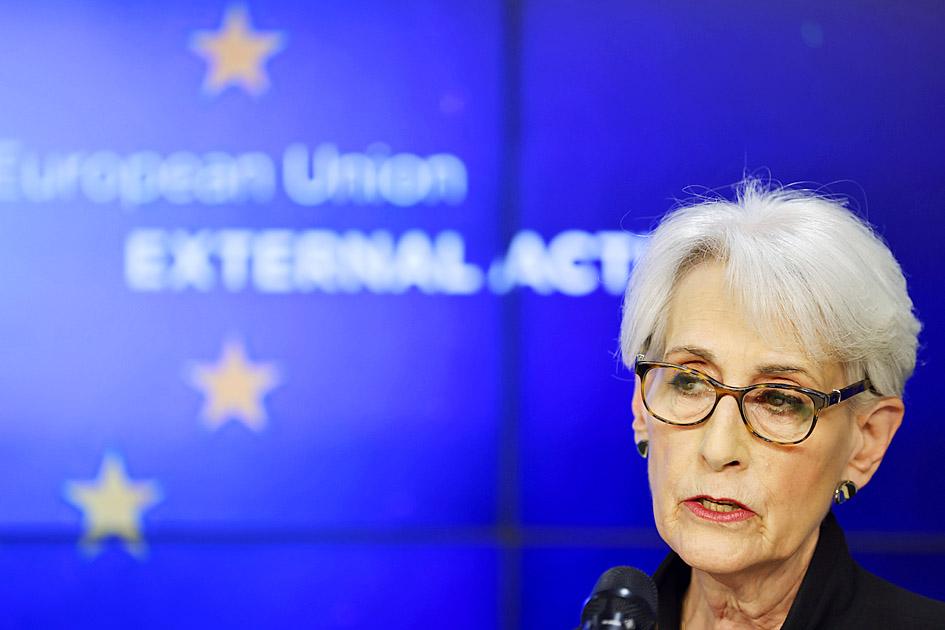
Photo: EPA-EFE
Washington accuses Beijing of wanting to reshape the world order.
In a speech on Wednesday last week, Blinken said Washington was engaged in vigorous competition with Beijing to preserve the current world order.
US President Joe Biden’s administration has spoken of the need to pressure China to play by the rules, including in its South China Sea and trade disputes.
“While Beijing may be thousands of miles away ... the PRC’s actions matter just as much for the future of Europe,” Sherman said, welcoming current cooperation with Europe while still seeking to “align our approaches.”
“We are all looking at issues of supply chains,” in the wake of the COVID-19 pandemic and the war in Ukraine, she added.
“The US is not seeking conflict” with China nor to “sever our economy from the PRC,” she said.
“We don’t want a new cold war,” but “we can’t rely on Beijing to change its behavior,” Sherman said.
The US is being vigilant over the alliance between Russia and China, threatening Beijing “with consequences” if the Chinese authorities ever decide to send military equipment to Russia, she added.
“Quite frankly, I think Russia and Putin will be a pariah for a very long time and I’m not sure the PRC will benefit,” she said.

PROVOCATIVE: Chinese Deputy Ambassador to the UN Sun Lei accused Japan of sending military vessels to deliberately provoke tensions in the Taiwan Strait China denounced remarks by Japan and the EU about the South China Sea at a UN Security Council meeting on Monday, and accused Tokyo of provocative behavior in the Taiwan Strait and planning military expansion. Ayano Kunimitsu, a Japanese vice foreign minister, told the Council meeting on maritime security that Tokyo was seriously concerned about the situation in the East China and South China seas, and reiterated Japan’s opposition to any attempt to change the “status quo” by force, and obstruction of freedom of navigation and overflight. Stavros Lambrinidis, head of the EU delegation to the UN, also highlighted South China Sea
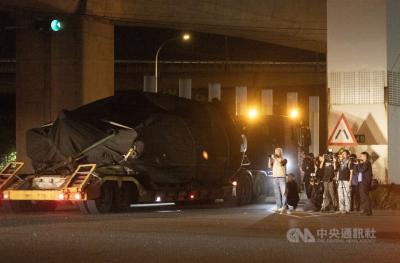
The final batch of 28 M1A2T Abrams tanks purchased from the US arrived at Taipei Port last night and were transported to the Armor Training Command in Hsinchu County’s Hukou Township (湖口), completing the military’s multi-year procurement of 108 of the tanks. Starting at 12:10am today, reporters observed more than a dozen civilian flatbed trailers departing from Taipei Port, each carrying an M1A2T tank covered with black waterproof tarps. Escorted by military vehicles, the convoy traveled via the West Coast Expressway to the Armor Training Command, with police implementing traffic control. The army operates about 1,000 tanks, including CM-11 Brave Tiger
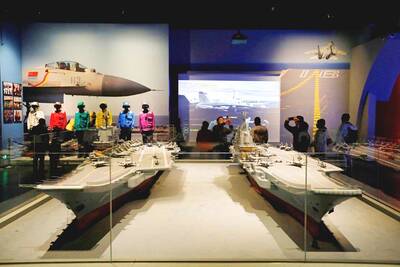
China on Wednesday teased in a video an aircraft carrier that could be its fourth, and the first using nuclear power, while making an allusion to Taiwan and vowing to further build up its islands, as it looks to boost maritime power, secure resources and bolster territorial claims. The video, issued on the eve of the 77th founding anniversary of the Chinese People’s Liberation Army Navy, featured fictional officers with names that are homophones of three commissioned aircraft carriers, the Liaoning (遼寧), Shandong (山東) and Fujian (福建). Titled Into the Deep, it showed a 19-year-old named “Hejian” (何劍) joining the group, sparking
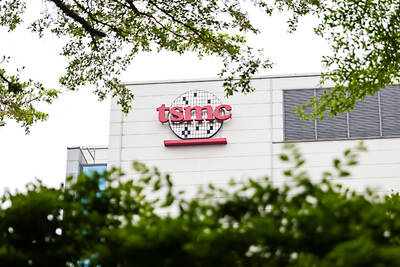
Taiwan Semiconductor Manufacturing Co (TSMC, 台積電), the world’s largest contract chipmaker, said it expects its 2-nanometer (2nm) chip capacity to grow at a compound annual rate of 70 percent from this year to 2028. The projection comes as five fabs begin volume production of 2-nanometer chips this year — two in Hsinchu and three in Kaohsiung — TSMC senior vice president and deputy cochief operating officer Cliff Hou (侯永清) said at the company’s annual technology symposium in Silicon Valley, California, last week. Output in the first year of 2-nanometer production, which began in the fourth quarter of last year, is expected to


 RSS
RSS