


People aged 12 to 17 could be eligible for COVID-19 booster shots as early as next month, Minister of Health and Welfare Chen Shih-chung (陳時中), who heads the Central Epidemic Command Center, said yesterday.
Although increasing the booster vaccination rate among all age groups is necessary to ease border restrictions, health experts disagree on whether to give young people additional shots, Chen told a news conference in Taipei, adding that the center was still discussing the issue.
The earliest that a third shot could be given to people aged 12 to 17 would be next month, as second doses of the Pfizer-BioNTech COVID-19 vaccine were administered to that group in December, he said.
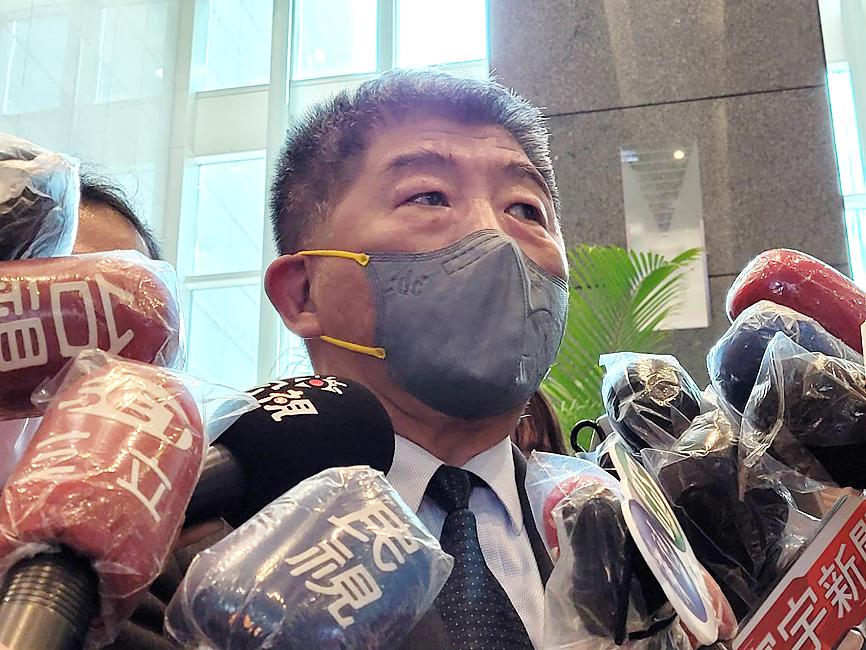
Photo: Lai Hsiao-tung, Taipei Times
“Some experts believe that as the number of local infections has stabilized, there is no need for young people to get boosters,” he said. “However, booster shots are meant as a preventative measure, and that should be the same for adults and young people.”
Regarding border restrictions, which were eased on Monday last week to reduce the quarantine period for business travelers to 10 days, Chen said it was too early lift them entirely, as some nations were still struggling to contain COVID-19.
Chen said that Hong Kong still had a high number of COVID-19-related deaths, while China on Sunday imposed a seven-day lockdown in Shenzhen and Dongguan.
“Some experts have been calling for the government to set a comprehensive timetable for the gradual lifting of border restrictions, but it is too early for that now,” he said.
Each stage of easing restrictions involves a review of COVID-19’s resilience to the nation’s control measures, and reviews of vaccine coverage and the pandemic situation overseas, he said, adding that the trend is toward easing restrictions.
Regarding rules for Tomb Sweeping Day next month, Chen said that disease control measures would be enforced at popular sites and areas where large crowds gather, as there are still risks of community infection.
Asked if any special measures were being planned for the elections in November, Chen said that there were no plans at this time, but “during the pandemic, we are always in a state of preparation.”
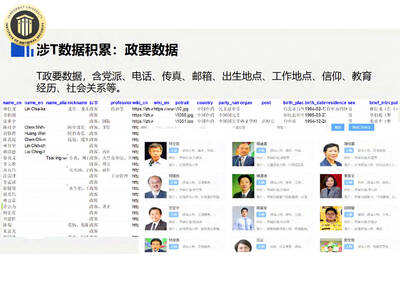
NETWORK-MAPPING PROJECT: The database contains 170 detailed files of Taiwanese politicians and about 23 million records of household registration data in Taiwan China has developed a network-mapping project targeting political figures and parties in Taiwan to monitor public opinion during elections and to craft tailored influence campaigns aimed at dividing Taiwanese society, according to documents leaked by Chinese technology firm GoLaxy (中科天璣). The documents, collected by Taipei-based Doublethink Lab, showed a database was specifically created to gather detailed information on Taiwanese political figures, including their political affiliations, job histories, birthplaces, residences, education, religion and a brief biography about them. Several notable Taiwanese politicians are in the database, including President William Lai (賴清德), former president Tsai Ing-wen (蔡英文), Minister of Foreign Affairs Lin Chia-lung (林佳龍),
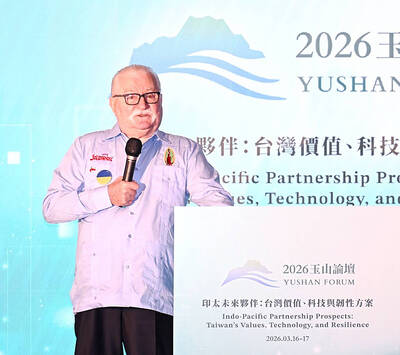
RECOGNITION: Former Fijian prime minister Mahendra Chaudhry said that Taiwan’s New Southbound Policy serves as a stabilizing force in the Indo-Pacific region Taiwan can lead the unification of the Chinese people, Nobel Peace Prize laureate and former Polish president Lech Walesa said in Taipei yesterday, adding that as the world order is changing, peaceful discussion would find good solutions, and that the use of force and coercion would always fail. Walesa made the remarks during his keynote address at a luncheon of the Yushan Forum in Taipei, titled “Indo-Pacific Partnership Prospects: Taiwan’s Values, Technology and Resilience,” organized by the Taiwan-Asia Exchange Foundation with the Ministry of Foreign Affairs. Walesa said that he had been at the forefront of a big peaceful revolution and “if
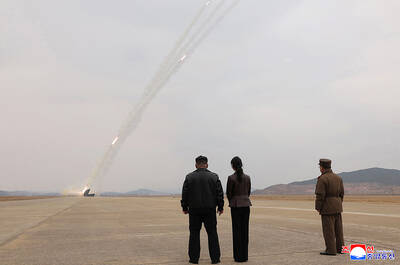
North Korea tested nuclear-capable rocket launchers, state media reported yesterday, a day after Seoul detected the launch of about 10 ballistic missiles. The test comes after South Korean and US forces launched their springtime military drills, due to run until Thursday. North Korean leader Kim Jong-un on Saturday oversaw the testing of the multiple rocket launcher system (MRLS), the Korean Central News Agency (KCNA) said. The test involved 12 600mm-caliber ultra-precision multiple rocket launchers and two artillery companies, it said. Kim said the drill gave Pyongyang’s enemies, within the 420km striking range, a sense of “uneasiness” and “a deep understanding
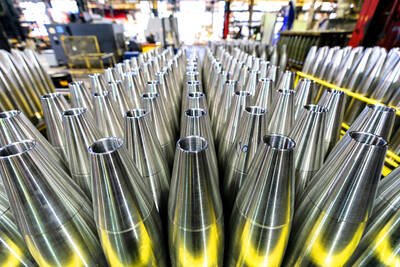
UPGRADED MISSILE: The Chungshan Institute of Science and Technology is reportedly to conduct a live-fire test of the Hsiung Feng III anti-ship missile on Thursday next week The US Army is planning to build new facilities to boost explosives production and strengthen its supply chain, a move aimed at addressing munitions shortages and supporting obligations to partners including Taiwan, Ukraine and Israel, Defense News reported. The army has issued a sources sought notice for a proposed Center of Excellence at the Blue Grass Army Depot in Kentucky, the report said. The facility would serve as a hub within the US industrial base for the production of key military explosives, including research department explosives (RDX) and high melting explosives (HMX), while also supporting research and development of next-generation materials. The proposed


 RSS
RSS