


UN Secretary-General Antonio Guterres told leaders in Beijing that he expects them to allow UN High Commissioner for Human Rights Michelle Bachelet to make a “credible” visit to China, including a stop in Xinjiang, his spokesman said on Saturday.
Guterres met with Chinese President Xi Jinping (習近平) and Chinese Minister of Foreign Affairs Wang Yi (王毅) on the sidelines of the Beijing Winter Olympics, a readout of their talks said.
Guterres “expressed his expectation that the contacts between the office of the High Commissioner for Human Rights and the Chinese authorities will allow for a credible visit of the High Commissioner to China, including Xinjiang,” it said.
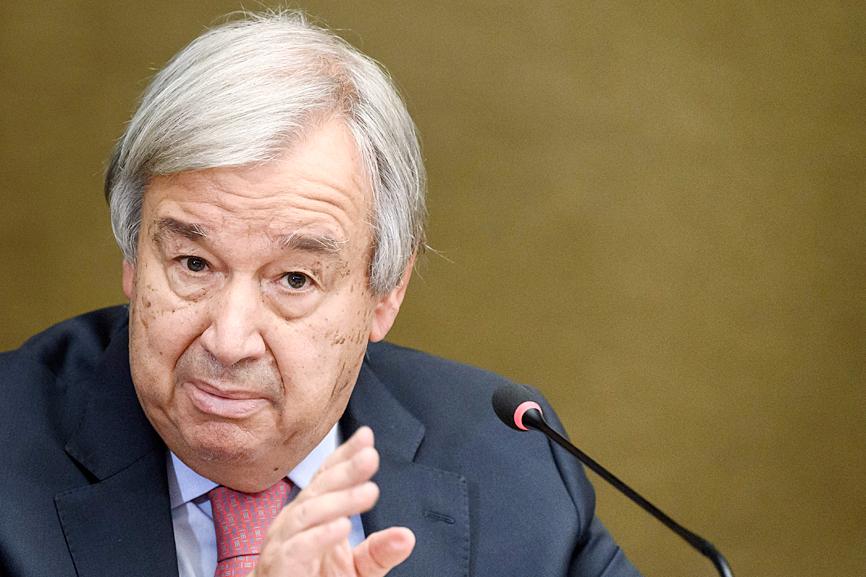
Photo: AFP
A readout of the meeting from China’s state-run Xinhua news agency made no mention of the rights issue.
Campaigners say that at least 1 million mostly Muslim minorities have been incarcerated in “re-education camps” in Xinjiang, a far-western region where China is accused of widespread human rights abuses including the forced sterilization of women and forced labor.
In the run-up to the Beijing Winter Olympics, the Chinese Ministry of Foreign Affairs repeatedly emphasized Guterres’ support of the Games at daily briefings.
The UN chief himself congratulated Xi on the organization of the Games in their talks in Beijing, the statement from the world body said.
Meanwhile, Egyptian President Abdel-Fattah al-Sissi was one of a half-dozen heads of state who met with Xi on Saturday after attending the Olympic opening ceremony, seeking closer ties with China while shunning Western criticism of their heavy-handed rule.
Xi “hailed enhanced political trust” between the countries, citing cooperation in fighting the COVID-19 pandemic. Their comprehensive strategic partnership is a model of “China-Arab, China-Africa and China-developing world solidarity,” the official China Global Television Network, quoted Xi as saying.
“China and Egypt share similar visions and strategies in defending their own interests, pursuing common development, enhancing their people’s well-being and promoting fairness and justice in the world, as the world is undergoing changes unseen in a century,” Xi said.
Since taking power, al-Sissi has overseen a widespread crackdown on dissent and opposition, jailing tens of thousands and drawing international criticism.
Also on Saturday, Xi met with the heads of Kazakhstan, Turkmenistan, Serbia, Ecuador and Qatar.
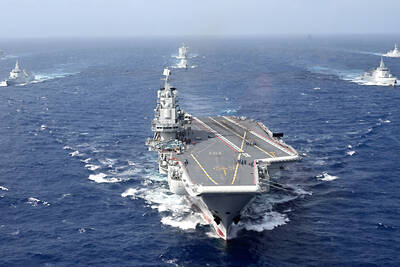
PROVOCATIVE: Chinese Deputy Ambassador to the UN Sun Lei accused Japan of sending military vessels to deliberately provoke tensions in the Taiwan Strait China denounced remarks by Japan and the EU about the South China Sea at a UN Security Council meeting on Monday, and accused Tokyo of provocative behavior in the Taiwan Strait and planning military expansion. Ayano Kunimitsu, a Japanese vice foreign minister, told the Council meeting on maritime security that Tokyo was seriously concerned about the situation in the East China and South China seas, and reiterated Japan’s opposition to any attempt to change the “status quo” by force, and obstruction of freedom of navigation and overflight. Stavros Lambrinidis, head of the EU delegation to the UN, also highlighted South China Sea
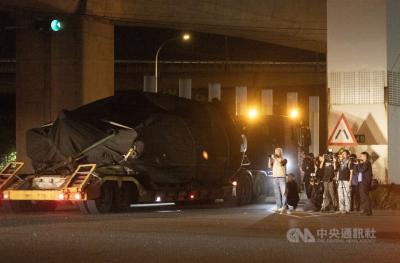
The final batch of 28 M1A2T Abrams tanks purchased from the US arrived at Taipei Port last night and were transported to the Armor Training Command in Hsinchu County’s Hukou Township (湖口), completing the military’s multi-year procurement of 108 of the tanks. Starting at 12:10am today, reporters observed more than a dozen civilian flatbed trailers departing from Taipei Port, each carrying an M1A2T tank covered with black waterproof tarps. Escorted by military vehicles, the convoy traveled via the West Coast Expressway to the Armor Training Command, with police implementing traffic control. The army operates about 1,000 tanks, including CM-11 Brave Tiger
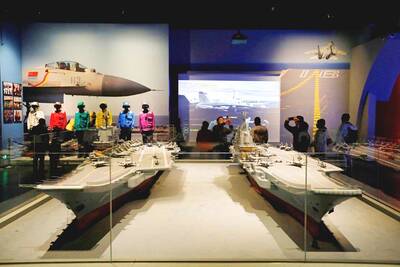
China on Wednesday teased in a video an aircraft carrier that could be its fourth, and the first using nuclear power, while making an allusion to Taiwan and vowing to further build up its islands, as it looks to boost maritime power, secure resources and bolster territorial claims. The video, issued on the eve of the 77th founding anniversary of the Chinese People’s Liberation Army Navy, featured fictional officers with names that are homophones of three commissioned aircraft carriers, the Liaoning (遼寧), Shandong (山東) and Fujian (福建). Titled Into the Deep, it showed a 19-year-old named “Hejian” (何劍) joining the group, sparking
BIG YEAR: The company said it would also release its A12 chip the same year to keep a ‘reliable stream of new silicon technologies’ flowing to its customers Taiwan Semiconductor Manufacturing Co (TSMC, 台積電) yesterday said its newest A13 chip is to enter volume production in 2029 as the chipmaker seeks to hold onto its tech leadership and demand for next-generation chips used in artificial intelligence (AI), high-performance-computing (HPC) and mobile applications. TSMC, the world’s biggest contract chipmaker, also unveiled its A12 chip at its annual technology symposium in Santa Clara, California. The A12 chip, which features TSMC’s super-power-rail technology to provide backside power delivery for AI and HPC applications, is also to enter volume production in 2029, a year after the scheduled release of the A14 chip. The technology moves


 RSS
RSS