


The leader of the Islamic State (IS) group killed in a US raid late on Thursday in northwestern Syria was a veteran insider and top ideologue of the extremist movement, and is believed to have played a key role in one of its most horrific atrocities: the enslavement of thousands of women from Iraq’s Yazidi religious minority.
Known as Abu Ibrahim al-Hashimi al-Qurayshi, he kept himself wrapped in mystery during his more than two years as the group’s “caliph.”
Almost no public photographs of him exist, and he never appeared in public or in IS videos.
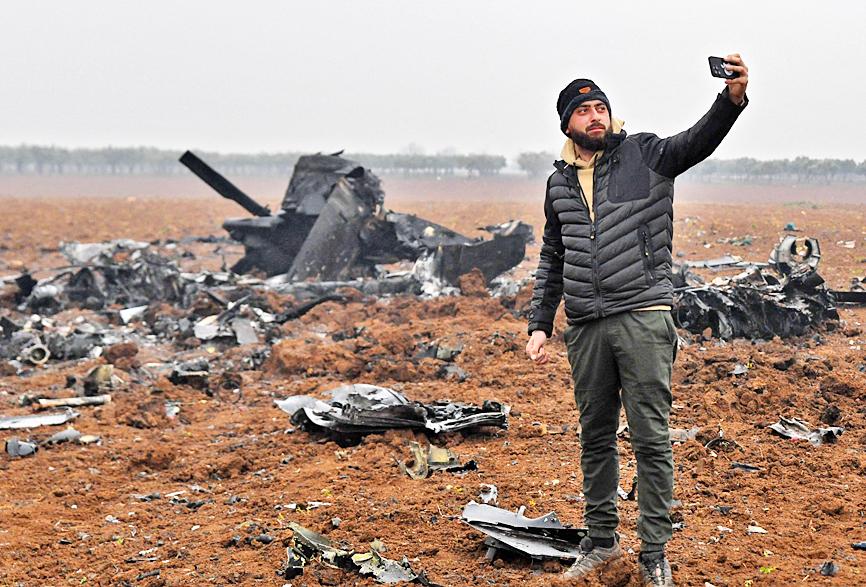
Photo: AFP
From hiding, he led the group’s remnants as they regrouped following the downfall of their caliphate and shifted underground to wage an insurgency in Iraq and Syria.
He met his end in Syria’s rebel-held Idlib Governorate, in a house he had rented only about 24km from the safehouse where his predecessor, Abu Bakr al-Baghdadi, was hunted down by the US in a similar raid in October 2019.
Al-Qurayshi’s death comes as IS militants, after years of low-level hit-and-run ambushes, had begun to carry out bolder, higher-profile attacks.
Last month, IS fighters attacked a prison in northeast Syria to free jailed comrades, leading to a 10-day battle with Kurdish-led forces that left about 500 dead.
Al-Qurayshi’s death might disrupt the group’s momentum in the short term, but is unlikely to hurt its operations in the long term.
“It’s an organization not focused on charismatic leadership, but ideas, which is why its leaders have been pretty low-profile,” said Aaron Zelin, a senior fellow at the Washington Institute for Near East Policy. “I think the IS machine will continue with whoever the new leader is.”
Al-Qurayshi’s real name was Amir Mohammed Saeed Abdul-Rahman al-Mawla.
He was an Iraqi in his mid-40s, born in 1976 and believed to be an ethnic Turkmen from the northern Iraqi town of Tel Afar.
He held a degree in Islamic law from the University of Mosul.
He took the al-Qurayshi nom de guerre after being elevated to IS leader following al-Baghdadi’s death — suggesting that he, like his predecessor, claimed links to the tribe of the Prophet Mohammed.
Al-Qurayshi, like his predecessor, spent his last days in Idlib, an area held by insurgent groups, in some distance from the main theaters of war in eastern Syria and Iraq where the group once held vast swaths of territory in a self-declared “caliphate.”
He was staying in a three-story house in the town of Atmeh, near the border with Turkey.
During the early morning raid, he blew himself up, killing a number of women and children along with him, US officials said.
First responders at the scene said that 13 people, including four women and six children, were killed during the raid, during which US forces battled fighters in and around the house.

Right-wing political scientist Laura Fernandez on Sunday won Costa Rica’s presidential election by a landslide, after promising to crack down on rising violence linked to the cocaine trade. Fernandez’s nearest rival, economist Alvaro Ramos, conceded defeat as results showed the ruling party far exceeding the threshold of 40 percent needed to avoid a runoff. With 94 percent of polling stations counted, the political heir of outgoing Costa Rican President Rodrigo Chaves had captured 48.3 percent of the vote compared with Ramos’ 33.4 percent, the Supreme Electoral Tribunal said. As soon as the first results were announced, members of Fernandez’s Sovereign People’s Party
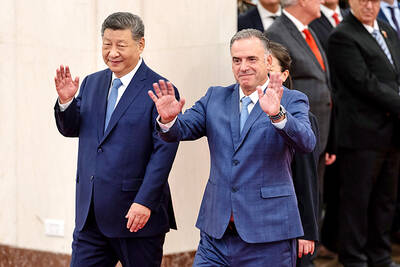
EMERGING FIELDS: The Chinese president said that the two countries would explore cooperation in green technology, the digital economy and artificial intelligence Chinese President Xi Jinping (習近平) yesterday called for an “equal and orderly multipolar world” in the face of “unilateral bullying,” in an apparent jab at the US. Xi was speaking during talks in Beijing with Uruguayan President Yamandu Orsi, the first South American leader to visit China since US special forces captured then-Venezuelan president Nicolas Maduro last month — an operation that Beijing condemned as a violation of sovereignty. Orsi follows a slew of leaders to have visited China seeking to boost ties with the world’s second-largest economy to hedge against US President Donald Trump’s increasingly unpredictable administration. “The international situation is fraught
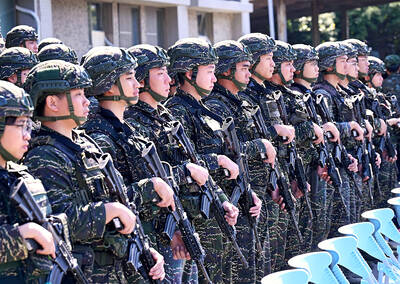
MORE RESPONSIBILITY: Draftees would be expected to fight alongside professional soldiers, likely requiring the transformation of some training brigades into combat units The armed forces are to start incorporating new conscripts into combined arms brigades this year to enhance combat readiness, the Executive Yuan’s latest policy report said. The new policy would affect Taiwanese men entering the military for their compulsory service, which was extended to one year under reforms by then-president Tsai Ing-wen (蔡英文) in 2022. The conscripts would be trained to operate machine guns, uncrewed aerial vehicles, anti-tank guided missile launchers and Stinger air defense systems, the report said, adding that the basic training would be lengthened to eight weeks. After basic training, conscripts would be sorted into infantry battalions that would take
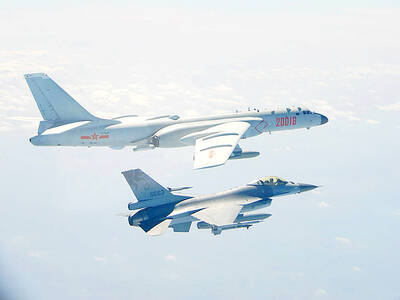
GROWING AMBITIONS: The scale and tempo of the operations show that the Strait has become the core theater for China to expand its security interests, the report said Chinese military aircraft incursions around Taiwan have surged nearly 15-fold over the past five years, according to a report released yesterday by the Democratic Progressive Party’s (DPP) Department of China Affairs. Sorties in the Taiwan Strait were previously irregular, totaling 380 in 2020, but have since evolved into routine operations, the report showed. “This demonstrates that the Taiwan Strait has become both the starting point and testing ground for Beijing’s expansionist ambitions,” it said. Driven by military expansionism, China is systematically pursuing actions aimed at altering the regional “status quo,” the department said, adding that Taiwan represents the most critical link in China’s


 RSS
RSS