


Doctors and experts from the Taiwan Medical Association (TMA) and the Strategy and Public Research Institute of Taiwan yesterday urged opposition parties to refrain from making the erroneous claim that imported pork containing traces of ractopamine is “toxic pork.”
They were responding to the first round of live debates over four referendum issues held on Saturday.
The debate over ractopamine has ceased to be a scientific discussion, but has become complicated by politics and international trade concerns, National Taiwan University Hospital toxicology professor Chiang Chih-kang (姜至剛) said.
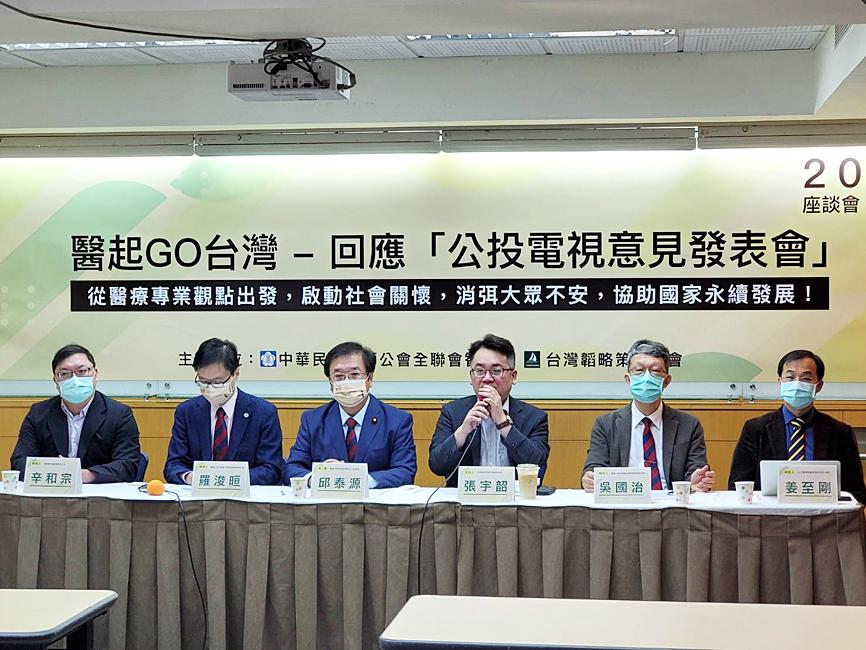
Photo: Lin Hui-chin, Taipei Times
“Ractopamine is used as a feed additive for livestock, and traces of it can be found in meat products, both in beef and pork imports,” Chiang said. “The main debate centers on whether it is safe for consumption and how to assure consumers concerned about its possible health risks.”
The international Codex Alimentarius Commission debated the issue, and has set the maximum residue limits (MRLs) for ractopamine based on scientific evidence, risk assessments and study results, he said.
“For Taiwan, we have an even tougher standard for ractopamine. There were many rounds of deliberation and input from experts, and cross-party negotiations in the legislature, before an agreement was made on the MRL, which conforms to international standards,” he added.
“The ractopamine issue is not an issue about food safety, because no pork containing ractopamine residue has been imported, so people have not eaten such pork,” TMA deputy secretary-general Lo Chun-hsuan (羅浚晅) said.
Moreover, there have been no reports of ill health or problems from eating such products, within the limits set by the commission, in other countries, he added.
“Pork containing traces of ractopamine does not equate to ‘toxic pork.’ The use of such a term must be based on scientific study and evaluation,” said Wu Kuo-chih (吳國治), deputy convener of the TMA’s think tank groups focused on sustainable development goals.
The Dec. 18 referendums also touch on the issue of nuclear power versus other sources of energy, Wu said.
“If we continue to burn coal, then it would pose as much of a danger to our citizens’ health. We must learn from the experience of nuclear power incidents in Chernobyl and Japan’s Fukushima. If we cannot guarantee the safety of nuclear power plants, then such a disaster could also befall our children or the next generation,” he said.
“Taiwan currently has no solution on how to treat spent fuel rods and nuclear waste. Moreover, no city or county is willing to take in this radioactive waste for storage in their area,” he said.
Democratic Progressive Party Legislator Chiu Tai-yuan (邱泰源), who is a doctor, said in his keynote address: “The four questions that people have to vote on in the referendum are great challenges for our nation.”
“We must understand that the results of the referendum will have an impact, and will affect Taiwan’s development, and people’s livelihoods and pursuit of happiness. It will also affect Taiwan’s plans for transition to renewable energy and international trade,” he added.
“The government has implemented policies to protect the health and safety of our citizens, while keeping in mind the nation’s future development. We trust that this government has undertaken thorough deliberation and discussion of the effects of these four issues, and that we are making progress in the right direction,” he said.

‘NO SECURITY RISK’: The Railway Bureau reassured the public that the technicians’ activities were limited to technical guidance and did not involve sensitive systems The Railway Bureau yesterday said it had invited eight Chinese technicians to assist with an airport MRT construction project. The bureau issued the confirmation after an Internet user said Chinese nationals had entered the construction zone of Taiwan Taoyuan International Airport’s Terminal 3 project. They asked why “individuals from an enemy state” were allowed access to such a major national infrastructure project, which raised serious concerns over Taiwan’s industrial safety, sensitive systems and information security. The bureau’s Northern Region Engineering Branch Office said subcontractor Taiwan Handle Industrial Co (台灣手把工業) of the Taoyuan airport MRT’s “Contract No. CU05 Project A14 Station Civil, MEP &

The National Chungshan Institute of Science and Technology yesterday showcased its locally developed variants of the Vision 60 robotic patrol dog, which it plans to deploy on the nation’s outlying territories in the South China Sea. The variants were produced under the Joint Lab project — created by the institute and domestic companies — and assembled with domestically produced motors, lenses and artificial intelligence (AI) systems alongside licensed tech from the US, Missile and Rocket Systems Research Division deputy director Jen Kuo-kang (任國光) told the media event at a military base in Taipei’s Dazhi (大直) area. Taiwan has built up its strengths
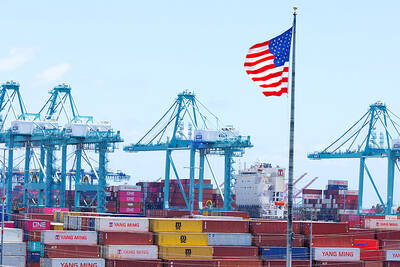
NOT IMMEDIATE: Taiwan has a chance to appeal the proposed 10 percent tariff before it starts, while other countries face a 12.5 percent tariff from the trade office Taiwan is among 60 economies determined by the US to have failed to impose or enforce a ban on the importation of goods produced with forced labor, according to a notice released on Tuesday by the Office of the US Trade Representative (USTR), which proposed imposing an additional 10 percent or more tariff on them. The USTR in a statement said that following an investigation, it had determined under Section 301 of the Trade Act of 1974 that the failure of the 60 economies to impose and effectively enforce a prohibition on the importation of goods produced with forced labor is
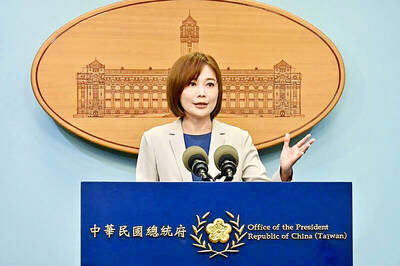
TIT-FOR-TAT: The US allegedly revoked the visa of a Chinese national working at Xinhua News Agency in the US in response to Beijing’s expulsion of Vivian Wang The Presidential Office yesterday condemned China for expelling a New York Times correspondent from Beijing following the newspaper’s interview with President William Lai (賴清德), saying the move highlighted Beijing’s suppression of press freedom and its threat to international news media. Taiwan has noted a series of recent incidents in which Beijing used similar tactics to “threaten and pressure international media outlets and journalists,” Presidential Office spokeswoman Karen Kuo (郭雅慧) said in a statement. “This concerns not only press freedom and freedom of expression, but also the safety of journalists, and Taiwan and relevant partners are paying close attention to the situation,” she


 RSS
RSS