


The US and its allies would take unspecified “action” if China were to use force to alter the “status quo” over Taiwan, US Secretary of State Antony Blinken said on Wednesday.
Blinken was asked at a forum hosted by the New York Times whether the US would step in to defend Taiwan in the event of an attack by China. He repeated regular US statements that Washington’s role is to make sure the island has the means to defend Taiwan, as is required under US law.
“At the same time, I think it’s fair to say that we’re not alone in this determination to make sure that we preserve peace and stability in that part of the world,” Blinken said.
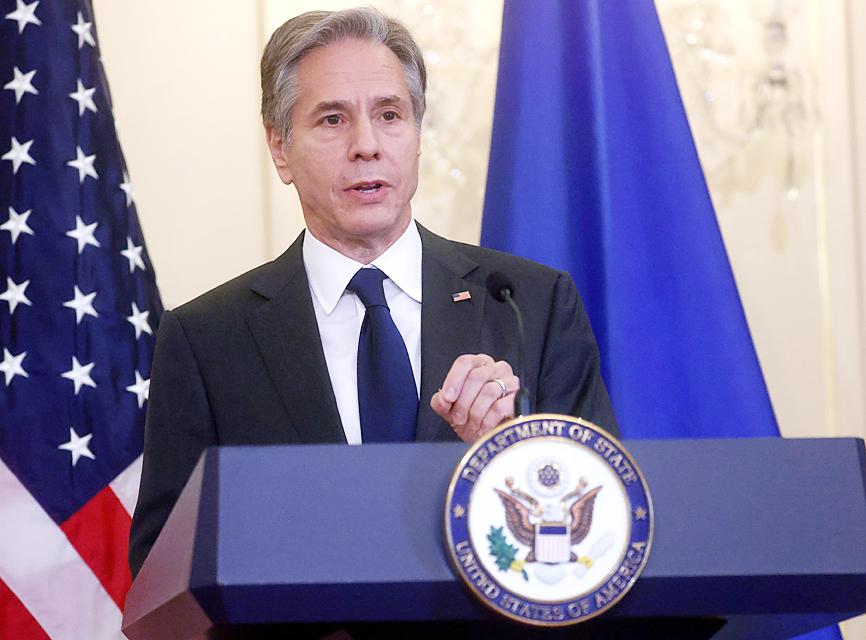
Photo: Reuters
“There are many countries, both in the region and beyond, that would see any unilateral action to use force to disrupt the status quo as a significant threat to peace and security, and they too would take action in the event that that happens,” he added.
Blinken did not say what sort of action he was referring to.
US President Joe Biden caused a stir last month when he said the US would come to Taiwan’s defense if China attacked.
Those remarks appeared to depart from a long-held policy of “strategic ambiguity,” not making clear how the US would respond. The White House quickly said Biden was not signaling a change in policy, and some analysts dismissed his comments as a gaffe.
US Representative Adam Schiff, the Democratic chairman of the influential US House Intelligence Committee, last week urged the Biden administration to be less ambiguous about what he called a US obligation to defend Taiwan from attack by China.
Blinken’s remarks came ahead of a virtual meeting between Biden and Chinese President Xi Jinping (習近平), which a source briefed on the matter said would be held as soon as next week.
Asked if the meeting would happen next week, Blinken said only that it was “coming up soon.”
In Taipei, Ministry of Foreign Affairs Department of North American Affairs Deputy Director-General Regine Chen (陳慧蓁) said senior US officials have repeatedly affirmed their commitment to Taiwan against Chinese military intimidation.
The government would continue to deepen cooperation with the US and other like-minded nations to promote peace, stability and prosperity in the Taiwan Strait and Indo-Pacific region, she added.
As for the planned virtual meeting between Biden and Xi, the ministry said it would coordinate closely with the US to ensure that its policy toward Taiwan remains unchanged.
In other developments, a US congressional delegation comprised of US senators John Cornyn, Tommy Tuberville, Mike Crapo and Mike Lee, as well as US Representative Jake Ellzey, who arrived in Taiwan on a US military transport plane on Tuesday, departed yesterday after a visit to Taiwan Semiconductor Manufacturing Co (台積電) in Hsinchu.
Additional reporting by Lu Yi-hsuan and staff writer
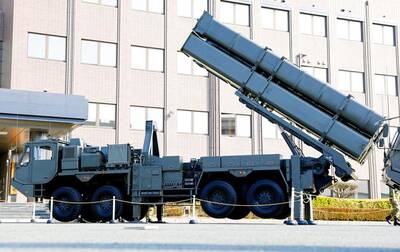
Japan has deployed long-range missiles in a southwestern region near China, the Japanese defense minister said yesterday, at a time when ties with Beijing are at their lowest in recent years. The missiles were installed in Kumamoto in the southern region of Kyushu, as Japan is attempting to shore up its military capacity as China steps up naval activity in the East China Sea. “Standoff defense capabilities enable us to counter the threat of enemy forces attempting to invade our country ... while ensuring the safety of our personnel,” Japanese Minister of Defense Shinjiro Koizumi said. “This is an extremely important initiative for

MORE POPULAR: Taiwan Pass sales increased by 59 percent during the first quarter compared with the same period last year, the Tourism Administration said The Tourism Administration yesterday said that it has streamlined the Taiwan Pass, with two versions available for purchase beginning today. The tourism agency has made the pass available to international tourists since 2024, allowing them to access the high-speed rail, Taiwan Railway Corp services, four MRT systems and four Taiwan Tourist Shuttles. Previously, five types of Taiwan Pass were available, but some tourists have said that the offerings were too complicated. The agency said only two types of Taiwan Pass would be available, starting from a three-day pass with the high-speed rail and a three-day pass with Taiwan Railway Corp. The former costs NT$2,800

POLLS CONCERNS: There are concerns within the KMT that a Cheng Li-wun-Xi Jinping meeting could trigger a voter backlash in elections in November Chinese Nationalist Party (KMT) Chairwoman Cheng Li-wun (鄭麗文) accepted an invitation from Chinese President Xi Jinping (習近平) to visit next month, her party and Chinese state media reported yesterday. Cheng, who took up her role in November last year, “gladly accepted” the invitation to lead a delegation to China, the KMT said in a statement, confirming a Xinhua news agency report. Cheng “looks forward to joint efforts by both parties to advance the peaceful development of cross-strait relations, promote cross-strait exchanges and cooperation, and work for peace in the Taiwan Strait and greater well-being for people on both sides,” the statement said. Chinese
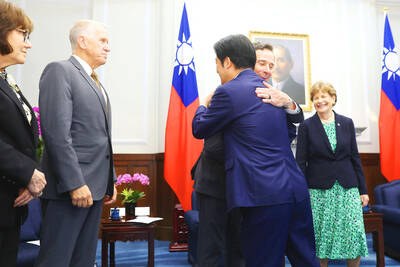
SIGNIFICANT TO THE WORLD: The delegation’s visit aims to send a clear message that bipartisan support for Taiwan is consistent, US Senator Jeanne Shaheen said The US Senate’s bipartisan support for Taiwan remains strong and Taiwan-US ties would continue for decades to come, a US Senate delegation said in Taipei yesterday, while calling on the legislature to swiftly pass a special defense budget bill. A US delegation led by Democratic US Senator Jeanne Shaheen and Republican US Senator John Curtis — both members of the US Senate Committee on Foreign Relations — arrived in Taiwan yesterday for a two-day visit. The other senators of the delegation included Senate Taiwan Caucus cochair Thom Tillis and Senate Committee on Armed Services senior member Jacky Rosen. Shaheen told a news


 RSS
RSS