


Four large media associations in Taiwan yesterday urged the government to create laws that would require Google and other large international platform operators to negotiate a reasonable split of their advertising revenue with local content providers.
Speaking at a news conference in Taipei, representatives from the Taiwan Digital and Marketing Association (DMA), Media Agency Association, Taipei Newspapers Association and Satellite Television Broadcasting Association said they also opposed a proposal requiring Internet platform operators to devote a percentage of their advertising revenue to the creation of a public fund, which would be used to support the production of quality news content.
“The government should stipulate laws to ensure that [media providers] secure their share of advertising revenue, rather than setting up a fund to address the issue. We hope that the government will listen to industry representatives,” DMA chairman Nathan Chiu (邱繼弘) said.
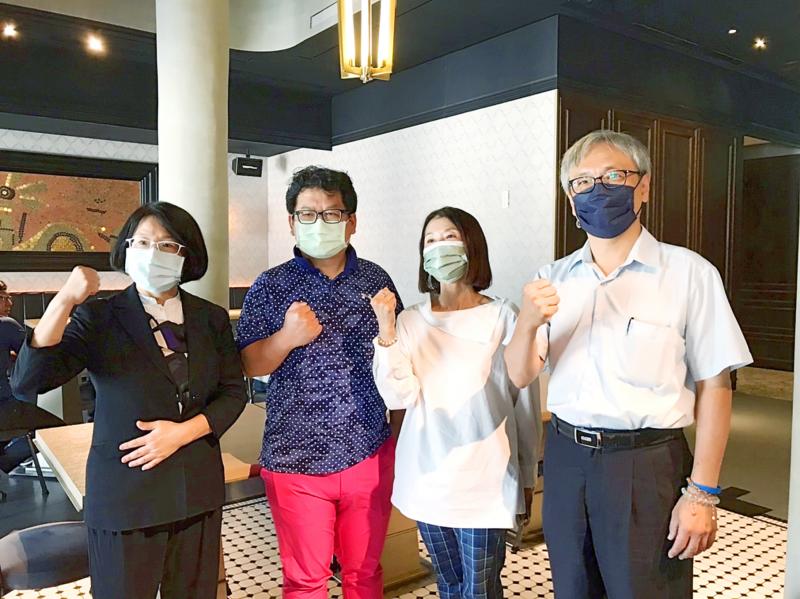
Photo: Yang Mien-chieh, Taipei Times
Taipei Newspaper Association secretary-general Aaker Chen (陳志光) said that his association’s position has always been that users should pay for media content.
There should be a reasonable mechanism governing the division of advertising revenue between media and platform operators, he added.
Local media providers can only secure a very small percentage of advertising revenue based on the advertising traffic their content brings in, and that business model should be changed, he said.
“We have seen in Australia that even media tycoons like Rupert Murdoch had trouble negotiating with Google or Facebook. It would be almost impossible for Taiwanese media to reach agreements with large platform operators,” he said.
His association has on multiple occasions urged the government to create laws to ensure that local content providers receive their fair share of advertising revenue, he added.
Chen said that his association was also against the proposal to establish a public fund made up of revenue collected from platform operators.
Several media experts have suggested that the fund be managed by a foundation, which would be in charge of distributing revenue to the providers of quality news content, he said.
“We believe that setting up such a fund is a really bad idea and goes against our ‘users pay’ principle,” Chen said.
“Using a government fund to support the production of high-quality content and giving content providers their fair share of advertising revenue should be treated as separate matters,” he added.
Satellite Television Broadcasting Association secretary-general May Chen (陳依玫) said that Google, Facebook and other digital platform operators have a social responsibility, given their strong global market power.
“In Taiwan, the least they can do is to sit down and negotiate with local media representatives. So far, we have not made much progress in this regard,” she said, adding that the government could facilitate such conversations.
Large platform operators not only have a responsibility to tackle issues caused by misinformation, but must also address the problem of content piracy.
DMA’s data showed that digital advertising revenue generated in Taiwan last year through access to content on general media and social media platforms topped NT$48.25 billion (US$1.73 billion), up 5.3 percent from 2019.
While 40.3 percent of the revenue came from access to general media content via mobile phones or tablets, 33.74 percent was gained through access to content on social media platforms via mobile devices, the data showed.
National Communications Commission Vice Chairman and spokesman Wong Po-tsung (翁柏宗) said that the commission would investigate how large platforms have affected broadcast media, adding that it would work with the Ministry of Culture and the Fair Trade Commission to address the issue.
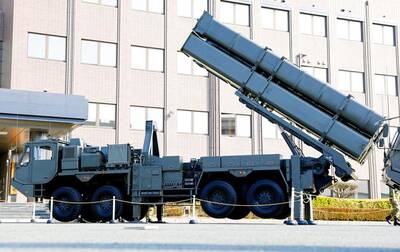
Japan has deployed long-range missiles in a southwestern region near China, the Japanese defense minister said yesterday, at a time when ties with Beijing are at their lowest in recent years. The missiles were installed in Kumamoto in the southern region of Kyushu, as Japan is attempting to shore up its military capacity as China steps up naval activity in the East China Sea. “Standoff defense capabilities enable us to counter the threat of enemy forces attempting to invade our country ... while ensuring the safety of our personnel,” Japanese Minister of Defense Shinjiro Koizumi said. “This is an extremely important initiative for
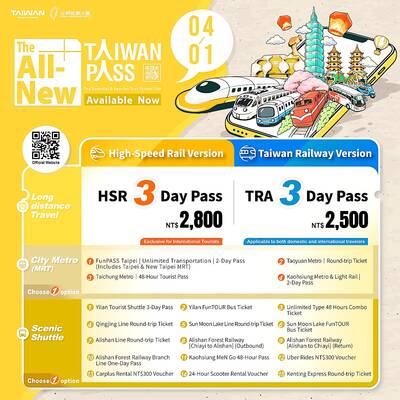
MORE POPULAR: Taiwan Pass sales increased by 59 percent during the first quarter compared with the same period last year, the Tourism Administration said The Tourism Administration yesterday said that it has streamlined the Taiwan Pass, with two versions available for purchase beginning today. The tourism agency has made the pass available to international tourists since 2024, allowing them to access the high-speed rail, Taiwan Railway Corp services, four MRT systems and four Taiwan Tourist Shuttles. Previously, five types of Taiwan Pass were available, but some tourists have said that the offerings were too complicated. The agency said only two types of Taiwan Pass would be available, starting from a three-day pass with the high-speed rail and a three-day pass with Taiwan Railway Corp. The former costs NT$2,800

POLLS CONCERNS: There are concerns within the KMT that a Cheng Li-wun-Xi Jinping meeting could trigger a voter backlash in elections in November Chinese Nationalist Party (KMT) Chairwoman Cheng Li-wun (鄭麗文) accepted an invitation from Chinese President Xi Jinping (習近平) to visit next month, her party and Chinese state media reported yesterday. Cheng, who took up her role in November last year, “gladly accepted” the invitation to lead a delegation to China, the KMT said in a statement, confirming a Xinhua news agency report. Cheng “looks forward to joint efforts by both parties to advance the peaceful development of cross-strait relations, promote cross-strait exchanges and cooperation, and work for peace in the Taiwan Strait and greater well-being for people on both sides,” the statement said. Chinese
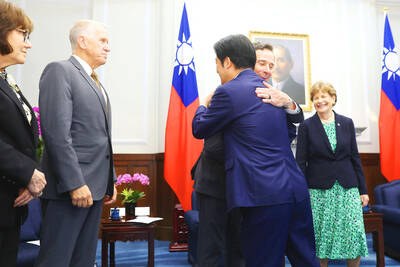
SIGNIFICANT TO THE WORLD: The delegation’s visit aims to send a clear message that bipartisan support for Taiwan is consistent, US Senator Jeanne Shaheen said The US Senate’s bipartisan support for Taiwan remains strong and Taiwan-US ties would continue for decades to come, a US Senate delegation said in Taipei yesterday, while calling on the legislature to swiftly pass a special defense budget bill. A US delegation led by Democratic US Senator Jeanne Shaheen and Republican US Senator John Curtis — both members of the US Senate Committee on Foreign Relations — arrived in Taiwan yesterday for a two-day visit. The other senators of the delegation included Senate Taiwan Caucus cochair Thom Tillis and Senate Committee on Armed Services senior member Jacky Rosen. Shaheen told a news


 RSS
RSS