


Adults aged 75 and older who received a first dose of the Moderna COVID-19 vaccine before July 9 are eligible to receive a second dose starting today, the Central Epidemic Command Center (CECC) said yesterday.
The CECC would begin distributing the vaccines today, after which local health departments would arrange for eligible recipients to receive their second dose at a designated vaccination site, Minister of Health and Welfare Chen Shih-chung (陳時中), who heads the center, told a news conference in Taipei.
About 291,000 people are included in the group, the CECC said.
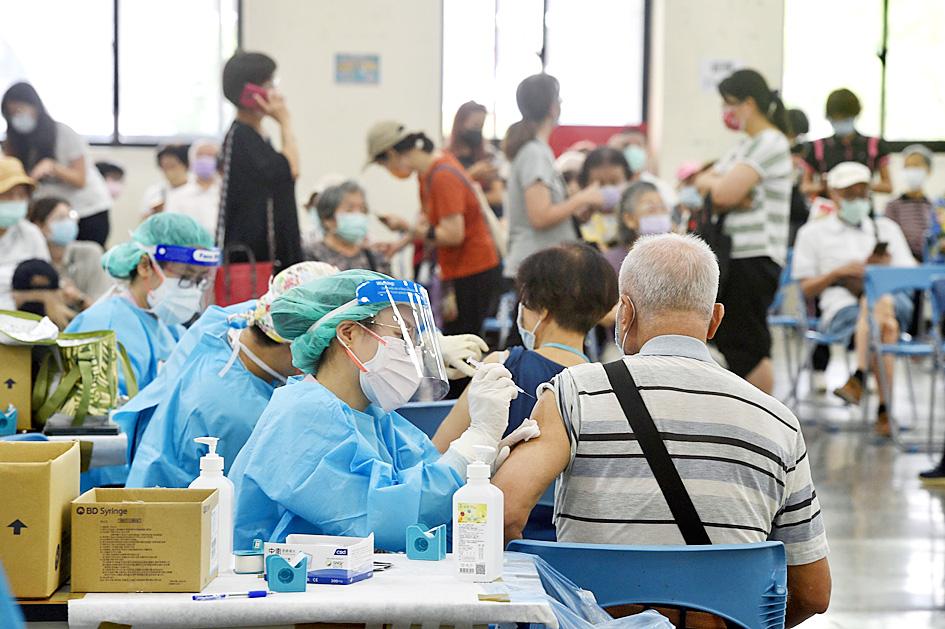
Photo: George Tsorng, Taipei Times
The latest measure came as the nation is expected to receive a new batch of the long-awaited Moderna vaccine doses tonight.
Chen confirmed that 1.08 million doses of the Moderna vaccine, as well as about 640,000 doses of the AstraZeneca vaccine, would arrive in Taiwan today.
The Moderna doses were to depart from Atlanta, Georgia, early this morning, and arrive at Taiwan Taoyuan International Airport tonight, the CECC said.
Taiwan has ordered 5.05 million doses of Moderna. Today’s batch, the seventh shipment delivered under the government’s contract, brings the total to 2.58 million.
The US and Czech governments have also donated 2.5 million and 30,000 Moderna doses respectively.
The Moderna doses arriving today would mainly be used to provide people with their second shot, Chen said.
The AstraZeneca doses were expected to arrive in the afternoon, he said.
The batch would be the ninth delivery made as part of a contract signed last year for 10 million doses, of which about 4.37 million — including today’s shipment — have been delivered, the CECC said.
Other AstraZeneca doses have come from the COVAX global vaccine distribution program or through donations from Japan, Lithuania and Poland.
Today’s AstraZeneca shipment is to expire on Jan. 31 next year, while the Moderna doses would likely expire in the middle of November, Chen said.
On Wednesday, 201,189 doses of COVID-19 vaccines were administered, of which 39,511 were first doses and 161,678 were second doses, CECC data showed.
As of Wednesday, 12,708,428 COVID-19 vaccine doses — 11,483,332 first doses and 1,225,096 second doses — had been given since vaccinations began on March 22, the data showed.
Chen said that 48.97 percent of the population had received at least one dose of a COVID-19 vaccine.
Additional reporting by CNA

Japan has deployed long-range missiles in a southwestern region near China, the Japanese defense minister said yesterday, at a time when ties with Beijing are at their lowest in recent years. The missiles were installed in Kumamoto in the southern region of Kyushu, as Japan is attempting to shore up its military capacity as China steps up naval activity in the East China Sea. “Standoff defense capabilities enable us to counter the threat of enemy forces attempting to invade our country ... while ensuring the safety of our personnel,” Japanese Minister of Defense Shinjiro Koizumi said. “This is an extremely important initiative for

MORE POPULAR: Taiwan Pass sales increased by 59 percent during the first quarter compared with the same period last year, the Tourism Administration said The Tourism Administration yesterday said that it has streamlined the Taiwan Pass, with two versions available for purchase beginning today. The tourism agency has made the pass available to international tourists since 2024, allowing them to access the high-speed rail, Taiwan Railway Corp services, four MRT systems and four Taiwan Tourist Shuttles. Previously, five types of Taiwan Pass were available, but some tourists have said that the offerings were too complicated. The agency said only two types of Taiwan Pass would be available, starting from a three-day pass with the high-speed rail and a three-day pass with Taiwan Railway Corp. The former costs NT$2,800

POLLS CONCERNS: There are concerns within the KMT that a Cheng Li-wun-Xi Jinping meeting could trigger a voter backlash in elections in November Chinese Nationalist Party (KMT) Chairwoman Cheng Li-wun (鄭麗文) accepted an invitation from Chinese President Xi Jinping (習近平) to visit next month, her party and Chinese state media reported yesterday. Cheng, who took up her role in November last year, “gladly accepted” the invitation to lead a delegation to China, the KMT said in a statement, confirming a Xinhua news agency report. Cheng “looks forward to joint efforts by both parties to advance the peaceful development of cross-strait relations, promote cross-strait exchanges and cooperation, and work for peace in the Taiwan Strait and greater well-being for people on both sides,” the statement said. Chinese

SIGNIFICANT TO THE WORLD: The delegation’s visit aims to send a clear message that bipartisan support for Taiwan is consistent, US Senator Jeanne Shaheen said The US Senate’s bipartisan support for Taiwan remains strong and Taiwan-US ties would continue for decades to come, a US Senate delegation said in Taipei yesterday, while calling on the legislature to swiftly pass a special defense budget bill. A US delegation led by Democratic US Senator Jeanne Shaheen and Republican US Senator John Curtis — both members of the US Senate Committee on Foreign Relations — arrived in Taiwan yesterday for a two-day visit. The other senators of the delegation included Senate Taiwan Caucus cochair Thom Tillis and Senate Committee on Armed Services senior member Jacky Rosen. Shaheen told a news


 RSS
RSS