


A batch of the Pfizer-BioNTech COVID-19 vaccine has become available ahead of schedule, the government said late on Wednesday, adding that it was “competing” with other countries for it, while strongly hinting that it was a done deal.
In June, the government authorized Taiwan Semiconductor Manufacturing Co (TSMC, 台積電) and the Hon Hai Precision Industry Co (鴻海精密)-affiliated Yonglin Foundation to represent it in purchase negotiations with BioNTech SE.
Last month, the companies said that they succeeded in purchasing 10 million doses between them — with an initial shipping date of late next month — and that they would be donated to the government upon delivery.
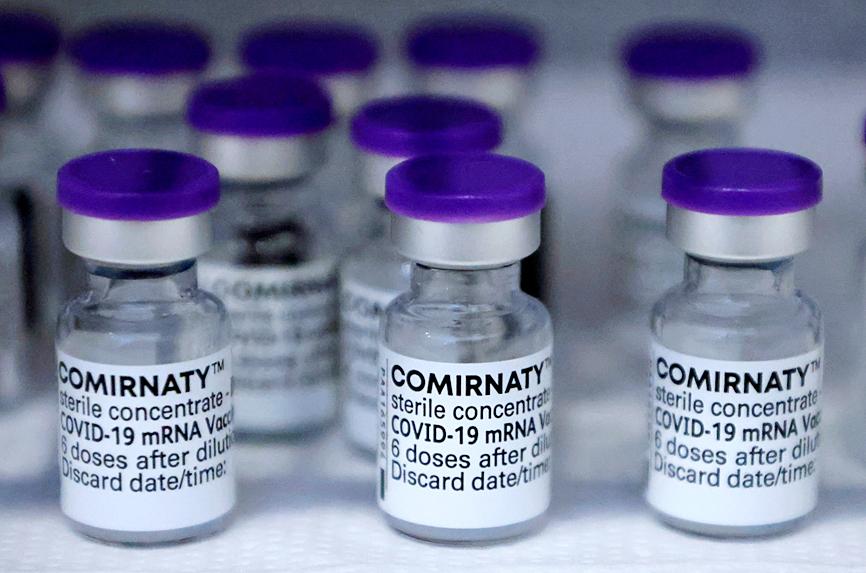
Photo: Reuters
The Central Epidemic Command Center (CECC) said in a news release on Wednesday that TSMC notified it about a batch originally destined for Shanghai Fosun Pharmaceutical Group Co (上海復星醫藥集團) — BioNTech’s authorized distributor in the region — that would “leave the factory” late this month.
Many countries were competing for the batch, TSMC said, adding that if Taiwan did not obtain it, the batch would be sent elsewhere.
The center did not confirm that Taiwan had obtained the batch, but the rest of the statement suggested that it had.
For example, the center noted that Taiwan approved the Pfizer-BioNTech vaccine for people aged 12 to 18, and that the new school semester is to begin next month.
As long as it could be confirmed that the batch was coming from the original manufacturer and the doses passed the necessary safety inspections, the government would rapidly distribute them for the peace of mind of parents, students and teachers, it added.
As the batch was intended to be sold to “another location,” the packaging would bear the Chinese brand name and the distributor’s name in Chinese on the vial, even though this is not what was agreed upon in the procurement contract, the center said.
However, the government is willing to accept these changes to ensure that a batch arrives earlier than expected, it added.
“As long as the safety and quality of the vaccine doses can be guaranteed, there can be flexibility on the issue of labeling,” the center said.
The center’s news release was issued after Reuters reported on Wednesday that Taiwan would receive a batch of the Pfizer-BioNTech vaccine early after China — the batch’s original destination — had delayed regulatory approval of the vaccine.
The shipment of more than 1 million doses should arrive in Taiwan late this month or early next month, Reuters said, quoting an anonymous source.
The Chinese-language Liberty Times (sister paper of the Taipei Times) yesterday quoted a senior official as saying that Taiwan would receive nearly 2 million vaccines as early as the end of this month.
When asked whether acceptance of the batch with the Chinese labeling would constitute tacit acceptance of Beijing’s “greater Zhonghua area” rhetoric, Mainland Affairs Council Deputy Minister Chiu Chui-cheng (邱垂正) yesterday said that the government’s priority was to address the pandemic.
As long as the doses are effective and arrive directly from the manufacturer, the government accepts the shipment early, he said.
Today and tomorrow, 265,000 doses of the AstraZeneca vaccine purchased by Taiwan and 30,000 doses of the Moderna vaccine from the Czech Republic are to arrive, sources said.
As of yesterday, 41.24 percent of Taiwan’s population of 23.5 million people had received one dose, CECC data showed.
Yesterday, the center reported eight new cases of COVID-19: two domestic cases and six imported.
The two local cases, contacts of previously confirmed COVID-19 patients, tested positive in quarantine, said Minister of Health and Welfare Chen Shih-chung (陳時中), who heads the center.
One lives in Taipei and the other in New Taipei City, he added.
The six imported cases were four Taiwanese who traveled from the US, one Japanese from Japan and an American from China, the center said.
Additional reporting by Chen Yu-fu
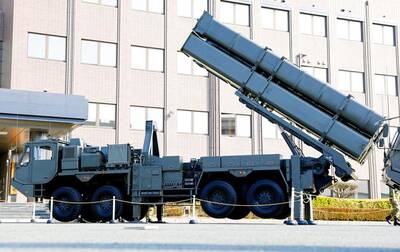
Japan has deployed long-range missiles in a southwestern region near China, the Japanese defense minister said yesterday, at a time when ties with Beijing are at their lowest in recent years. The missiles were installed in Kumamoto in the southern region of Kyushu, as Japan is attempting to shore up its military capacity as China steps up naval activity in the East China Sea. “Standoff defense capabilities enable us to counter the threat of enemy forces attempting to invade our country ... while ensuring the safety of our personnel,” Japanese Minister of Defense Shinjiro Koizumi said. “This is an extremely important initiative for
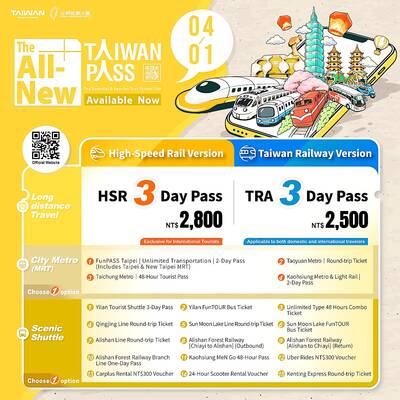
MORE POPULAR: Taiwan Pass sales increased by 59 percent during the first quarter compared with the same period last year, the Tourism Administration said The Tourism Administration yesterday said that it has streamlined the Taiwan Pass, with two versions available for purchase beginning today. The tourism agency has made the pass available to international tourists since 2024, allowing them to access the high-speed rail, Taiwan Railway Corp services, four MRT systems and four Taiwan Tourist Shuttles. Previously, five types of Taiwan Pass were available, but some tourists have said that the offerings were too complicated. The agency said only two types of Taiwan Pass would be available, starting from a three-day pass with the high-speed rail and a three-day pass with Taiwan Railway Corp. The former costs NT$2,800

POLLS CONCERNS: There are concerns within the KMT that a Cheng Li-wun-Xi Jinping meeting could trigger a voter backlash in elections in November Chinese Nationalist Party (KMT) Chairwoman Cheng Li-wun (鄭麗文) accepted an invitation from Chinese President Xi Jinping (習近平) to visit next month, her party and Chinese state media reported yesterday. Cheng, who took up her role in November last year, “gladly accepted” the invitation to lead a delegation to China, the KMT said in a statement, confirming a Xinhua news agency report. Cheng “looks forward to joint efforts by both parties to advance the peaceful development of cross-strait relations, promote cross-strait exchanges and cooperation, and work for peace in the Taiwan Strait and greater well-being for people on both sides,” the statement said. Chinese

SIGNIFICANT TO THE WORLD: The delegation’s visit aims to send a clear message that bipartisan support for Taiwan is consistent, US Senator Jeanne Shaheen said The US Senate’s bipartisan support for Taiwan remains strong and Taiwan-US ties would continue for decades to come, a US Senate delegation said in Taipei yesterday, while calling on the legislature to swiftly pass a special defense budget bill. A US delegation led by Democratic US Senator Jeanne Shaheen and Republican US Senator John Curtis — both members of the US Senate Committee on Foreign Relations — arrived in Taiwan yesterday for a two-day visit. The other senators of the delegation included Senate Taiwan Caucus cochair Thom Tillis and Senate Committee on Armed Services senior member Jacky Rosen. Shaheen told a news


 RSS
RSS