


The Central Epidemic Command Center (CECC) yesterday reported 297 new local COVID-19 cases, 258 backlogged cases and 19 deaths.
While the center’s disease prevention measures over the past two weeks have helped reduce the spread of the disease, they have not been able to curb the outbreak, Minister of Health and Welfare Chen Shih-chung (陳時中), who heads the center, told a daily news briefing in Taipei.
The daily number of local cases over the past two weeks has remained consistent, showing no sign of declining, Chen said.
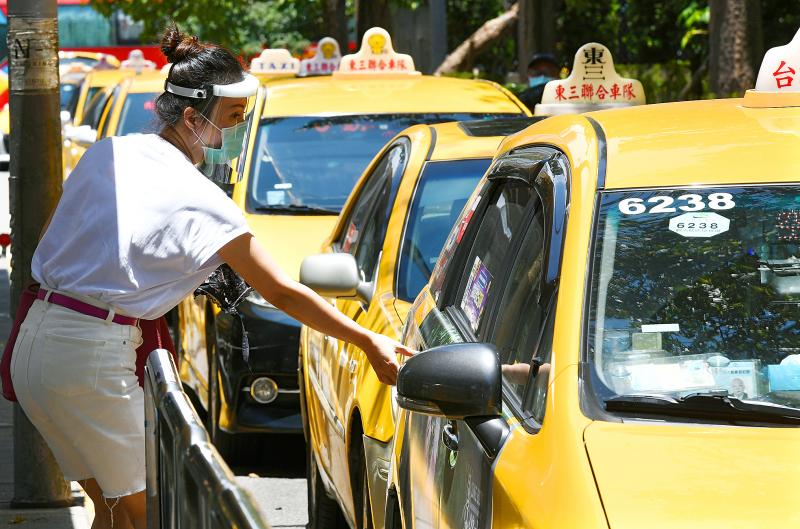
Photo: Liao Chen-huei, Taipei Times
The center’s priorities are to speed up virus screening in infection hot spots and identify more potential case in local communities, he added.
Of the new local cases, 157 are male and 140 are female, with the onset of their symptoms between April 29 and Thursday, Chen said.
New Taipei City had the most locally transmitted cases at 136, followed by Taipei with 94, Taoyuan with 21, Taichung with 10, Hualien County with nine and Changhua County with seven, the center’s data showed.
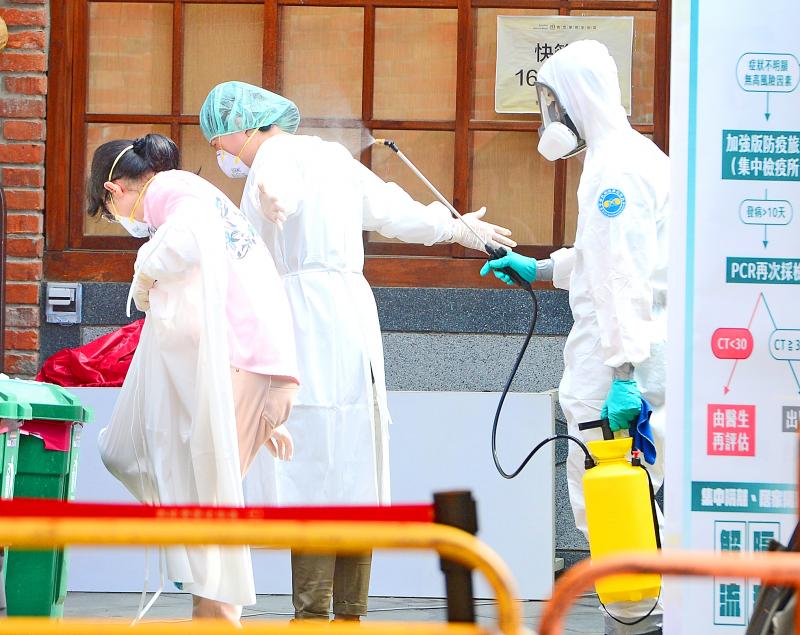
Photo: Wang Yi-sung, Taipei Times
Keelung and Tainan had six cases each, Chiayi City had two, and Hsinchu county and city, Kaohsiung, and Pingtung, Taitung and Nantou counties had one each, the data showed.
The center also reported 19 deaths — 14 men and five women, aged 40 to 80.
Among the fatalities, 13 had chronic diseases, ranging from high blood pressure, hyperlipidemia, diabetes, heart disease, cerebral stroke, kidney disorders or combinations of illnesses; two did not have any chronic disease; and the medical histories of the remaining four were being reviewed, the center said.
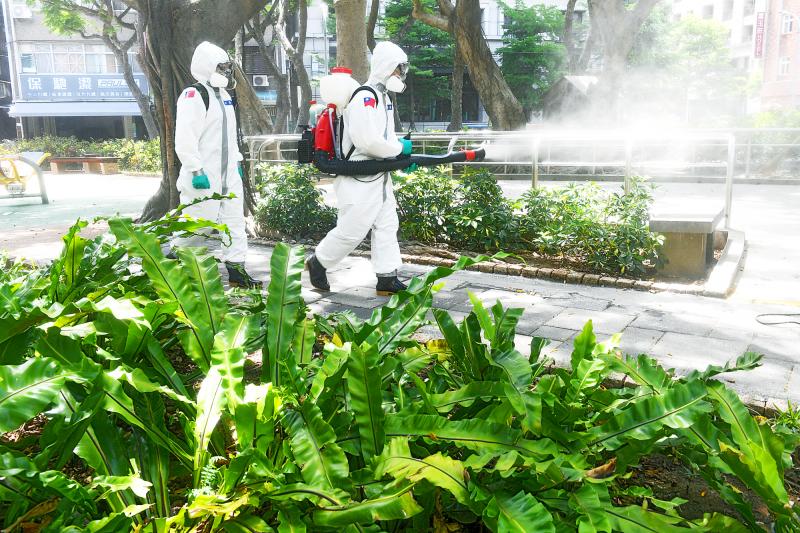
Photo: CNA
Of the 258 backlogged cases, 133 are male and 125 are female, with the onset of their symptoms from May 11 to Thursday, center data showed.
Among them, 141 are from New Taipei City, 114 from Taipei, two from Changhua and one from Taoyuan, the data showed.
Regarding the total 555 cases reported yesterday, 110 have been linked to an outbreak in Taipei’s Wanhua District (萬華), while another nine had visited teahouses in the district; one was linked to a civic club; 181 were linked to existing infection sources; 111 are still being investigated; and 143 have no identifiable infection source yet, the center said.
After many hospitals in Taipei, including National Taiwan University Hospital, called for patients to be sent to hospitals in other areas, Deputy Minister of Health and Welfare Shih Chung-liang (石崇良) said that despite a problem of patient distribution among hospitals, the nation’s medical capacity is sufficient.
At the 180 hospitals devoted to treating COVID-19 patients, 9,015 beds are occupied, while 7,380 remain open, including 1,183 beds in New Taipei City, 682 in Taipei, 445 in Taoyuan and 163 in Keelung, the data showed.
Meanwhile, the CECC said that it would allow companies to use rapid COVID-19 testing on their employees, but that the tests would have to be administered by medical personnel and that plans were not yet final.
With the rapid escalation of locally transmitted COVID-19 cases, the CECC, the Ministry of Labor and the Ministry of Economic Affairs have discussed calls by some Taiwanese corporations to be allowed to screen their employees for the disease.
The agencies have tasked the Ministry of Economic Affairs with drafting a proposal on the issue, with recommendations on whether employers should be allowed to require the tests and how to deal with false positive results.
Deputy Minister of the Interior Chen Tsung-yen (陳宗彥), who is also the CECC deputy head, said yesterday that the CECC had already “agreed in principle” to the idea.
Additional reporting by CNA

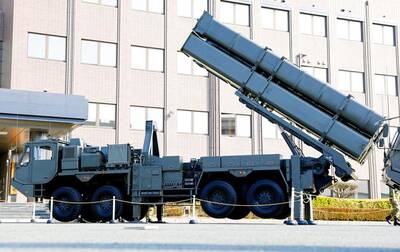
Japan has deployed long-range missiles in a southwestern region near China, the Japanese defense minister said yesterday, at a time when ties with Beijing are at their lowest in recent years. The missiles were installed in Kumamoto in the southern region of Kyushu, as Japan is attempting to shore up its military capacity as China steps up naval activity in the East China Sea. “Standoff defense capabilities enable us to counter the threat of enemy forces attempting to invade our country ... while ensuring the safety of our personnel,” Japanese Minister of Defense Shinjiro Koizumi said. “This is an extremely important initiative for

MORE POPULAR: Taiwan Pass sales increased by 59 percent during the first quarter compared with the same period last year, the Tourism Administration said The Tourism Administration yesterday said that it has streamlined the Taiwan Pass, with two versions available for purchase beginning today. The tourism agency has made the pass available to international tourists since 2024, allowing them to access the high-speed rail, Taiwan Railway Corp services, four MRT systems and four Taiwan Tourist Shuttles. Previously, five types of Taiwan Pass were available, but some tourists have said that the offerings were too complicated. The agency said only two types of Taiwan Pass would be available, starting from a three-day pass with the high-speed rail and a three-day pass with Taiwan Railway Corp. The former costs NT$2,800

NEW LOW: The council in 2024 based predictions on a pessimistic estimate for the nation’s total fertility rate of 0.84, but last year that rate was 0.69, 17 percent lower An expected National Development Council (NDC) report expects the nation’s population to drop below 12 million by 2065, with the old-age dependency ratio to top 100 percent sooner than 2070, sources said yesterday. The council is slated to release its latest population projections in August, using an ultra-low fertility model, the sources said. The previous report projected that Taiwan’s population would fall to 14.37 million by 2070, but based on a new estimate of the total fertility rate (TFR) — the average number of children born to a woman over her lifetime — the population is expected to reach 12 million by

COUNTERING HOSTILITY: The draft bill would require the US to increase diplomatic pressure on China and would impose sanctions on those who sabotage undersea cable networks US lawmakers on Thursday introduced a bipartisan bill to bolster the resilience of Taiwan’s submarine cables to counter China’s hostile activities. The proposal, titled the critical undersea infrastructure resilience initiative act, was cosponsored by Republican representatives Mike Lawler and Greg Stanton, and Democratic Representative Dave Min. US Senators John Curtis and Jacky Rosen also introduced a companion bill in the US Senate, which has passed markup at the chamber’s Committee on Foreign Relations. The House’s version of the bill would prioritize the deployment of sensors to detect disruptions or potential sabotage in real-time and enhance early warning capabilities through global intelligence sharing frameworks,


 RSS
RSS