

US Secretary of State Antony Blinken on Friday urged the WHO to invite Taiwan to participate in the World Health Assembly (WHA) as an observer, saying that China’s objections are to blame for Taiwan’s exclusion from the organization.
Blinken’s remarks came after the French Senate on Thursday passed a resolution 304-0 backing Taiwan’s participation in international organizations, including the WHO, and after the G7 foreign ministers backed Taiwan’s WHA bid in a joint communique on Wednesday.
The 74th WHA is to take place virtually from May 24 to June 1. Taiwan participated as an observer from 2009 to 2016, but has since been denied entry.
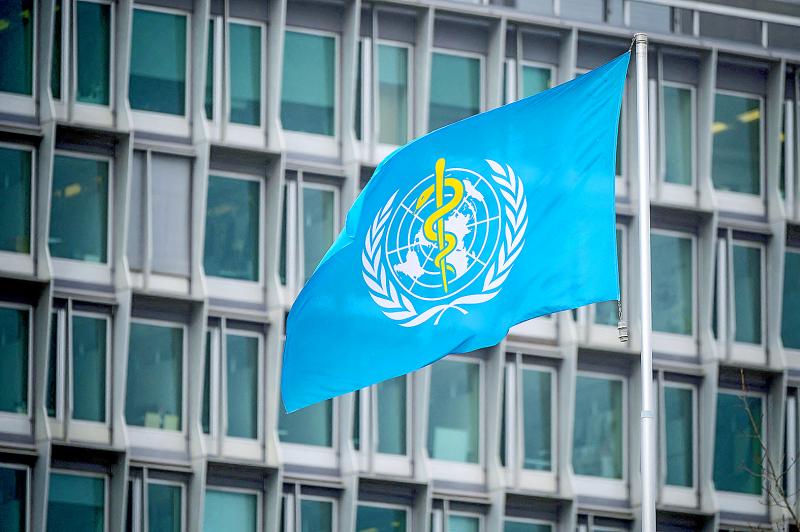
Photo: AFP
“Unless the organization’s leadership takes appropriate action, the assembly will once again exclude the vital participation of Taiwan,” Blinken said.
“There is no reasonable justification for Taiwan’s continued exclusion from this forum, and the United States calls upon the WHO director-general to invite Taiwan to participate as an observer at the WHA — as it has in previous years, prior to objections registered by the government of the People’s Republic of China,” he said.
“WHO leadership and all responsible nations should recognize that excluding the interests of 24 million people at the WHA serves only to imperil, not advance, our shared global health objectives,” he added.
“Taiwan is a reliable partner, a vibrant democracy and a force for good in the world, and its exclusion from the WHA would be detrimental to our collective international efforts to get the pandemic under control and prevent future health crises,” he said.
“We urge Taiwan’s immediate invitation to the World Health Assembly,” Blinken said.
The Ministry of Foreign Affairs yesterday thanked Blinken for repeatedly voicing support for Taiwan’s participation in the WHA.
The US has never ceased in its support for Taiwan’s WHA bid, with its support stronger this year than ever, the ministry said in a statement, adding that Washington has been a bellwether in leading other countries to voice support for Taiwan.
The nation welcomes more countries to work with Taiwan to “go beyond politics” and protect universal health, it said.
Taiwan has been striving to join international organizations related to healthcare and medicine, but encountered irrational obstacles and pressure from China, Executive Yuan spokesman Lo Ping-cheng (羅秉成) said separately.
The nation thanks the US, France and other major powers for supporting it and affirming its achievements in healthcare, Lo said, adding that it would continue to deepen relations with like-minded countries.
Separately, the leaders of Taiwan’s three Caribbean allies also urged the WHO to allow Taiwan’s participation in the WHA. They made the calls through pre-recorded videos provided by their embassies in Taiwan.
“It makes absolutely no sense to exclude Taiwan” from the WHA, Saint Vincent and the Grenadines Prime Minister Ralph E. Gonsalves said, adding that excluding the nation would “limit the effectiveness of that assembly and the operations of the World Health Organization.”
“Leave the politics out, this is about health,” he said.
Saint Kitts and Nevis Minister of Foreign Affairs Mark Brantley said that Taiwan should be included in the WHA so that it can play a role in international affairs.
“Taiwan has demonstrated throughout this COVID-19 pandemic that it is a global leader,” Brantley said, adding that Taiwan has “set global standards in handling this pandemic.”
“Taiwan has proved itself to be a successful model in the global fight against the pandemic, not just by successful management of the spread, but also by helping other countries, including my country Saint Lucia, to combat the outbreak,” Saint Lucia Minister of Health Mary Isaac said, adding that it is time to “let Taiwan help.”
Additional reporting by Lee Hsin-fang and CNA

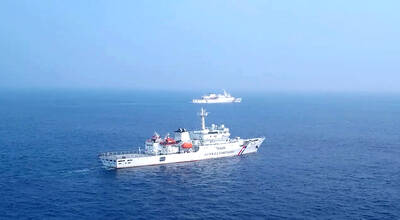
PATROL PARTNERS: The ‘Chiayi’ and the ‘Penghu’ departed for a two-day joint patrol of Palau’s exclusive economic zone, the CGA’s second diplomatic visit to the country The Coast Guard Administration (CGA) set a record for its southernmost deployment of a coast guard vessel as the vessels Chiayi and the Penghu reached Palau’s Pulo Anna Island on Saturday in a cooperative exercise between the two countries. The island, about 217 nautical miles (401km) southwest of Koror in the Palauan state of Sonsorol and 1,220 nautical miles from Taiwan’s southernmost point, Oluanpi (鵝鑾鼻), is the furthest south a CGA vessel has sailed. The two vessels are in Palau for the coast guard’s second diplomatic visit to the country. They docked at Malakal Harbor on Tuesday last week. The coast guard
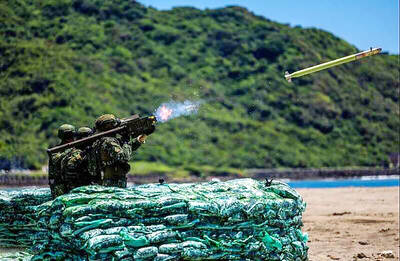
BATCH 1: The military has plans to assign the weapons to the army to defend Taiwan proper, as well as outlying islands and the navy for the Marine Corps, the official said Taiwan is to receive 500 Stinger missiles and 178 launchers from the US by the end of the year, the first batch under a planned two-stage acquisition totaling 2,621 missiles and 763 launchers, a defense official said yesterday on condition of anonymity. The portable missiles would play a vital role in the nation’s air defense capabilities, the source said. The army plans to deploy 2,235 missiles and 657 launchers to defend Taiwan proper and outlying islands, they said, citing military documents. The navy is allotted 295 missiles and 85 launchers to arm the Marine Corps and some surface vessels that lack air defense
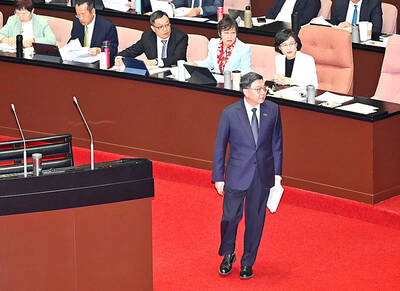
The government is monitoring online rumors that a pneumonic plague outbreak has spread from Russia into China, and it might enhance quarantine measures, Premier Cho Jung-tai (卓榮泰) said yesterday. During a legislative meeting, Democratic Progressive Party Legislator Wang Ting-yu (王定宇) said that rumors had circulated that the disease had spread across several Chinese provinces. He asked Cho whether the government was prepared to prevent the disease spreading to Taiwan, given the volume of traffic between the two sides, and how concerned the government was about the alleged outbreak. The Ministry of Health and Welfare had implemented border quarantine measures after briefing the Executive

The European Parliament on Wednesday adopted a recommendation on EU-China political relations that rejected China’s efforts to restrict Taiwan’s participation in international organizations and exchanges. The recommendation, addressed to the European Council, the European Commission and EU High Representative for Foreign Affairs and Security Policy Kaja Kallas, includes several references to EU-Taiwan relations and expresses support for closer ties, saying they would bring positive benefits and have strategic importance. Describing Taiwan as a valuable partner in trade and technology, the European Parliament said it “rejects China’s attempts to coerce international organizations, third countries and other actors into restricting Taiwan’s international participation and


 RSS
RSS