


The G7 nations on Wednesday scolded China and Russia, casting the Kremlin as malicious and Beijing as a bully, but beyond words there were few concrete steps aside from expressing support for Taiwan and Ukraine.
Founded in 1975 as a forum for the West’s richest nations to discuss crises such as the OPEC oil embargo, the G7 this week addressed what it perceives as the biggest threats: China, Russia and the COVID-19 pandemic.
G7 foreign ministers, in a 12,400-word communique, said that Russia was trying to undermine democracies and threatening Ukraine, while China was guilty of human rights abuses and of using its economic clout to bully others.
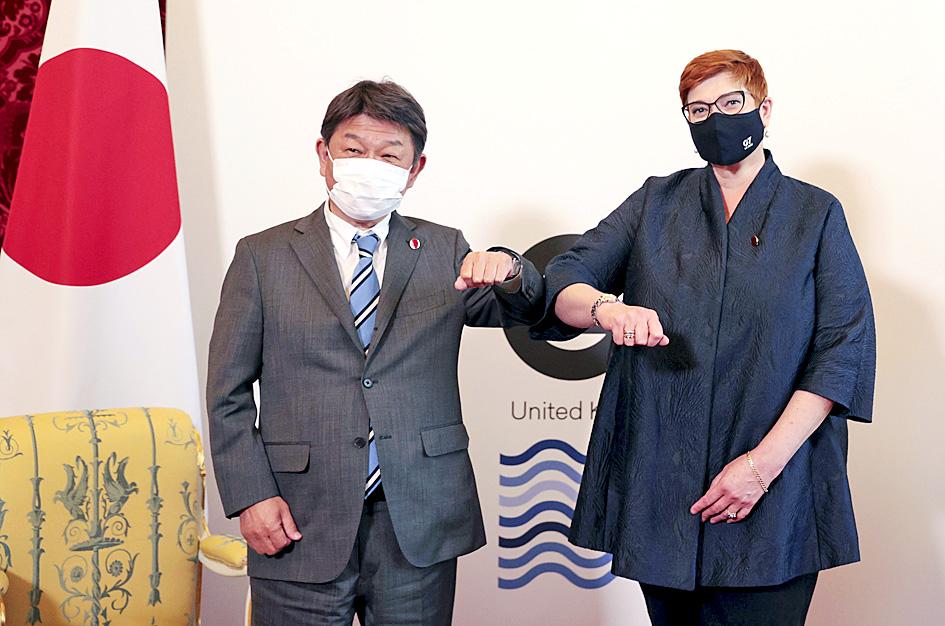
Photo: AP
However, there was little concrete action mentioned in the communique that would unduly worry either Chinese President Xi Jinping (習近平) or Russian President Vladimir Putin.
The G7 said it would bolster collective efforts to stop China’s “coercive economic policies” and to counter Russian disinformation — part of a move to present the West as a much broader alliance than just the core G7 countries.
“I think [China is] more likely to need to, rather than react in anger, it is more likely going to need to take a look in the mirror and understand that it needs to take into account this growing body of opinion, that thinks these basic international rules have got to be adhered to,” British Secretary of State for Foreign, Commonwealth and Development Affairs Dominic Raab said.
Russia denies it is meddling beyond its borders and says the West is gripped by anti-Russian hysteria, while China says the West is a bully and that its leaders have a post-imperial mindset that makes them feel they can act like global police officers.
“We will work collectively to foster global economic resilience in the face of arbitrary, coercive economic policies and practices,” the G7 ministers said on China.
Speaking in Beijing, Chinese Ministry of Foreign Affairs spokesman Wang Wenbin (汪文斌) condemned the statement, saying that it made “groundless accusations” that were a gross interference in China’s internal affairs.
“This is the wanton destruction of the norms of international relations,” he said.
The G7 as a group should take concrete action to boost the global economic recovery, instead of disrupting it, he added.
Wang also attacked G7 countries for hoarding COVID-19 vaccines and having a “wishy-washy” stance toward helping other countries.
“They should not criticize and interfere in other countries with a high-and-mighty attitude, undermining the current top priority of international anti-pandemic cooperation,” he said.
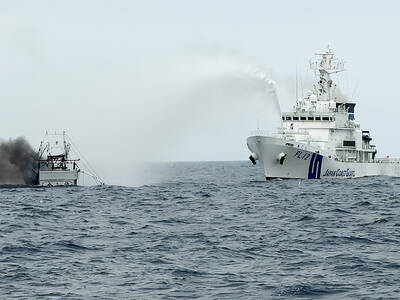
CREDIT-GRABBER: China said its coast guard rescued the crew of a fishing vessel that caught fire, who were actually rescued by a nearby Taiwanese boat and the CGA Maritime search and rescue operations do not have borders, and China should not use a shipwreck to infringe upon Taiwanese sovereignty, the Coast Guard Administration (CGA) said yesterday. The coast guard made the statement in response to the China Coast Guard (CCG) saying it saved a Taiwanese fishing boat. The Chuan Yu No. 6 (全漁6號), a fishing vessel registered in Keelung, on Thursday caught fire and sank in waters northeast of Diaoyutai Islands (釣魚台). The vessel left Keelung’s Badouzih Fishing Harbor (八斗子漁港) at 3:35pm on Sunday last week, with seven people on board — a 62-year-old Taiwanese captain surnamed Chang (張) and six
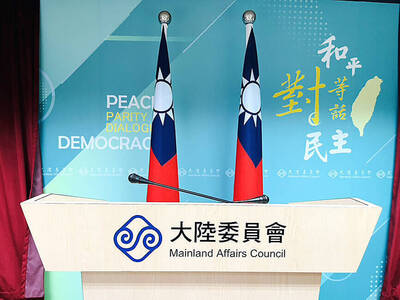
RISKY BUSINESS: The ‘incentives’ include initiatives that get suspended for no reason, creating uncertainty and resulting in considerable losses for Taiwanese, the MAC said China’s “incentives” failed to sway sentiment in Taiwan, as willingness to work in China hit a record low of 1.6 percent, a Ministry of Labor survey showed. The Directorate-General of Budget, Accounting and Statistics (DGBAS) also reported that the number of Taiwanese workers in China has nearly halved from a peak of 430,000 in 2012 to an estimated 231,000 in 2024. That marked a new low in the proportion of Taiwanese going abroad to work. The ministry’s annual survey on “Labor Life and Employment Status” includes questions respondents’ willingness to seek employment overseas. Willingness to work in China has steadily declined from
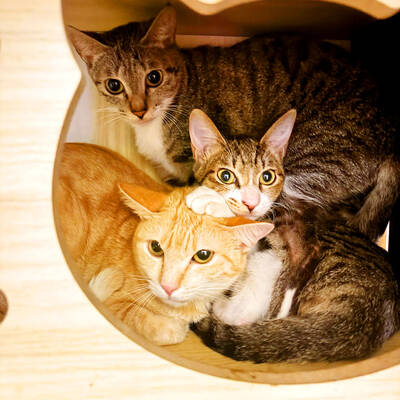
The number of pet cats in Taiwan surpassed that of pet dogs for the first time last year, reaching 1,742,033, a 32.8 percent increase from 2023, the Ministry of Agriculture said yesterday, citing a survey. By contrast, the number of pet dogs declined slightly by 1.2 percent over the same period to 1,462,528, the ministry said. Despite the shift, households with dogs still slightly outnumber those with cats by 1.2 percent. However, while the number of households with multiple dogs has remained relatively stable, households keeping more than two cats have increased, contributing to the overall rise in the feline population. The trend

LEVERAGE: China did not ‘need to fire a shot’ to deny Taiwan airspace over Africa when it owns ‘half the continent’s debt,’ a US official said, calling it economic warfare The EU has raised concerns about overflight rights following the delay of President William Lai’s (賴清德) planned state visit to the Kingdom of Eswatini after three African nations denied overflight clearance for his charter at the last minute. Taiwanese allies Paraguay and Saint Kitts and Nevis, as well as several US lawmakers and the Inter-Parliamentary Alliance on China (IPAC) condemned China for allegedly pressuring the countries. Lai was scheduled to fly directly to Taiwan’s only African ally from yesterday to Sunday to celebrate the 40th anniversary of King Mswati III’s accession and his 58th birthday, but Seychelles, Mauritius and Madagascar suddenly revoked


 RSS
RSS