


China yesterday bristled after Western nations lined up to impose sanctions over its crackdown on Uighur Muslims in Xinjiang, the first concerted international action against Beijing since US President Joe Biden took office.
Rights groups believe at least 1 million Uighurs and other mostly Muslim minorities have been incarcerated in camps in the northwestern region, where China is also accused of forcibly sterilizing women and imposing forced labor.
Beijing has strongly denied the allegations and says training programs, work schemes and better education have helped stamp out extremism in the region.
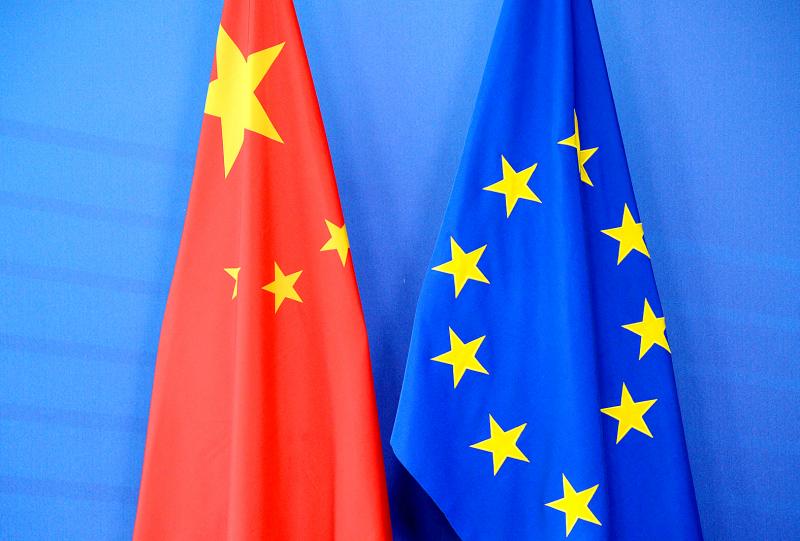
Photo: Reuters
On Monday, the EU, the UK and Canada blacklisted four former and current officials in the Xinjiang region, while the US, which had already sanctioned two of those officials in July last year, added the other pair to the list.
New Zealand and Australia yesterday welcomed the measures, but both stopped short of introducing their own on China, a major export market for their goods.
Beijing snapped back immediately, announcing entry bans on 10 Europeans — including five members of the European Parliament — as well as two EU bodies and two think tanks.
The head of the EU delegation, as well as the British ambassador to China, have been summoned by the Chinese Ministry of Foreign Affairs as Beijing goes into attack mode, accusing the West of “lies” and “fabrications” over Xinjiang, and downplaying the impact of the coordinated action.
“Frankly ... we are not worried at all,” Chinese foreign ministry spokeswoman Hua Chunying (華春瑩) told reporters.
“We urge others not to underestimate the firm will of the Chinese people to defend their national interests and national dignity,” she said, adding those who do “will eventually pay for their stupidity and arrogance.”
Still, the unified move to sanction the officials signaled a possible watershed in the diplomatic approach toward China.
The British Foreign, Commonwealth and Development Office said the sanctions were “the clearest possible signal that the international community is united in its condemnation of China’s human rights violations in Xinjiang.”
US Secretary of State Antony Blinken said China “continues to commit genocide and crimes against humanity in Xinjiang,” and called on Beijing to “bring an end to the repression of Uighurs.”
The sanctions, whose impact is mainly symbolic, mark the first time Brussels and London have targeted China over accusations of widespread abuses and forced labor in Xinjiang.
China’s tit-for-tat sanctions drew condemnation from the EU.
Reinhard Butikofer, a German legislator targeted by the sanctions, said the response was “brazen and ridiculous”.
The EU faces a delicate balancing act over relations with China, as it treats Beijing as a rival, but also a potential economic partner.
Late last year, Brussels sealed a major investment accord with China after seven years of negotiations.
The pact has to be approved by the European Parliament, but there has been growing opposition to signing off on the deal.

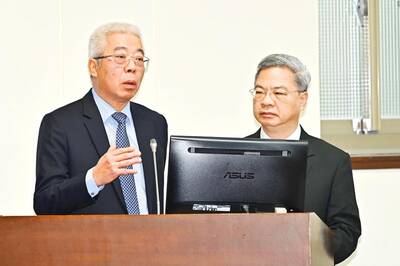
Taiwan has arranged for about 8 million barrels of crude oil, or about one-third of its monthly needs, to be shipped from the Red Sea this month to bypass the Strait of Hormuz and ease domestic supply pressures, CPC Corp, Taiwan (CPC, 台灣中油) said yesterday. The state-run oil company has worked with Middle Eastern suppliers to secure routes other than the Strait of Hormuz, through which about 20 percent of the world’s oil and liquefied natural gas typically passes, CPC chairman Fang Jeng-zen (方振仁) said at a meeting of the legislature’s Economics Committee in Taipei. Suppliers in Saudi Arabia have indicated they
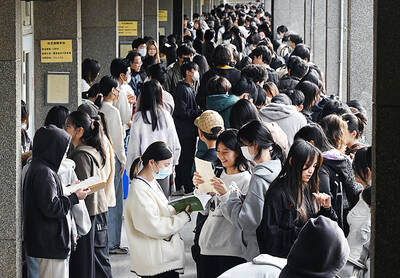
A global survey showed that 60 percent of Taiwanese had attained higher education, second only to Canada, the Ministry of the Interior said. Taiwan easily surpassed the global average of 43 percent and ranked ahead of major economies, including Japan, South Korea and the US, data from the Organisation for Economic Co-operation and Development (OECD) for 2024 showed. Taiwan has a high literacy rate, data released by the ministry showed. As of the end of last year, Taiwan had 20.617 million people aged 15 or older, accounting for 88.5 percent of the total population, with a literacy rate of 99.4 percent, the data
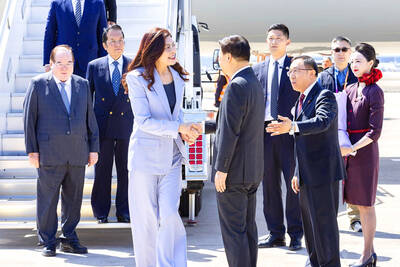
CCP ‘PAWN’? Beijing could use the KMT chairwoman’s visit to signal to the world that many people in Taiwan support the ‘one China’ principle, an academic said Chinese Nationalist Party (KMT) Chairwoman Cheng Li-wun (鄭麗文) yesterday arrived in China for a “peace” mission and potential meeting with Chinese President Xi Jinping (習近平), while a Taiwanese minister detailed the number of Chinese warships currently deployed around the nation. Cheng is visiting at a time of increased Chinese military pressure on Taiwan, as the opposition-dominated Legislative Yuan stalls a government plan for US$40 billion in extra defense spending. Speaking to reporters before going to the airport, Cheng said she was going on a “historic journey for peace,” but added that some people felt uneasy about her trip. “If you truly love Taiwan,

NEW LOW: The council in 2024 based predictions on a pessimistic estimate for the nation’s total fertility rate of 0.84, but last year that rate was 0.69, 17 percent lower An expected National Development Council (NDC) report expects the nation’s population to drop below 12 million by 2065, with the old-age dependency ratio to top 100 percent sooner than 2070, sources said yesterday. The council is slated to release its latest population projections in August, using an ultra-low fertility model, the sources said. The previous report projected that Taiwan’s population would fall to 14.37 million by 2070, but based on a new estimate of the total fertility rate (TFR) — the average number of children born to a woman over her lifetime — the population is expected to reach 12 million by


 RSS
RSS