


The National Health Research Institutes (NHRI) yesterday said that a new cancer drug delivery system — DBPR115 — developed by an affiliated institute has obtained approval from the US Food and Drug Administration as an investigational new drug that can enter phase 1 clinical trials.
The NHRI said that the delivery system was developed by researchers at its Institute of Biotechnology and Pharmaceutical Research (IBPR), supported by the Ministry of Economic Affairs’ Department of Industrial Technology, under the government’s technology development program.
IBPR Director Chang Jang-yang (張俊彥) said that drugs can be used to treat cancer cells, but high doses often cause severe side effects, as they can also damage normal cells.
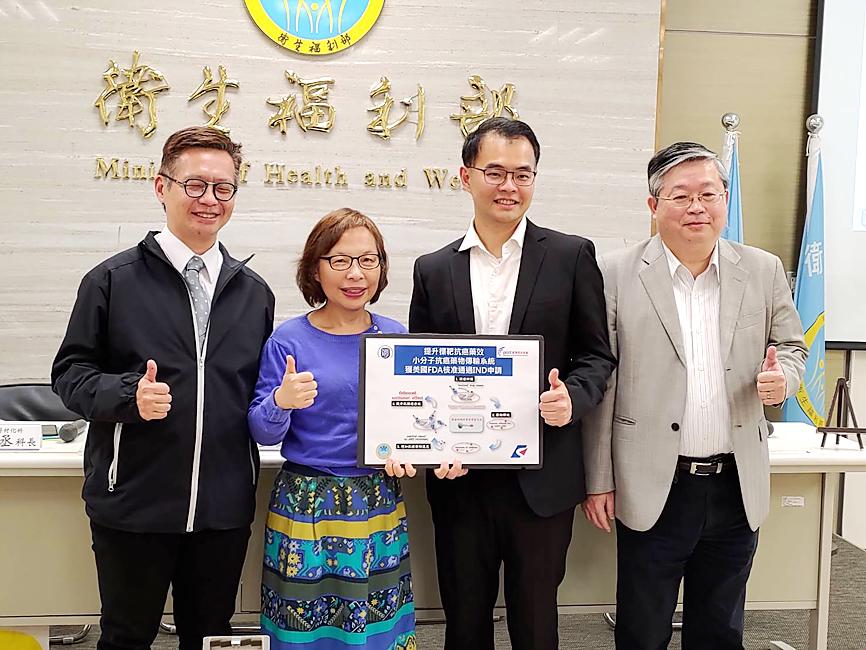
Photo: Wu Liang-yi, Taipei Times
The new system more effectively delivers drugs to targeted cancer cells, reducing the side effects, Chang said.
Using as an example irinotecan — a drug used to treat colon, rectal or pancreatic cancer — the new system can deliver 20 percent of the original dosage of the drug to achieve the same therapeutic effect, he said.
Many existing targeted drug therapies use drugs combined with monoclonal antibodies, which can identify and attack cells that have particular types of antigen, but sometimes antigen shedding by the cancer cells can reduce the delivery efficiency of the antibody-based drugs, IBPR associate investigator Tsou Lun (鄒倫) said.
The new delivery system uses a small molecule to replace the antibody and bind it to the drug, delivering it to targeted cancer sites more efficiently, increasing drug concentration at targeted tumor sites for a better therapeutic effect with reduced side effects, Tsou said.
The small molecule drug delivery system can also enhance the drug’s ability to recognize signals from cancer cells more effectively, he said.

OPTIMISTIC: The DGBAS sharply upgraded its GDP growth estimate from 3.54 percent to 7.71 percent after the Taiwan-US trade agreement signing and given AI optimism The US imported more from Taiwan than China for the first time in decades, as US President Donald Trump’s tariffs reshape trade flows while a global boom in artificial intelligence (AI) fuels demand for tech products. US purchases of goods from China plunged almost 44 percent in December last year from 2024 to US$21.1 billion, US Department of Commerce data showed on Thursday. By contrast, shipments from Taiwan more than doubled during the same period to US$24.7 billion. The soaring Taiwanese shipments to the US reflect the huge expansion in supplies of chips and servers for AI companies, which has completely changed
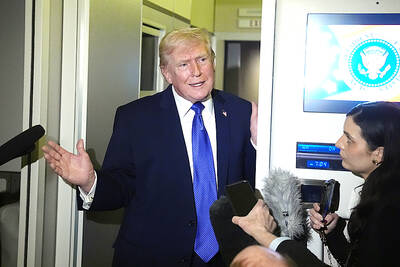
NON-NEGOTIABLE: The US president’s action ran counter to one of the US’ ‘six assurances’ on not consulting China about arms sales to Taiwan, US lawmakers said US President Donald Trump’s admission that he is discussing arms sales to Taiwan with Chinese President Xi Jinping (習近平) is “alarming and a blatant violation of US policy and the six assurances,” US Representative Ro Khanna said on Tuesday. Trump on Monday said he would decide soon on whether to send more weapons to Taiwan, after Xi warned him not to do so. “I’m talking to him about it. We had a good conversation, and we’ll make a determination pretty soon,” Trump told reporters aboard Air Force One when asked about warnings raised by Beijing during a phone call with Xi over
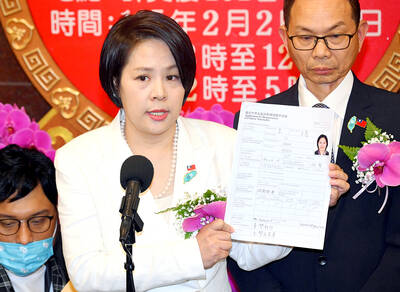
The Central Election Commission has amended election and recall regulations to require elected office candidates to provide proof that they have no Chinese citizenship, a Cabinet report said. The commission on Oct. 29 last year revised the Measures for the Permission of Family-based Residence, Long-term Residence and Settlement of People from the Mainland Area in the Taiwan Area (大陸地區人民在台灣地區依親居留長期居留或定居許可辦法), the Executive Yuan said in a report it submitted to the legislature for review. The revision requires Chinese citizens applying for permanent residency to submit notarial documents showing that they have lost their Chinese household record and have renounced — or have never
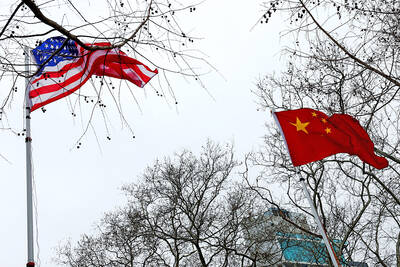
US and Chinese fighter jets briefly faced off above waters near the Korean Peninsula this week, Yonhap News agency reported, marking a rare confrontation in that area between the two superpowers. About 10 US fighter jets on Wednesday departed an airbase in Pyeongtaek, South Korea, for drills above international waters off South Korea’s western coast, the news outlet cited unidentified military sources as saying. While the US planes did not enter China’s air defense identification zone, Beijing scrambled planes as they neared that region, the report said. “The Chinese People’s Liberation Army organized naval and air forces to monitor and effectively respond


 RSS
RSS