


Beijing’s move to amend Hong Kong election laws contravenes promises made by China and undermines its credibility for any future agreements, Mainland Affairs Council (MAC) Minister Chiu Tai-san (邱太三) said yesterday.
By a vote of 2,895-0, with one abstention, the Chinese National People’s Congress on Thursday passed a proposal giving a pro-Beijing committee power to appoint more of Hong Kong’s lawmakers, reducing the proportion of those directly elected, and ensuring that only those determined to be “patriots” would be allowed to run for office.
Many see the proposal as effectively ending the territory’s already weakened local democracy.
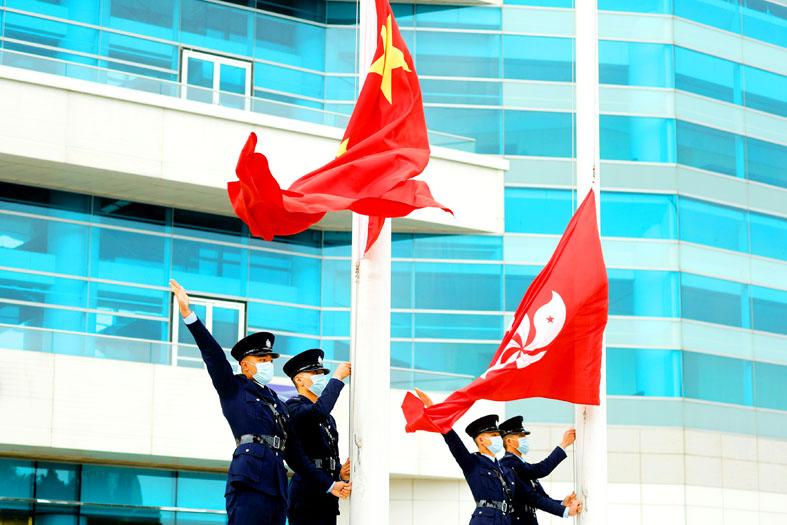
Photo: Reuters
Chiu said the move contravenes Hong Kongers’ wish for general elections, adding that the process of having a committee review and nominate lawmakers goes against the principle of democratic elections.
China’s attempt to impose its will and define the political framework for Hong Kong severely undermines its touted “one country, two systems” model for Hong Kong and it undercuts Chinese credibility for any political promises given, Chiu added.
“Taiwanese will have to reassess all promises made by China and consider its trustworthiness,” Chiu said.
The Democratic Progressive Party expressed regret that Beijing had reneged on its promises under the “one country, two systems” model, party spokesperson Hsieh Pei-fen (謝佩芬) said.
China should be condemned for seeking to undermine and smother vibrant democratic movements in Hong Kong through institutional changes, she added.
Chinese Nationalist Party (KMT) Chairman Johnny Chiang (江啟臣) also expressed regret over the decision.
Beijing must ensure the freedom and democratization of Hong Kong if it wishes to win the “hearts and minds” of Hong Kongers, he said.
Former president Ma Ying-jeou (馬英九) said that China’s actions have officially put to rest the “one country, two systems” model proposed by former Chinese leader Deng Xiaoping (鄧小平) in 1984.
It is regrettable to see China tell the world with its actions that the model is dead, he said.
Additional reporting by Shih Hsiao-kuang and agencies

CREDIT-GRABBER: China said its coast guard rescued the crew of a fishing vessel that caught fire, who were actually rescued by a nearby Taiwanese boat and the CGA Maritime search and rescue operations do not have borders, and China should not use a shipwreck to infringe upon Taiwanese sovereignty, the Coast Guard Administration (CGA) said yesterday. The coast guard made the statement in response to the China Coast Guard (CCG) saying it saved a Taiwanese fishing boat. The Chuan Yu No. 6 (全漁6號), a fishing vessel registered in Keelung, on Thursday caught fire and sank in waters northeast of Diaoyutai Islands (釣魚台). The vessel left Keelung’s Badouzih Fishing Harbor (八斗子漁港) at 3:35pm on Sunday last week, with seven people on board — a 62-year-old Taiwanese captain surnamed Chang (張) and six
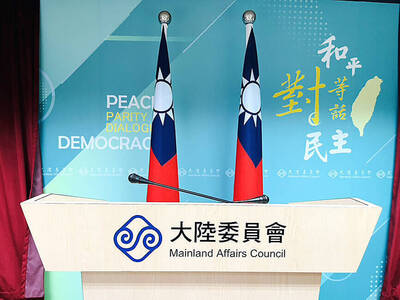
RISKY BUSINESS: The ‘incentives’ include initiatives that get suspended for no reason, creating uncertainty and resulting in considerable losses for Taiwanese, the MAC said China’s “incentives” failed to sway sentiment in Taiwan, as willingness to work in China hit a record low of 1.6 percent, a Ministry of Labor survey showed. The Directorate-General of Budget, Accounting and Statistics (DGBAS) also reported that the number of Taiwanese workers in China has nearly halved from a peak of 430,000 in 2012 to an estimated 231,000 in 2024. That marked a new low in the proportion of Taiwanese going abroad to work. The ministry’s annual survey on “Labor Life and Employment Status” includes questions respondents’ willingness to seek employment overseas. Willingness to work in China has steadily declined from

The Legislative Yuan’s Finance Committee yesterday approved proposed amendments to the Amusement Tax Act (娛樂稅法) that would abolish taxes on films, cultural activities and competitive sporting events, retaining the fee only for dance halls and golf courses. The proposed changes would set the maximum tax rate for dance halls and golf courses at 50 and 20 percent respectively, with local governments authorized to suspend the levies. Article 2 of the act says that “amusement tax shall be levied on tickets sold or fees charged by amusement places, facilities or activities” in six categories: “Cinema; professional singing, story-telling, dancing, circus, magic show, acrobatics
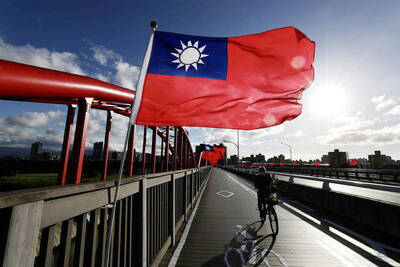
INFLATION UP? The IMF said CPI would increase to 1.5 percent this year, while the DGBAS projected it would rise to 1.68 percent, with GDP per capita of US$44,181 The IMF projected Taiwan’s real GDP would grow 5.2 percent this year, up from its 2.1 percent outlook in January, despite fears of global economic disruptions sparked by the US-Iran conflict. Taiwan’s consumer price index (CPI) is projected to increase to 1.5 percent, while unemployment would be 3.4 percent, roughly in line with estimates for Asia as a whole, the international body wrote in its Global Economic Outlook Report published in the US on Monday. The figures are comparatively better than the IMF outlook for the rest of the world, which pegged real GDP growth at 3.1 percent, down from 3.3 percent


 RSS
RSS