


Taiwan’s domestically developed COVID-19 vaccines could start mass production in July, but only if they successfully complete ongoing clinical trials, Minister of Health and Welfare Chen Shih-chung (陳時中) said yesterday.
Speaking to reporters before a legislative hearing in Taipei, Chen said that Taiwanese vaccines could hopefully enter production in July at the earliest.
Taiwan is making progress in its vaccine development, after Medigen Vaccine Biologics Corp (高端疫苗) and United Biomedical Inc (聯亞生技) were approved to enter the second phase of clinical trials in late December last year and January respectively.
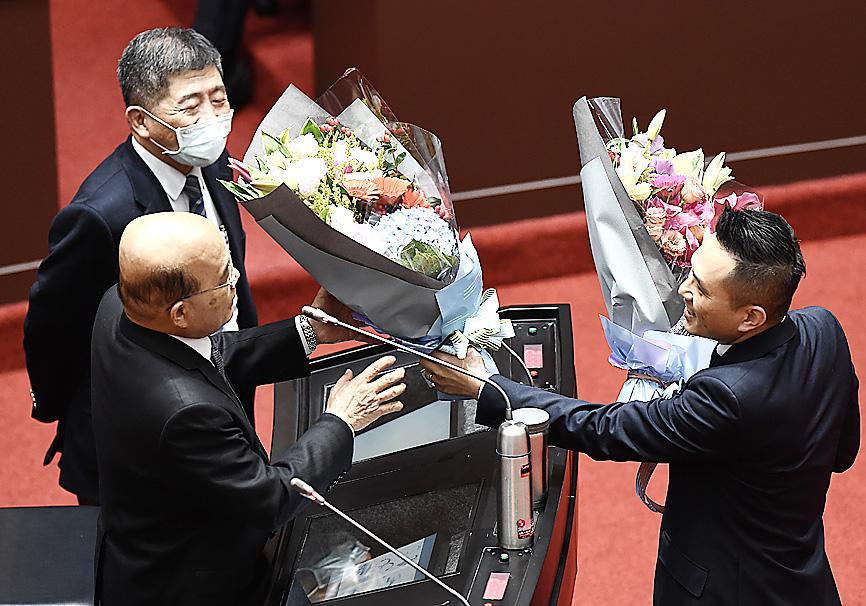
Photo: Chien Jung-fong, Taipei Times
Medigen in January said it planned to recruit at least 3,700 participants for trials, while working with 11 hospitals, on its vaccine, MVC-COV1901, which was developed with the US National Institutes of Health.
The company received NT$1.7 million (US$60,122) in government subsidies for its phase 1 trials and was to receive another NT$300 million for its phase 2 trials.
United Biomedical in late January said it would recruit 3,850 volunteers for phase 2 trials of its vaccine candidate, UB-612, a multitope protein/peptide-based vaccine.
Asked whether President Tsai Ing-wen (蔡英文), Premier Su Tseng-chang (蘇貞昌) and Chen would be among the first to receive the AstraZeneca COVID-19 vaccine, Chen said that if there is any public hesitancy, they would be willing to volunteer to demonstrate the safety of the vaccine to those concerned about side effects.
However, Chen said he hoped that the vaccination program would proceed in accordance with the government’s priority list.
The minister’s comments came after 117,000 doses of the AstraZeneca COVID-19 vaccine, purchased directly from the company, arrived in Taiwan on Wednesday.
No new COVID-19 cases were reported yesterday.
To date, Taiwan has recorded 960 cases of COVID-19, 844 of which have been classified as imported. Of the total, 928 people have recovered, nine have died, and 23 are in hospital, according to CECC statistics.

OPTIMISTIC: The DGBAS sharply upgraded its GDP growth estimate from 3.54 percent to 7.71 percent after the Taiwan-US trade agreement signing and given AI optimism The US imported more from Taiwan than China for the first time in decades, as US President Donald Trump’s tariffs reshape trade flows while a global boom in artificial intelligence (AI) fuels demand for tech products. US purchases of goods from China plunged almost 44 percent in December last year from 2024 to US$21.1 billion, US Department of Commerce data showed on Thursday. By contrast, shipments from Taiwan more than doubled during the same period to US$24.7 billion. The soaring Taiwanese shipments to the US reflect the huge expansion in supplies of chips and servers for AI companies, which has completely changed
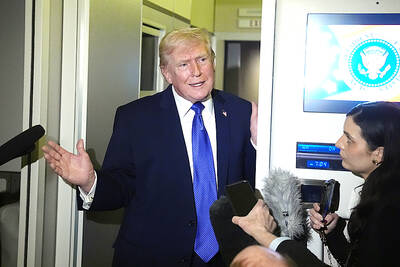
NON-NEGOTIABLE: The US president’s action ran counter to one of the US’ ‘six assurances’ on not consulting China about arms sales to Taiwan, US lawmakers said US President Donald Trump’s admission that he is discussing arms sales to Taiwan with Chinese President Xi Jinping (習近平) is “alarming and a blatant violation of US policy and the six assurances,” US Representative Ro Khanna said on Tuesday. Trump on Monday said he would decide soon on whether to send more weapons to Taiwan, after Xi warned him not to do so. “I’m talking to him about it. We had a good conversation, and we’ll make a determination pretty soon,” Trump told reporters aboard Air Force One when asked about warnings raised by Beijing during a phone call with Xi over
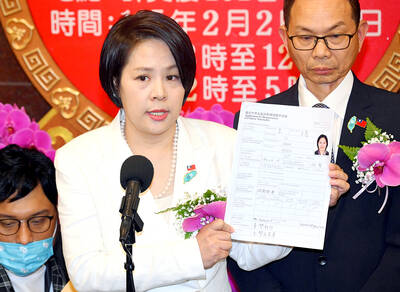
The Central Election Commission has amended election and recall regulations to require elected office candidates to provide proof that they have no Chinese citizenship, a Cabinet report said. The commission on Oct. 29 last year revised the Measures for the Permission of Family-based Residence, Long-term Residence and Settlement of People from the Mainland Area in the Taiwan Area (大陸地區人民在台灣地區依親居留長期居留或定居許可辦法), the Executive Yuan said in a report it submitted to the legislature for review. The revision requires Chinese citizens applying for permanent residency to submit notarial documents showing that they have lost their Chinese household record and have renounced — or have never
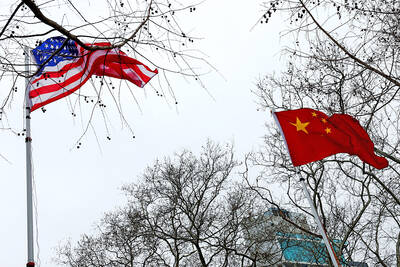
US and Chinese fighter jets briefly faced off above waters near the Korean Peninsula this week, Yonhap News agency reported, marking a rare confrontation in that area between the two superpowers. About 10 US fighter jets on Wednesday departed an airbase in Pyeongtaek, South Korea, for drills above international waters off South Korea’s western coast, the news outlet cited unidentified military sources as saying. While the US planes did not enter China’s air defense identification zone, Beijing scrambled planes as they neared that region, the report said. “The Chinese People’s Liberation Army organized naval and air forces to monitor and effectively respond


 RSS
RSS