


The Ministry of Economic Affairs yesterday said that it has tightened control on Chinese investments in Taiwan due to national security concerns, following in the steps of countries such as the US and Japan.
Based on new regulations, Chinese military-owned companies and Chinese Communist Party-owned companies are banned from investing in Taiwan.
The regulations took effect yesterday, the ministry said.
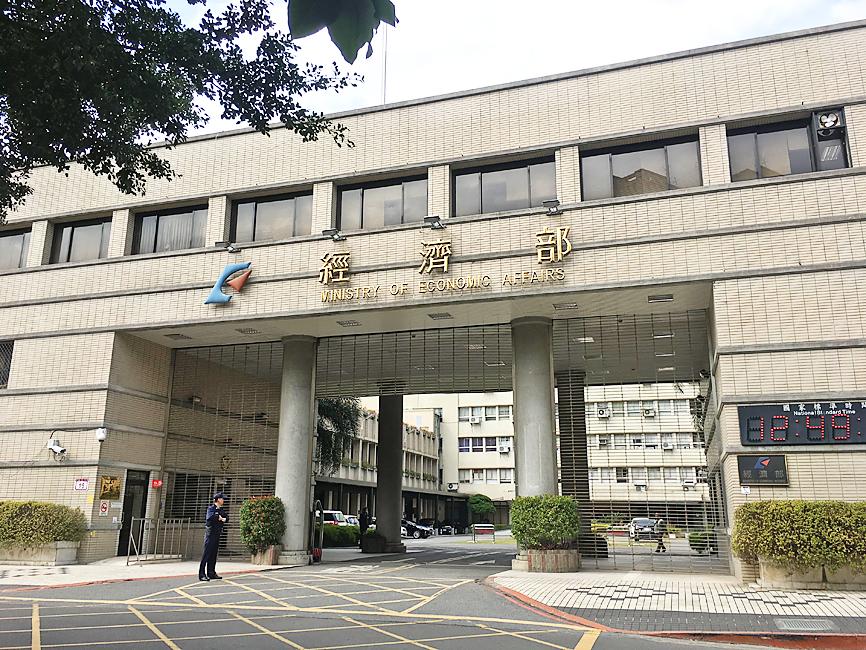
Photo: Huang Pei-chun, Taipei Times
There is a worldwide trend of scrutinizing investments from China more closely due to concerns that China could gain access to key technologies and information, Investment Commission spokesman Su Chi-yen (蘇琪彥) said.
“The US, Germany, Japan and Australia have all been regulating Chinese investments more strictly, not just Taiwan,” Su said. “Protecting business intelligence is a matter of national security.”
Articles 3, 4 and 6 of the Measures Governing Investment Permits to the People of the Mainland Area (大陸地區人民來台投資許可辦法) have been changed to expand the definition of Chinese capital to close loopholes that could be used by companies seeking to skirt regulations.
Article 3 has been updated to consider funds from any company with more than 30 percent Chinese capital to be wholly Chinese owned as far as its subsidiaries are concerned, rather than 40 percent under the previous rules.
Another change in Article 3 targets “material control.” Under the old rules, a board of directors had to be made up of less than 50 percent Chinese nationals to be considered a non-Chinese company. Now the rule extends to any other organizations that might be in material control of the company.
“There have been examples of companies where the real decisionmakers are not on the board, but on an ‘executive committee’ that is technically under the board. Now those organizations are covered by the law,” Su said.
Article 4 has expanded the definition of “investment” to cover any purchase of Taiwanese companies or assets by a Chinese company, even in the absence of a stock deal.
“If the percentage of investment is very low, we would tell the company to keep us apprised of any changes in their ownership structure. If it is higher, then those companies would be barred from sensitive industries,” Su said.
“Chinese companies are restricted to investing in non-sensitive sectors such as retail and wholesale,” Su said.
Not only are technically advanced sectors such as IC design and telecoms off limits, but Chinese companies are also banned from investing in advertising and cultural industries due to “the unique dynamics of the cross-strait relationship,” Su said.
Any company found to be in contravention of the regulations would have to pay a maximum fine of NT$25 million and divest immediately, Su said.
The ministry also announced an amendment to the Regulations Governing Investment or Technical Cooperation in the Mainland Area (在大陸地區從事投資或技術合作許可辦法), tightening control of Taiwanese technology and intellectual property (IP) going to China.
“Selling or licensing Taiwanese technology or IP will now be considered ‘technical cooperation’ and must be approved in advance,” the ministry said in a release.
“This includes indirect technical cooperation through a third country,” it said, adding that the scope of the sectors targeted has also been widened from the IC sector to any “specialist technology.”
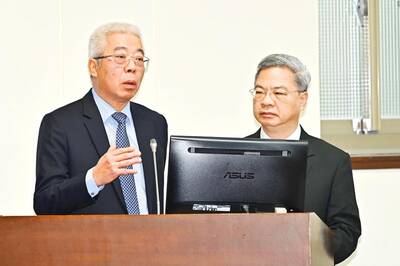
Taiwan has arranged for about 8 million barrels of crude oil, or about one-third of its monthly needs, to be shipped from the Red Sea this month to bypass the Strait of Hormuz and ease domestic supply pressures, CPC Corp, Taiwan (CPC, 台灣中油) said yesterday. The state-run oil company has worked with Middle Eastern suppliers to secure routes other than the Strait of Hormuz, through which about 20 percent of the world’s oil and liquefied natural gas typically passes, CPC chairman Fang Jeng-zen (方振仁) said at a meeting of the legislature’s Economics Committee in Taipei. Suppliers in Saudi Arabia have indicated they
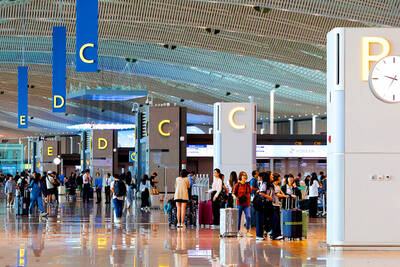
South Korea has adjusted its electronic arrival card system to no longer list Taiwan as a part of China, a move that the Ministry of Foreign Affairs said would help facilitate exchanges between the two sides. South Korea previously listed “Taiwan” as “Taiwan (China)” in the drop-down menus of its online arrival card system, where people had to fill out where they came from and their next destination. The ministry had requested South Korea make a revision and said it would change South Korea’s name on Taiwan’s online immigration system from “Republic of Korea” to “Korea (South),” should the issue not be
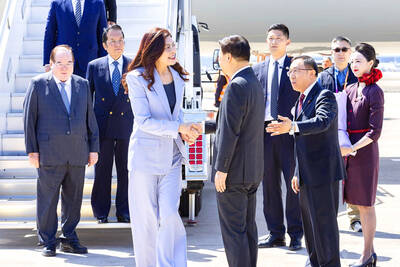
CCP ‘PAWN’? Beijing could use the KMT chairwoman’s visit to signal to the world that many people in Taiwan support the ‘one China’ principle, an academic said Chinese Nationalist Party (KMT) Chairwoman Cheng Li-wun (鄭麗文) yesterday arrived in China for a “peace” mission and potential meeting with Chinese President Xi Jinping (習近平), while a Taiwanese minister detailed the number of Chinese warships currently deployed around the nation. Cheng is visiting at a time of increased Chinese military pressure on Taiwan, as the opposition-dominated Legislative Yuan stalls a government plan for US$40 billion in extra defense spending. Speaking to reporters before going to the airport, Cheng said she was going on a “historic journey for peace,” but added that some people felt uneasy about her trip. “If you truly love Taiwan,

Tainan, Taipei and New Taipei City recorded the highest fines nationwide for illegal accommodations in the first quarter of this year, with fines issued in the three cities each exceeding NT$7 million (US$220,639), Tourism Administration data showed. Among them, Taipei had the highest number of illegal short-term rental units, with 410. There were 3,280 legally registered hotels nationwide in the first quarter, down by 14 properties, or 0.43 percent, from a year earlier, likely indicating operators exiting the market, the agency said. However, the number of unregistered properties rose to 1,174, including 314 illegal hotels and 860 illegal short-term rental


 RSS
RSS