


The Taiwan External Trade Development Council (TAITRA) and the American Institute in Taiwan (AIT) yesterday issued a joint statement on security supply chains, saying that they would augment consultations and cooperation, especially in the information and communications technology (ICT) and medical sectors, and ensure that “supply chains are secure and free from political coercion.”
The partnership would focus on encouraging partners to bring supply chains closer to home or like-minded economies, and to develop new supply chains based on shared values, the statement read.
“Developing supply chain resilience in like-minded priority regions, such as India, ASEAN and the Visegrad Group, which will collectively reinforce the Taiwan New Southbound Policy and US Indo-Pacific strategy” will be one of the partnership’s goals, it read.
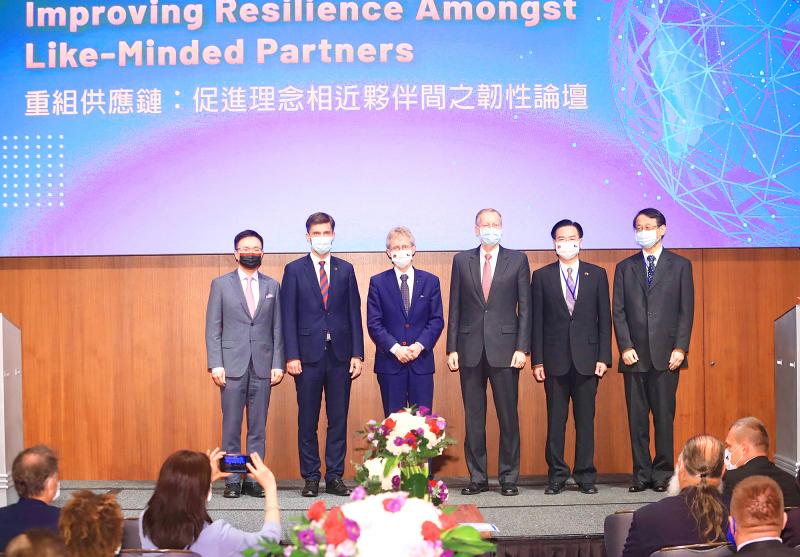
Photo: CNA
The joint statement was issued following the Forum on Supply Chain Restructuring: Improving Resilience Amongst Like-Minded Partners hosted by the AIT at the Shangri-La Hotel in Taipei.
At the forum, envoys of the US, Europe and Japan, as well as a Czech delegation visiting Taipei, expressed their support for restructuring a global supply chain based on the values of democracy, free markets and respect for intellectual property (IP) rights.
In his opening remarks, AIT Director Brent Christensen told the Czech delegation that the AIT and Taiwan’s representative office in the US last week issued a declaration on 5G security that echoes last year’s Prague Proposals.
Czech Senate President Milos Vystrcil and his delegation’s visit to Taipei has highlighted Taiwan’s significance in so many areas “that are vital to our future prosperity and national security,” Christensen said.
Supply chain resiliency is just one of the areas in which Taiwan is to play a key role in the post-COVID-19 era, he added.
Taiwanese firms are leading industry players that helped to develop ICT and other supply chains in China more than 30 years ago, but Taiwanese firms adhere to the rule of law and protect intellectual property, he said.
COVID-19 has exposed the risk of overreliance on a single country or supplier for critical materials such as medical supplies or pharmaceuticals, Minister of Foreign Affairs Joseph Wu (吳釗燮) said.
In his speech, on the final day of the delegation’s visit, Vystrcil endorsed the values of freedom, democracy and an open economy, while highlighting the importance of seeking like-minded suppliers in strategic sectors, such as medical supplies.
European Economic and Trade Office Director Filip Grzegorzewski, Japan-Taiwan Exchange Association Representative Hiroyasu Izumi and TAITRA Chairman James Huang (黃志芳) also attended the forum.
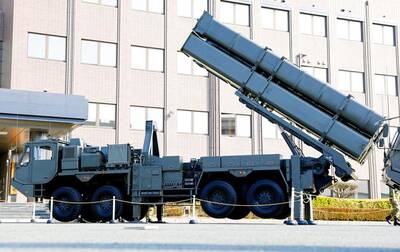
Japan has deployed long-range missiles in a southwestern region near China, the Japanese defense minister said yesterday, at a time when ties with Beijing are at their lowest in recent years. The missiles were installed in Kumamoto in the southern region of Kyushu, as Japan is attempting to shore up its military capacity as China steps up naval activity in the East China Sea. “Standoff defense capabilities enable us to counter the threat of enemy forces attempting to invade our country ... while ensuring the safety of our personnel,” Japanese Minister of Defense Shinjiro Koizumi said. “This is an extremely important initiative for
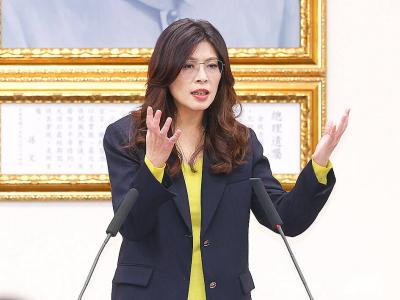
Chinese Nationalist Party (KMT) Chairwoman Cheng Li-wun (鄭麗文) today accepted an invitation from Chinese President Xi Jinping (習近平) to lead a delegation to China next month, saying she hopes to promote the peaceful development of cross-strait relations and bring stability to the Taiwan Strait. “I am grateful and happy to accept this invitation,” Cheng said in a statement from the KMT chairperson’s office. Cheng said she hopes both sides can work together to promote the peaceful development of cross-strait relations, enhance exchange and cooperation, bring stability to the Taiwan Strait and improve people’s livelihoods. At today's news conference, Cheng said any efforts to
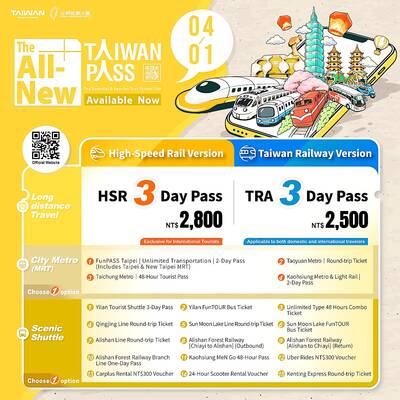
MORE POPULAR: Taiwan Pass sales increased by 59 percent during the first quarter compared with the same period last year, the Tourism Administration said The Tourism Administration yesterday said that it has streamlined the Taiwan Pass, with two versions available for purchase beginning today. The tourism agency has made the pass available to international tourists since 2024, allowing them to access the high-speed rail, Taiwan Railway Corp services, four MRT systems and four Taiwan Tourist Shuttles. Previously, five types of Taiwan Pass were available, but some tourists have said that the offerings were too complicated. The agency said only two types of Taiwan Pass would be available, starting from a three-day pass with the high-speed rail and a three-day pass with Taiwan Railway Corp. The former costs NT$2,800

The nation’s fastest supercomputer, Nano 4 (晶創26), is scheduled to be launched in the third quarter, and would be used to train large language models in finance and national defense sectors, the National Center for High-Performance Computing (NCHC) said. The supercomputer, which would operate at about 86.05 petaflops, is being tested at a new cloud computing center in the Southern Taiwan Science Park in Tainan. The exterior of the server cabinet features chip circuitry patterns overlaid with a map of Taiwan, highlighting the nation’s central position in the semiconductor industry. The center also houses Taiwania 2, Taiwania 3, Forerunner 1 and


 RSS
RSS