


If Taiwan fails to curb its carbon dioxide emissions over the next 30 years, rising sea levels and storm surges would pose a threat to millions of residents in the six special municipalities, Greenpeace Taiwan said yesterday as it urged the central and local governments to take action.
The call came as the environmental group released a report on its analysis of the problems that Taiwan could face as the global sea level rises, warning that the seas around Taiwan are rising at twice the global average due to the nation’s location and influence from ocean currents.
Greenpeace climate and energy campaign director Lena Chang (張皪心) told a news conference in Taipei that the analysis showed that global warming has the potential to severely affect Taiwan, but it is not just the central government that needs to take action, but also the mayors of the six cities.
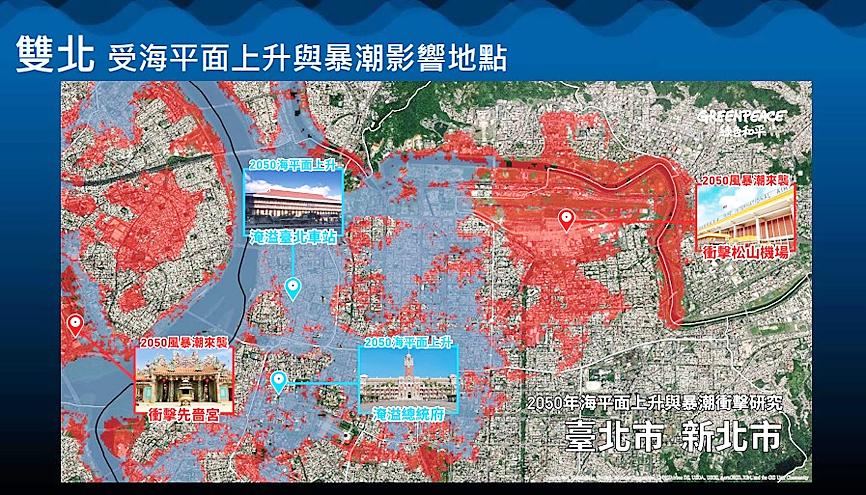
Photo courtesy of Greenpeace Taiwan
The special municipalities account for more than 70 percent of Taiwan’s population, “so their mayors have a responsibility to protect their residents’ lives and property from threats,” she said.
Typhoons and tropical storms would cause sea levels to rise further, and strong winds brought by such systems can cause storm surges, in which seawater flows inland, the report said.
Taiwan suffered storm surge damage during Typhoon Dujuan in 2015 and Typhoon Megi in 2016, which led to flooding in multiple locations across the nation, it added.
Citing sea-level research conducted by the US-based non-profit organization Climate Central, the report said 1,398km2 of Taiwan’s land mass would be inundated by seawater if no aggressive action is taken to curb carbon emissions before 2050.
This could affect 1.2 million people, while storm surges could expand the risk to more than 2.9 million residents in the special municipalities and swamp 2,120km2 of land, it said.
The affected building areas would be about the size of 500 Taipei Arenas, it added.
Simulations showed that the Presidential Office Building, Taipei International Airport (Songshan airport), Taipei Railway Station and the Taipei Children’s Amusement Park would be flooded, while Taichung’s Gaomei Wetlands and Mitsui Outlet in the Port of Taichung would bear the brunt of the flooding damage, the report said.
Tainan would see the worst damage, with floodwater submerging historic sites such as Fort Zealandia and the Sicao Fortress, it said.
Tourist attractions in Kaohsiung such as the Pier-2 Art Center, 85 Sky Tower and Kaohsiung Formosa Boulevard MRT Station would also be flooded, it said.
Mayors of the six municipalities should conduct comprehensive assessments on the climate risks that their cities could face, “such as identifying transportation hubs, historic sites and infrastructure that are most susceptible to climate change and planning city development accordingly,” the report said.
They should set carbon-cutting goals and ways to achieve them, including medium and long-term goals to develop renewable energy and a timeline to retire gasoline-powered motor vehicles, it added.
Additional reporting by staff writer
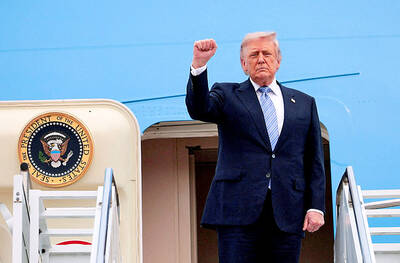
US-CHINA SUMMIT: MOFA welcomed US reassurance of no change in its Taiwan policy; Trump said he did not comment when Xi talked of opposing independence US President Donald Trump yesterday said he has not made a decision on whether to move forward with a major arms package for Taiwan after hearing concerns about it from Chinese President Xi Jinping (習近平). Trump’s comments on Taiwan came as he flew back to Washington after wrapping up critical talks in which both leaders said important progress was made in stabilizing US-China relations even as deep differences persist between the world’s two biggest powers on Iran and Taiwan. “I will make a determination,” Trump said, adding: “I’ll be making decisions. But, you know, I think the last thing we need right
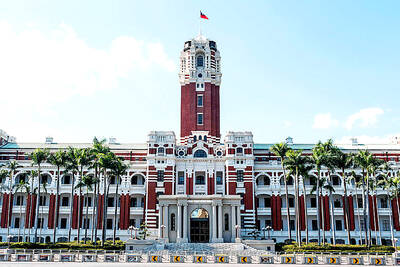
SECURITY: Taipei presses the US for arms supplies, saying the arms sales are not only a reflection of the US security commitment to Taiwan but also serve as a mutual deterrent against regional threats Taiwan is committed to preserving the cross-strait “status quo” and contributing to regional peace and stability, the Presidential Office said yesterday. “It is an undeniable fact that the Republic of China is a sovereign and independent democratic nation,” Presidential Office spokeswoman Karen Kuo (郭雅慧) reiterated, adding that Beijing has no right to claim sovereignty over Taiwan. The statements came after US President Donald Trump warned against Taiwanese independence. Trump wrapped up a state visit to Beijing on Friday, during which Chinese President Xi Jinping (習近平) had pressed him not to support Taiwan. Taiwan depends heavily on US security backing to deter China from carrying
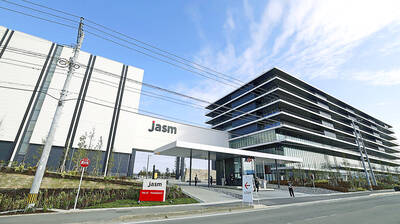
The subsidiary of Taiwan Semiconductor Manufacturing Co (TSMC, 台積電) in Kumamoto, Japan, turned a profit in the first quarter of this year, marking the first time the first fab of the unit has become profitable since mass production started at the end of 2024. According to the contract chipmaker’s financial statement released on Friday, Japan Advanced Semiconductor Manufacturing Inc (JASM), a joint venture running the fab in Kumamoto, posted NT$951 million (US$30.19 million) in profit in the January-to-March period, compared with a loss of NT$1.39 billion in the previous quarter, and a loss of NT$3.25 billion in the first quarter of
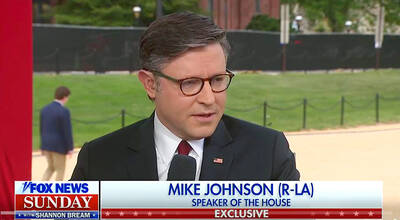
RESOLUTE BACKING: Two Republican senators are planning to introduce legislation that would impose immediate sanctions on China if it attempts to invade Taiwan US House of Representatives Speaker Mike Johnson on Sunday reaffirmed US congressional support for Taiwan, saying the US and “all freedom-loving people” have a stake in preventing China from seizing Taiwan by force. Johnson made the remarks in an interview with Fox News Sunday on US President Donald Trump’s summit with Chinese President Xi Jinping (習近平) last week. In an interview that aired on Friday on Fox News, just as Trump wrapped up a high-stakes visit to China, he said he has yet to green-light a new US$14 billion arms package to Taiwan and that it “depends on China.” “It’s a very good


 RSS
RSS