


US lawmakers and officials are crafting proposals to push US companies to move operations or key suppliers out of China that include tax breaks, new rules and carefully structured subsidies.
Interviews with a dozen current and former government officials, industry executives and members of Congress show widespread discussions underway — including the idea of a “reshoring fund” originally stocked with US$25 billion — to encourage US companies to drastically revamp their relationship with China.
US President Donald Trump has long pledged to bring manufacturing back from overseas, but the spread of COVID-19 and related concerns about US medical and food supply chains dependency on China are “turbocharging” new enthusiasm for the idea in the White House.
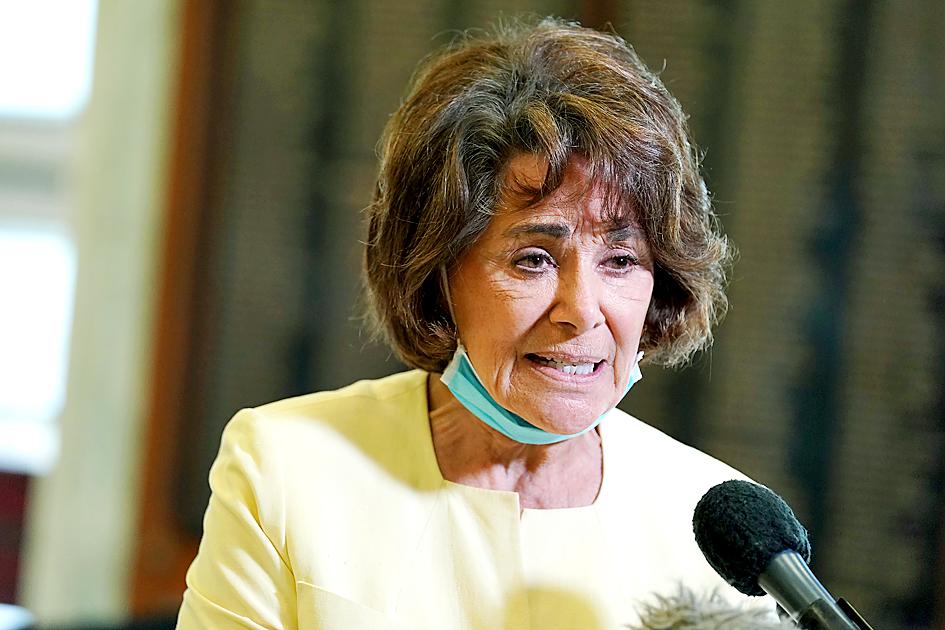
Photo: Bloomberg
Trump on Thursday signed an order that gave a US overseas investment agency new powers to help manufacturers in the US.
The goal is to “produce everything America needs for ourselves and then export to the world, and that includes medicines,” he said.
However, the administration remains divided over how best to proceed, and the issue is unlikely to be addressed in the next fiscal stimulus to offset the coronavirus downturn.
Both Republicans and Democrats are crafting bills to decrease US reliance on China-made products, which accounted for about 18 percent of imports last year.
“The whole subject of supply chains and integrity of supply chains ... does have a greater place in members’ minds,” US Representative Mac Thornberry, the top Republican on the US House of Representatives Armed Services Committee, said on May 7.
The medical supply chain and defense-related goods are top of the list.
“Coronavirus has been a painful wakeup call that we are too reliant on nations like China for critical medical supplies,” US Senator Lindsey Graham, a Republican, said on Friday.
He is expected to issue a new bill this week.
US Senator Josh Hawley, another Republican, is pushing for local content rules for medical supply chains, and “generous investment subsidies” to encourage increased domestic production of a range of goods and components.
US Senator Marco Rubio introduced a bill that would bar sale of some sensitive goods to China, and raise taxes on US companies’ income from China.
A bipartisan bill introduced by US Representative Anna Eschoo, a Democrat, and US Representative Susan Brooks, a Republican, would commission a panel to recommend ways to cut drug supply reliance on China.
US Representative Mark Green’s “SOS Act” proposes funding takeovers of vulnerable US firms critical to national security.
A controversial idea being floated would allocate as much as US$25 billion to firms that make essential goods to move production home, ensuring that even products far down the supply chain were sourced domestically, two administration officials said.
No lawmaker has publicly embraced it, but several congressional aides acknowledged it is part of the broader discussions.
However, given longstanding concerns about the government setting “industrial policy,” the notion of subsidizing industry directly is polarizing, even among Trump’s top advisers.
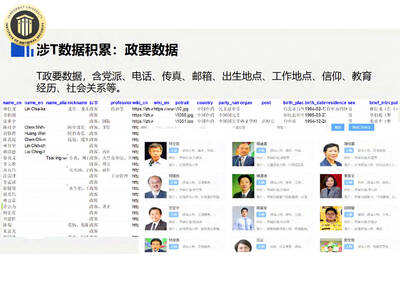
NETWORK-MAPPING PROJECT: The database contains 170 detailed files of Taiwanese politicians and about 23 million records of household registration data in Taiwan China has developed a network-mapping project targeting political figures and parties in Taiwan to monitor public opinion during elections and to craft tailored influence campaigns aimed at dividing Taiwanese society, according to documents leaked by Chinese technology firm GoLaxy (中科天璣). The documents, collected by Taipei-based Doublethink Lab, showed a database was specifically created to gather detailed information on Taiwanese political figures, including their political affiliations, job histories, birthplaces, residences, education, religion and a brief biography about them. Several notable Taiwanese politicians are in the database, including President William Lai (賴清德), former president Tsai Ing-wen (蔡英文), Minister of Foreign Affairs Lin Chia-lung (林佳龍),
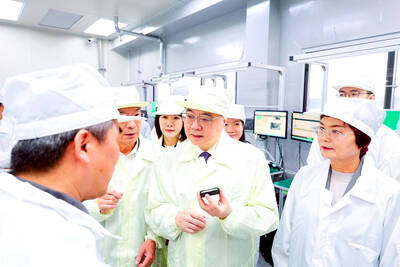
KEY INDUSTRY: The vice premier discussed a plan to create a non-red drone supply chain by next year, which has been allocated a budget of more than NT$7.2 billion The government has budgeted NT$44.2 billion (US$1.38 billion) to cultivate Taiwan’s uncrewed aerial vehicle (UAV) industry over the next five years, which would make the nation a major player in the industry’s democratic supply chain in the Asia-Pacific region, Premier Cho Jung-tai (卓榮泰) said yesterday. Cho made the remarks during a visit to the facilities of Cub Elecparts Inc (為升電裝). Democratic Progressive Party (DPP) Legislator Chen Su-yueh (陳素月) and Chinese Nationalist Party (KMT) Legislator Hsieh Yi-fong (謝依鳳) also participated in the trip. Cub Elecparts has transitioned from the automotive industry to the defense industry, which is the top priority among the nation’s
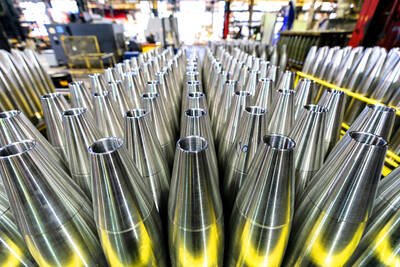
UPGRADED MISSILE: The Chungshan Institute of Science and Technology is reportedly to conduct a live-fire test of the Hsiung Feng III anti-ship missile on Thursday next week The US Army is planning to build new facilities to boost explosives production and strengthen its supply chain, a move aimed at addressing munitions shortages and supporting obligations to partners including Taiwan, Ukraine and Israel, Defense News reported. The army has issued a sources sought notice for a proposed Center of Excellence at the Blue Grass Army Depot in Kentucky, the report said. The facility would serve as a hub within the US industrial base for the production of key military explosives, including research department explosives (RDX) and high melting explosives (HMX), while also supporting research and development of next-generation materials. The proposed
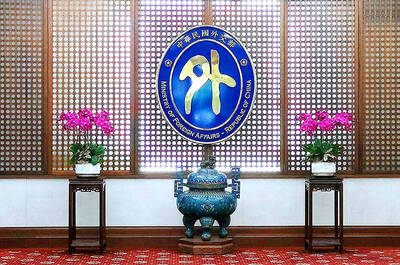
SOUTH KOREA DISPUTE: If Seoul continues to ignore its request, Taiwan would change South Korea’s designation on its arrival cards, the foreign ministry said If South Korea does not reply appropriately to a request to correct Taiwan’s name on its e-Arrival card system before March 31, the government would take corresponding measures to change how South Korea is labeled on the online Taiwan Arrival Card system, the Ministry of Foreign Affairs said yesterday. South Korea’s e-Arrival card system lists Taiwan as “China (Taiwan)” in the “point of departure” and “next destination” fields. Taipei has asked Seoul to change the wording. Since March 1, South Koreans who hold government-issued Alien Resident Certificates (ARC) have been identified as from “South Korea” rather than the “Republic of Korea,” the


 RSS
RSS