


Taiwan has not yet received an invitation to attend the World Health Assembly (WHA), but would strive until the last moment to participate, the Ministry of Foreign Affairs (MOFA) said yesterday.
The WHA, the WHO’s decision-making body, is expected to hold a virtual meeting on May 18 for its 73rd session.
Taiwan has not been invited to the WHA since 2016, when the WHO sent Taiwan an invitation two weeks before the assembly, and just before the Chinese Nationalist Party (KMT) handed over power to the Democratic Progressive Party.
Photo: EPA-EFE
At a news conference in Geneva, Switzerland, on Monday, WHO principal legal officer Steven Solomon said that “some 49 years ago the UN and the WHO decided that there is only one legitimate representative of China within the UN systems, and that is the People’s Republic of China.”
The involvement of any Taiwanese observer at the WHA “is a question for the 194 governments of the WHO. It is not something that the WHO secretariat has the authority to decide,” he said.
Two member states have formally proposed that the matter be considered in the assembly, he said, without naming them.
Some WHO members have had telephone conferences with officials from Taiwan’s Centers for Disease Control, and would do so again, he said, acknowledging Taiwan’s success in responding to the COVID-19 pandemic.
At a news briefing in Taipei yesterday, ministry spokeswoman Joanne Ou (歐江安) thanked the nation’s allies for tendering the proposal, and added that more would voice their support.
The ministry would name its supporters later, at the proper moment, she added.
A WHO director-general does have the authority to invite an observer to join the assembly, just as when Taiwan was invited from 2009 to 2016 and made concrete contributions through its participation, she said.
While the WHO secretariat often cites UN General Assembly Resolution 2758 in 1971 to justify its exclusion of Taiwan, Ou said that the UN resolution, as well as WHA Resolution 25.1, only deal with the representative for China, and do not mention Taiwan.
The two resolutions do not give the People’s Republic of China the power to represent Taiwanese at the UN and its specialized agencies, she said.
Only Taiwan’s government elected by its people can represent Taiwanese at the WHO and be responsible for their welfare, she said, urging the WHO to free itself from the yoke of Beijing’s political power and demonstrate its impartiality.
As the world is threatened by the pandemic, Taiwan’s full participation at all WHO meetings and mechanisms is more necessary and urgent than ever, she said, adding that the nation could share the “Taiwan model” for containing the disease.
Separately yesterday, Minister of Health and Welfare Chen Shih-chung (陳時中), who heads the Central Epidemic Command Center, called Solomon’s remarks a “bureaucratic reply.”
The WHA and the WHO have a responsibility to deal with the issue, Chen said, adding that the decision made 49 years ago “can be changed in seven years” or less, depending on the situation in the world, and health and human rights needs.
Solomon’s reply that a decision was made 49 years ago was an “irresponsible answer,” he added.
Additional reporting by Sherry Hsiao

A signaling system malfunction disrupted high-speed rail (HSR) services beginning at 8am today, with trains temporarily reduced to three northbound and three southbound trains per hour as authorities conduct inspections. The malfunction occurred on a section of track in Miaoli County during pre-operation checks early this morning, forcing northbound and southbound trains to use a single track, the HSR operator said. The regular schedule has been replaced with three hourly trains offering only nonreserved seating in each direction, stopping at every station, it said, adding that business class cars would still have reserved seating. Departures from terminal stations are scheduled at the top

‘NO SECURITY RISK’: The Railway Bureau reassured the public that the technicians’ activities were limited to technical guidance and did not involve sensitive systems The Railway Bureau yesterday said it had invited eight Chinese technicians to assist with an airport MRT construction project. The bureau issued the confirmation after an Internet user said Chinese nationals had entered the construction zone of Taiwan Taoyuan International Airport’s Terminal 3 project. They asked why “individuals from an enemy state” were allowed access to such a major national infrastructure project, which raised serious concerns over Taiwan’s industrial safety, sensitive systems and information security. The bureau’s Northern Region Engineering Branch Office said subcontractor Taiwan Handle Industrial Co (台灣手把工業) of the Taoyuan airport MRT’s “Contract No. CU05 Project A14 Station Civil, MEP &
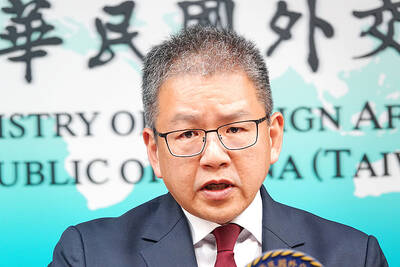
Taiwan is still in the process of assessing the possibility of recruiting workers from Eswatini, the Ministry of Foreign Affairs said yesterday, adding that its goal is to help Eswatini upgrade its vocational training centers. If there are plans to recruit workers from Eswatini, safeguarding national security, protecting public health and ensuring the employment rights of Taiwanese would be prerequisites, Department of West Asian and African Affairs Director-General Yen Chia-liang (顏嘉良) told a news conference. Key considerations would also include filling labor shortages in specific industries, and fostering bilateral professional and technical exchanges, he said. Yen was asked about the progress of labor

A US uncrewed surface vessel (USV) encountered multiple Chinese warships during an autonomous transit of the Taiwan Strait, US defense company Seasats said in a statement on Wednesday. Seasats announced that a Lightfish USV had completed the first autonomous transit of the Taiwan Strait. Over five days, the USV traversed the entire length of the Strait while constantly monitoring surface vessel traffic, the company said. The Lightfish encountered multiple Chinese warships, one of which was a Chinese People’s Liberation Army Navy (PLAN) Type 056 corvette, it said. The Chinese vessels were operating “well within Taiwan’s exclusive economic zone without transmitting their identity via the


 RSS
RSS