


Starlux Airlines Co (星宇航空) has officially become the nation’s seventh international carrier after the Ministry of Transportation and Communications approved its application yesterday.
The Civil Aeronautics Administration (CAA) last week forwarded Starlux’s application to the ministry for final approval after the carrier passed four of the five certification procedures stated in the Regulations of Civil Air Transport Enterprise (民用航空運輸業管理規則).
They included procedures the company was obligated to complete before and after it filed the application, as well as the CAA’s review of its paperwork and aircraft tests.
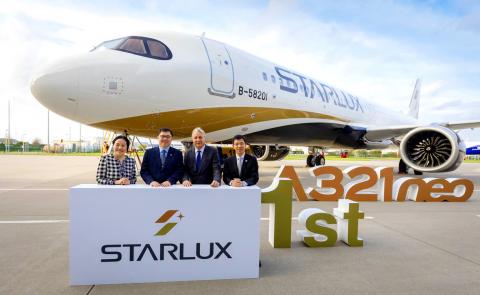
Photo courtesy of Starlux Airlines
The fifth and final stage was approval by Minister of Transportation and Communications Lin Chia-lung (林佳龍).
The CAA will be in charge of issuing an air operator’s certificate to the airline following the ministry’s approval, Lin said.
Although it has obtained an air operator’s certificate, Starlux still has to apply for an airline call sign from the International Civil Aviation Organization, as well as an airline code from the International Air Transport Association, the company said.
The airline code is used to label the flight number in the ticket-booking system, it said.
Starlux also needs to obtain air route certificates from the CAA to offer flights to Macau, Vietnam’s Da Nang City and Malaysia’s Penang state — three destinations that it plans to launch simultaneously on Jan. 23.
The company has not announced when travelers can start booking tickets for the three inaugural flights.
Media reports had said that Starlux chairman Chang Kuo-wei (張國煒), who is a licensed pilot, could operate one of the inaugural flights himself.
However, Starlux spokesman Nieh Kuo-wei (聶國維) said that it is not likely, as Jan. 23 would be the first day of the airline’s operation and Chang would be busy hosting guests.
“We will not engage in a price war with other airlines, even though we are a new carrier. By the time we launch our operations, the nation will be about to celebrate the Lunar New Year holiday and many people are scheduled to travel and return homeduring that period. We will consider offering discounts from time to time after the launch of our services,” he said.
The company has leased 10 Airbus A321neo aircraft, with the first one arriving at the end of October.
The second and third aircraft are to arrive this month and in the middle of next month.
Deliveries of all 10 aircraft should be completed by 2022.
Starlux this year also signed a contract to purchase 17 Airbus A350 aircraft, which are to be delivered between 2021 and 2024.
It is scheduled to launch flight services to the US using the A350 aircraft in 2022.
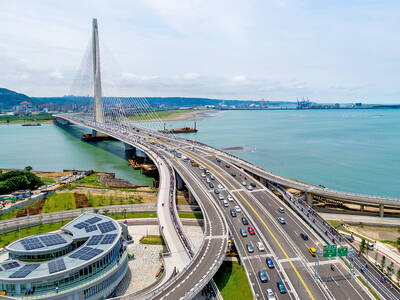
The Ministry of Transportation and Communications yesterday inaugurated the Danjiang Bridge across the Tamsui River in New Taipei City, saying that the structure would be an architectural icon and traffic artery for Taiwan. Feted as a major engineering achievement, the Danjiang Bridge is 920m long, 211m tall at the top of its pylon, and is the longest single-pylon asymmetric cable-stayed bridge in the world, the government’s Web site for the structure said. It was designed by late Iraqi-British architect Zaha Hadid. The structure, with a maximum deck of 70m, accommodates road and light rail traffic, and affords a 200m navigation channel for boats,
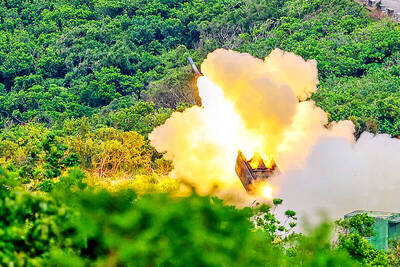
PRECISION STRIKES: The most significant reason to deploy HIMARS to outlying islands is to establish a ‘dead zone’ that the PLA would not dare enter, a source said A High Mobility Artillery Rocket System (HIMARS) would be deployed to Penghu County and Dongyin Island (東引) in Lienchiang County (Matsu) to force the Chinese military to retreat at least 100km from the coastline, a military source said yesterday. Taiwan has been procuring HIMARS and Army Tactical Missile Systems (ATACMS) from the US in batches. Once all batches have been delivered, Taiwan would possess 111 HIMARS units and 504 ATACMS, which have a range of 300km. Considering that “offense is the best defense,” the military plans to forward-deploy the systems to outlying islands such as Penghu and Dongyin so that
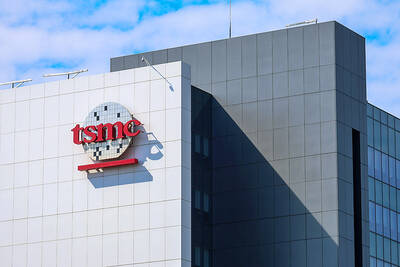
Taiwan Semiconductor Manufacturing Co (TSMC, 台積電), the world’s largest foundry service provider, yesterday said that global semiconductor revenue is projected to hit US$1.5 trillion in 2030, after the figure exceeds US$1 trillion this year, as artificial intelligence (AI) demand boosts consumption of token and compute power. “We are still at the beginning of the AI revolution, but we already see a significant impact across the whole semiconductor ecosystem,” TSMC deputy cochief operating officer Kevin Zhang (張曉強) said at the company’s annual technology symposium in Hsinchu City. “It is fair to say that in the past decade, smartphones and other mobile devices were
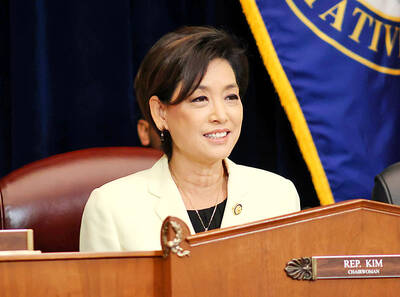
‘CLEAR MESSAGE’: The bill would set up an interagency ‘tiger team’ to review sanctions tools and other economic options to help deter any Chinese aggression toward Taiwan US Representative Young Kim has introduced a bill to deter Chinese aggression against Taiwan, calling for an interagency “tiger team” to preplan coordinated sanctions and economic measures in response to possible Chinese military or political action against Taiwan. “[Chinese President] Xi Jinping [習近平] has directed the People’s Liberation Army to be ready to invade Taiwan by 2027. China has a plan. America should have one too,” Kim said in a news release on Thursday last week. She introduced the “Deter PRC [People’s Republic of China] aggression against Taiwan act” to “ensure the US has a coordinated sanctions strategy ready should


 RSS
RSS