


Hong Kong democracy activists Joshua Wong (黃之鋒), Lester Shum (岑敖暉) and Eddie Chu (朱凱迪) yesterday called on Taiwanese to support the territory’s fight for greater democracy and autonomy by holding a rally before China’s National Day on Oct. 1.
The trio arrived in Taiwan yesterday morning at the invitation of the Light Foundation, and visited the New Power Party (NPP) and the Democratic Progressive Party (DPP) headquarters in the afternoon.
“The imposition of emergency law in Hong Kong is very likely, and so we urge Taiwanese to show solidarity with Hong Kong by holding a street rally before Oct. 1,” Wong said after a one-hour meeting with DPP officials.
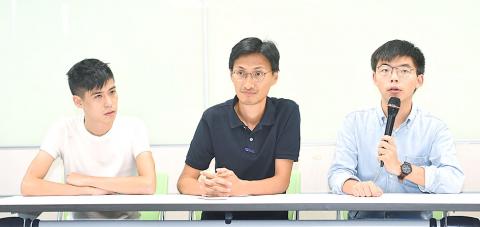
Photo: Liu Hsin-de, Taipei Times
“We would also like to see people in other countries rally for Hong Kong on a weekend before Oct. 1. It is to let the Beijing government know that although it can shut down the demonstrations in Hong Kong, people around the world are standing in solidarity with us,” he said.
“I feel that Hong Kong and Taiwan are bound together in this struggle, that we are facing oppression by the same authoritarian regime, the same subjugating force from China. We hope to make changes, for Hong Kong to have democracy and freedom in the future,” he added.
Five years ago, during Hong Kong’s “Umbrella movement” and Taiwan’s Sunflower movement, the slogan was “Hong Kong today, Taiwan tomorrow,” he said.
This time, it is “Today’s Taiwan, for tomorrow’s Hong Kong,” he said.
“We hope that Hong Kong will one day become like Taiwan today, a place with democracy and freedom,” he said.
China will be celebrating the 70th anniversary of its founding on Oct. 1, said Chu, a Hong Kong lawmaker.
“This is the bottom line for the Beijing government; it will not allow any further protests beyond Oct. 1,” he said.
“China could clamp down, preventing Hong Kong’s democracy movement from going past Oct. 1, so it is necessary for us to stay together to reach that date, and we hope Taiwanese can help us hold on and continue the movement beyond that date,” he said.
The DPP said it would support activities organized by civil groups in Taiwan to express solidarity with Hong Kongers.
“If our friends in Hong Kong encounter an emergency that requires assistance from Taiwan, our current law has the leeway to provide forms of assistance,” DPP Deputy Secretary-General Lin Fei-fan (林飛帆) said.
“We also support the government strengthening laws governing relations with Hong Kong and Macau, which could be needed as a legal basis to assist the people of Hong Kong during emergency situations,” Lin added.
Earlier in the afternoon, following a closed-door meeting with NPP Chairman Hsu Yung-ming (徐永明), Legislator Huang Kuo-chang (黃國昌) and caucus director Chen Hui-min (陳惠敏) at the Legislative Yuan in Taipei, Wong reiterated his call for the Taiwanese government to provide political asylum to Hong Kongers in need.
Huang said that the NPP would continue to push for the passage of a refugee act and amendments to the Act Governing Relations with Hong Kong and Macau (香港澳門關係條例).
Provisions on political asylum in the act are overly simple and will require more details on how it can be applied to individuals, Huang added.
At a cross-caucus negotiation, the NPP will push for the legislation and amendments, as well as propose issuing a joint resolution expressing support for Hong Kong’s pro-democracy campaigns, Hsu said.
The Hong Kong activists took part in a discussion forum in Taichung last night.
They are to head back to Taipei today to take part in another democracy discussion before leaving for Germany and the US.
They are to return to Hong Kong on Sept. 23.
Additional reporting by CNA
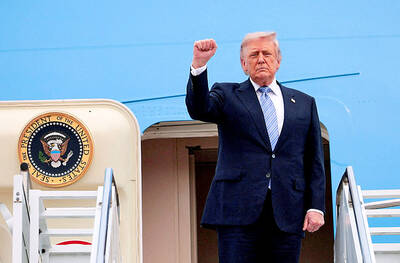
US-CHINA SUMMIT: MOFA welcomed US reassurance of no change in its Taiwan policy; Trump said he did not comment when Xi talked of opposing independence US President Donald Trump yesterday said he has not made a decision on whether to move forward with a major arms package for Taiwan after hearing concerns about it from Chinese President Xi Jinping (習近平). Trump’s comments on Taiwan came as he flew back to Washington after wrapping up critical talks in which both leaders said important progress was made in stabilizing US-China relations even as deep differences persist between the world’s two biggest powers on Iran and Taiwan. “I will make a determination,” Trump said, adding: “I’ll be making decisions. But, you know, I think the last thing we need right
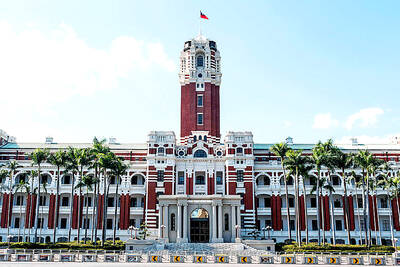
SECURITY: Taipei presses the US for arms supplies, saying the arms sales are not only a reflection of the US security commitment to Taiwan but also serve as a mutual deterrent against regional threats Taiwan is committed to preserving the cross-strait “status quo” and contributing to regional peace and stability, the Presidential Office said yesterday. “It is an undeniable fact that the Republic of China is a sovereign and independent democratic nation,” Presidential Office spokeswoman Karen Kuo (郭雅慧) reiterated, adding that Beijing has no right to claim sovereignty over Taiwan. The statements came after US President Donald Trump warned against Taiwanese independence. Trump wrapped up a state visit to Beijing on Friday, during which Chinese President Xi Jinping (習近平) had pressed him not to support Taiwan. Taiwan depends heavily on US security backing to deter China from carrying
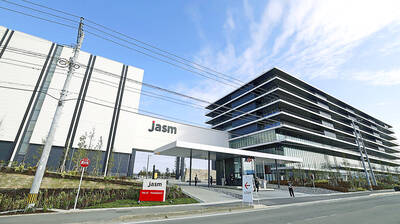
The subsidiary of Taiwan Semiconductor Manufacturing Co (TSMC, 台積電) in Kumamoto, Japan, turned a profit in the first quarter of this year, marking the first time the first fab of the unit has become profitable since mass production started at the end of 2024. According to the contract chipmaker’s financial statement released on Friday, Japan Advanced Semiconductor Manufacturing Inc (JASM), a joint venture running the fab in Kumamoto, posted NT$951 million (US$30.19 million) in profit in the January-to-March period, compared with a loss of NT$1.39 billion in the previous quarter, and a loss of NT$3.25 billion in the first quarter of
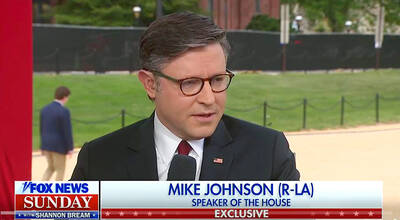
RESOLUTE BACKING: Two Republican senators are planning to introduce legislation that would impose immediate sanctions on China if it attempts to invade Taiwan US House of Representatives Speaker Mike Johnson on Sunday reaffirmed US congressional support for Taiwan, saying the US and “all freedom-loving people” have a stake in preventing China from seizing Taiwan by force. Johnson made the remarks in an interview with Fox News Sunday on US President Donald Trump’s summit with Chinese President Xi Jinping (習近平) last week. In an interview that aired on Friday on Fox News, just as Trump wrapped up a high-stakes visit to China, he said he has yet to green-light a new US$14 billion arms package to Taiwan and that it “depends on China.” “It’s a very good


 RSS
RSS