


Minister of Education Pan Wen-chung (潘文忠) yesterday said that he has asked the Sports Administration and the Chinese Taipei Skating Union (CTSU) to jointly appeal a decision made by the International Skating Union (ISU) on Monday to terminate Taiwan’s right to host the Asian Open Figure Skating Classic in October.
“The nation’s participation in international sporting events has been interfered with by political or other unknown factors. This has affected the development of sports education, as well as the opportunities available for athletes. We should express our strongest objection [to the decision],” Pan said.
It is not the first time that the nation’s right to host a sports event has been terminated without prior notice or legitimate reason. Last year, Taichung lost the right to host the East Asian Youth Games due to the pressure from Beijing.
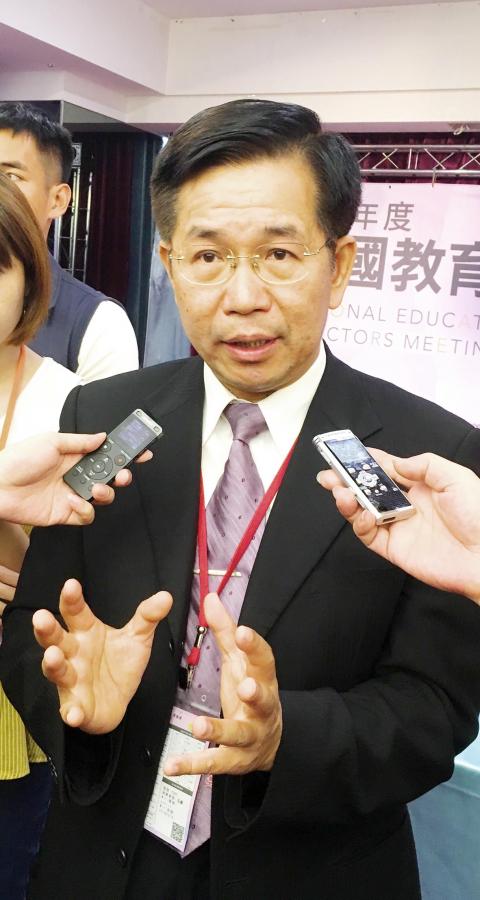
Photo: Lin Hsian-yun, Taipei Times
The Asian Open Figure Skating Classic was scheduled to take place at the Taipei Arena from Oct. 30 to Nov. 3
The CTSU on Tuesday announced that the ISU had told it on Monday night that the plan had been canceled and the competition would be held by the Hong Kong Skating Union instead, with the venue being in Dongguan in China’s Guangdong Province.
“We immediately contacted the ISU and inquired about the reasons for the cancelation. It told us that it was the ISU council’s decision to hand the right to host the competition to the Hong Kong Skating Union and have the competition take place in Dongguan. We are deeply sorry for what happened. We are in the process of understanding how the board came to the decision, preparing to appeal the decision and to pursue further communications with ISU officials. We will keep everybody posted if there is any further information on this matter,” the union said in a statement yesterday.
The CTSU hosted the ISU Four Continent Figure Skating Championships in 2011, 2014, 2016 and last year, and the 2017 World Junior Figure Skating Championships, it said, adding that it would quickly cancel the contracts it had signed with sponsors.
The Sports Administration said that it would meet with the Ministry of Foreign Affairs and the Chinese Taipei Olympic Committee tomorrow to discuss possible ways to help the union appeal the decision.
There is no Chinese member on the ISU council, sports administration officials said.
Executive Yuan spokeswoman Kolas Yotaka said that the ISU should say explicitly for what reasons or under what pressure did it decide to cancel the competition. It should tell the truth and give the union and figure skaters the justice they deserve, she said.
Some people suspect that the cancelation might be due to the ongoing protests in Hong Kong. Earlier this year, the Hong Kong Skating Union rescheduled the Asian Open Figure Skating Trophy due to “recent social issues happening in Hong Kong.”
The foreign ministry said it deeply regretted the ISU’s decision to revoke Taiwan’s right to host the event due to political factors.
Beijing’s malicious suppression of Taiwanese civic groups’ attendance at global events would only incur Taiwanese hatred toward it yet again, the ministry said.
The ministry would continue to work to ensure that Taiwan’s civic groups could host and attend international sporting events, and that Taiwanese athletes could participate in them with equal rights and dignity, it added.

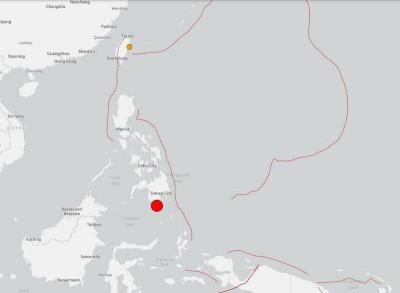
A magnitude 7.8 earthquake struck off the southern coast of Mindanao in the Philippines at 7:38am today, prompting the US Tsunami Warning System to issue an alert for neighboring countries, including Taiwan. The system issued a purple alert indicating a "tsunami threat." The potential threat zone includes Taiwan, the Philippines, Papua New Guinea, Yap and Palau. Philippine authorities were assessing the damage from the quake, with the office of civil defense seeking to verifying initial reports that 15 people had been killed and 129 injured in the region, mostly from falling debris. Arlene Hollero, disaster chief of Maasim town in the Philippines' Sarangani Province,

RESILIENCE: Taiwan plays a key role in semiconductors, energy, information infrastructure and advanced manufacturing, AIT Director Raymond Greene said Taiwan’s continued investment in deterrence and resilience remains vital, especially in uncrewed systems and other emerging technologies, American Institute in Taiwan (AIT) Director Raymond Greene said yesterday. Greene made the remarks at the annual National Strategic Summit on Supply Chain Resilience held by the Research Institute for Democracy, Society and Emerging Technology (DSET), a government-backed think tank. As Taiwan last year became the US’ fourth-largest trading partner and supply chain security is becoming more important, cooperation in emerging technologies continues to deepen between the two countries, he said. The US is committed to accelerating innovation, building key infrastructure, strengthening cooperation

The National Chungshan Institute of Science and Technology yesterday showcased its locally developed variants of the Vision 60 robotic patrol dog, which it plans to deploy on the nation’s outlying territories in the South China Sea. The variants were produced under the Joint Lab project — created by the institute and domestic companies — and assembled with domestically produced motors, lenses and artificial intelligence (AI) systems alongside licensed tech from the US, Missile and Rocket Systems Research Division deputy director Jen Kuo-kang (任國光) told the media event at a military base in Taipei’s Dazhi (大直) area. Taiwan has built up its strengths

RIGHT DIRECTION: Taiwan’s efforts to prevent forced labor include a proposal to ‘fully prohibit’ employers from withholding workers’ documents, an official said Taiwan is to establish a mechanism to restrict imports of goods linked to forced labor, the Executive Yuan said yesterday, after the US proposed imposing additional tariffs on Taiwanese goods over labor concerns. “The Ministry of Labor and the Ministry of Economic Affairs are to establish an interministerial review procedure,” Executive Yuan spokesperson Michelle Lee (李慧芝) said at a news briefing in Taipei. “The government is to use the Foreign Trade Act [貿易法] as the legal basis to restrict imports of goods produced with forced labor” and bring its supply chain governance more in line with international standards on human rights, resilience


 RSS
RSS