

President Tsai Ing-wen (蔡英文) yesterday asserted her determination to safeguard the nation’s sovereignty as she toured a military field exercise at a coast guard base at New Taipei City’s Port of Taipei.
The joint Jin Hua and Hai An Field Exercise No. 10 simulated scenarios such as a terrorist attack; an incident involving a nuclear, biological or chemical agent; maritime hostage-taking; and a large-scale rescue operation.
“The international situation is undergoing significant changes that pose great challenges to existing counterterrorism and national defense paradigms,” Tsai said in a speech before the exercise began.
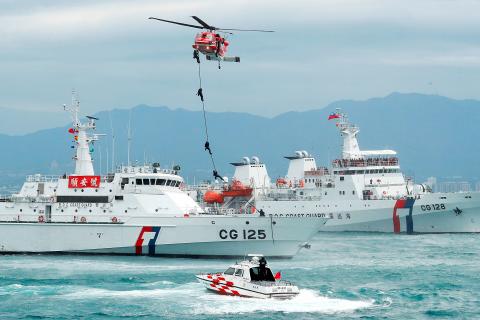
Photo: Tyrone Siu, Reuters
“Security strategy must account for terrorist attacks; attacks utilizing nuclear, chemical or biological agents; and attacks on critical infrastructure that are the emergent security threats of the modern age,” she added.
As a critical node of maritime transport and the main access point to the nation’s northern region, the Port of Taipei’s defenses must be carefully tested for weaknesses so that they could be rectified, she said.
“The government’s ability to respond to emergencies must be improved, while making a clear public demonstration of our will to defend every inch of the nation’s sovereign territory, freedoms and democracy,” she said.
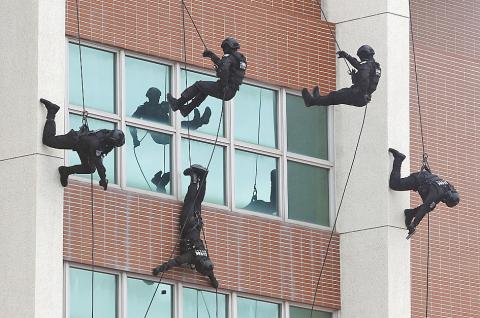
Photo: Chiang Ying-ying, AP
Agencies taking part in the exercise included the coast guard, police, all branches of the military, the Centers for Disease Control, the Toxic and Chemical Substances Bureau and the National Airborne Service Corps, the coast guard said.
The field exercise involved 737 personnel, 17 surface vessels, three helicopters, six uncrewed aerial vehicles (UAVs) and 24 special-purpose motor vehicles, it said.
New equipment included the coast guard’s shipborne 2.75 inch rocket turret systems, rotary-wing UAVs and mobile radar system, the Atomic Energy Council’s vehicle-mounted radiation measurement device and the army’s Type 99 nuclear, biological and chemical reconnaissance vehicle.
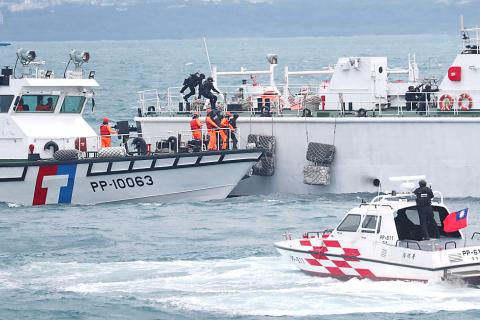
Photo: CNA
Separately yesterday, in response to a Pentagon report on China’s military, Tsai said that China’s frequent military drills have been disruptive to regional stability, while Taiwan has contributed to peace.
“I am confident that Taiwan’s conduct in the past two to three years has built trust in the international community, and the public should rest assured knowing that the armed forces are making every conceivable preparation to defend the safety of Taiwanese,” Tsai added.

Taiwan, which accounts for more than half of the global outsourced semiconductor assembly and testing market, is well-positioned to develop copackaged optics (CPO) and manufacture precision silicon photonics chips, the Ministry of Economic Affairs said yesterday. Silicon photonics are emerging as a mainstream optical communications technology and is seen as key to overcoming bottlenecks in AI computing power. The technology is a key project under the government’s New 10 Major AI Infrastructure Projects, with industry, government, academia and research institutions working to overcome critical technological hurdles and build a self-reliant silicon photonics supply chain, the ministry said. Nvidia Corp in March invested US$4
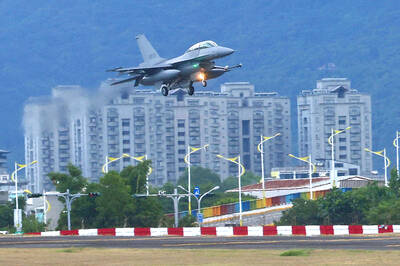
The air force plans to build 26 more hardened aircraft shelters as the number of F-16Vs stationed along Taiwan’s east coast is expected to reach 120 when the final shipment of 66 jets procured from the US arrives. The incoming jets would be stationed at Chihhang Air Base in Taitung County, augmenting the F-16V Block 20s operated by the 5th Tactical Fighter Wing in Hualien County, officials said yesterday. The air force plans to allocate more than NT$6.88 billion (US$218.1 million) from next year to 2031 to build the shelters in Hualien and Taitung as part of the implementation of a “one
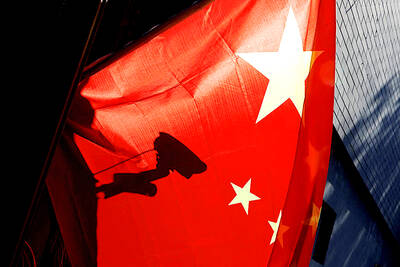
NO LIMITS: More legislation expanding Beijing’s control over the movement of people, money and information raises risks for Taiwanese travelers and businesses, officials said China is set to implement several laws in the coming months that expand the definition of national security, creating greater risks for Taiwanese traveling to or doing business in China, Taiwanese officials said yesterday. Beijing’s Ethnic Unity and Progress Promotion Law took effect on July 1, while a draft “Internet Information Service Management Measures” finished its public consultation on Aug. 2, but has yet to be adopted. China’s Regulations of the State Council on Exit and Entry Administration are to take effect on Tuesday next week, while amendments to its National Defense Mobilization Law and the Ministry of Public Security’s Measures
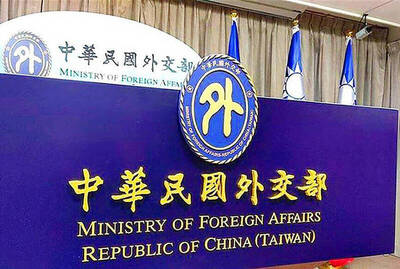
China’s continued efforts to inject geopolitical rivalry into the region and disrupt Pacific nations’ discussions of regional issues warrant greater international attention, a foreign affairs official said yesterday. Minister of Foreign Affairs Lin Chia-lung (林佳龍) last week led a delegation to diplomatic ally Palau to attend events related to the 55th Pacific Islands Forum (PIF) summit. However, the absence of some member-state leaders has been interpreted by some people as a sign of fracturing in Pacific unity. Thirteen PIF members were represented by their heads of state or government, while Fiji, New Caledonia, Vanuatu and Samoa sent ministerial-level representatives, a diplomatic official


 RSS
RSS