


President Tsai Ing-wen (蔡英文) yesterday expressed gratitude to the US government for continuing to sell arms to Taiwan and helping the nation bolster its self-defense capabilities.
In a meeting with a delegation led by US senators Chris Coons and Maggie Hassan, Tsai said that this year marks the 40th anniversary of the US’ Taiwan Relations Act (TRA).
Citing US House of Representatives Speaker Nancy Pelosi, Tsai said that for four decades the TRA has bolstered the relationship between Taiwan and the US, which is based on their shared values of democracy, freedom, security and human rights.

Photo: CNA
Tsai also expressed gratitude for the US Congress’ bipartisan support for improving relations between the two nations.
Coons, along with senators from the Democratic and Republican parties, introduced the US’ Taiwan Assurance Act, which backs Taiwan’s participation in international organizations, calls for opening dialogue on a Taiwan-US free-trade agreement and emphasizes that Taiwan is a vital part of the US’ free and open Indo-Pacific strategy, Tsai said.
The act also directs the US secretary of defense to work to include Taiwan in bilateral and multilateral military training exercises, Tsai added, thanking Coon for his efforts.
The solid security partnership between Taiwan and the US is vital to regional peace and stability and is in the best interests of the Indo-Pacific region, she said.
Taiwan and the US can bolster their partnership based on the existing foundation and work together to become a force for good in the region and in the world, Tsai said.
“Taiwan is already ready, willing and able to contribute more to the international community,” she added.
Coons and Hassan arrived in Taiwan on Saturday on the final leg of a trip to East Asia that included stops in Tokyo, Seoul, Beijing and Hangzhou, China.
At a later news conference at the Ministry of Foreign Affairs in Taipei, the senators said the purpose of their trip is to reiterate that the US and Taiwan’s long-standing partnership is based on the US’ “one China” policy and the Taiwan Relations Act.
The trip is not meant to create political news, change the “status quo” in the Taiwan Strait or encourage Taiwanese independence or other political views, said Coons, who is a member of the Senate’s Foreign Relations Committee.
The purpose of the trip is to reiterate the importance of US-Taiwan relations and to visit the American Institute in Taiwan’s new complex, he said.
In response to media queries on what advice he would give former US vice president and Democratic presidential hopeful Joe Biden with regards to Taiwan, Coons said he would recommend that Biden spend more time visiting East Asia.
Biden previously visited Taiwan and understands the value of engaging personally, Coons added.
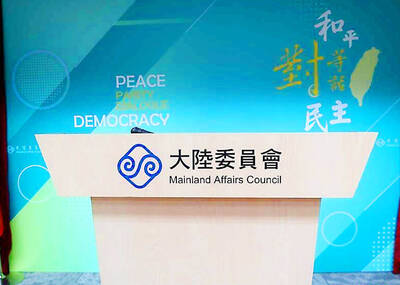
NO RECIPROCITY: Taipei has called for cross-strait group travel to resume fully, but Beijing is only allowing people from its Fujian Province to travel to Matsu, the MAC said The Mainland Affairs Council (MAC) yesterday criticized an announcement by the Chinese Ministry of Culture and Tourism that it would lift a travel ban to Taiwan only for residents of China’s Fujian Province, saying that the policy does not meet the principles of reciprocity and openness. Chinese Deputy Minister of Culture and Tourism Rao Quan (饒權) yesterday morning told a delegation of Chinese Nationalist Party (KMT) lawmakers in a meeting in Beijing that the ministry would first allow Fujian residents to visit Lienchiang County (Matsu), adding that they would be able to travel to Taiwan proper directly once express ferry

STUMPED: KMT and TPP lawmakers approved a resolution to suspend the rate hike, which the government said was unavoidable in view of rising global energy costs The Ministry of Economic Affairs yesterday said it has a mandate to raise electricity prices as planned after the legislature passed a non-binding resolution along partisan lines to freeze rates. Chinese Nationalist Party (KMT) lawmakers proposed the resolution to suspend the price hike, which passed by a 59-50 vote. The Taiwan People’s Party (TPP) voted with the KMT. Legislative Speaker Han Kuo-yu (韓國瑜) of the KMT said the resolution is a mandate for the “immediate suspension of electricity price hikes” and for the Executive Yuan to review its energy policy and propose supplementary measures. A government-organized electricity price evaluation board in March
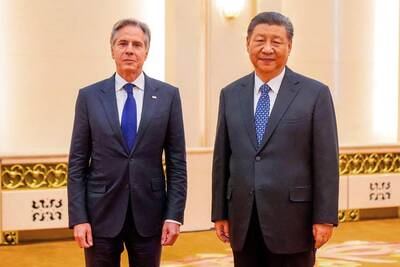
MANAGING DIFFERENCES: In a meeting days after the US president signed a massive foreign aid bill, Antony Blinken raised concerns with the Chinese president about Taiwan US Secretary of State Antony Blinken yesterday met with Chinese President Xi Jinping (習近平) and senior Chinese officials, stressing the importance of “responsibly managing” the differences between the US and China as the two sides butt heads over a number of contentious bilateral, regional and global issues, including Taiwan and the South China Sea. Talks between the two sides have increased over the past few months, even as differences have grown. Blinken said he raised concerns with Xi about Taiwan and the South China Sea, along with China’s support for Russia and its invasion of Ukraine, as well as other issues

FAST RELEASE: The council lauded the developer for completing model testing in only four days and releasing a commercial version for use by academia and industry The National Science and Technology Council (NSTC) yesterday released the latest artificial intelligence (AI) language model in traditional Chinese embedded with Taiwanese cultural values. The council launched the Trustworthy AI Dialogue Engine (TAIDE) program in April last year to develop and train traditional Chinese-language models based on LLaMA, the open-source AI language model released by Meta. The program aims to tackle the information bias that is often present in international large-scale language models and take Taiwanese culture and values into consideration, it said. Llama 3-TAIDE-LX-8B-Chat-Alpha1, released yesterday, is the latest large language model in traditional Chinese. It was trained based on Meta’s Llama-3-8B


 RSS
RSS