


Australian Minister of Defense Christopher Pyne yesterday urged China to resolve tensions in the South China Sea in accordance with international law.
Pyne said the artificial islands Beijing has been building in the disputed waters have “increased anxiety” and “not increased regional confidence in China’s strategic intentions.”
“On the other hand, resolving disputes in the South China Sea in accordance with international law would build confidence in China’s willingness to support and champion a strategic culture that respects the rights of all states,” he said in a speech at the International Institute for Strategic Studies’ Fullerton Forum in Singapore, which was attended by defense representatives from 24 countries.
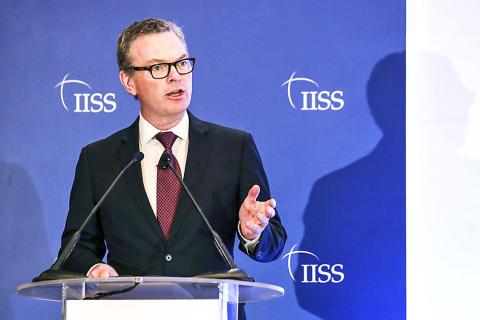
Photo: AP
Australia is open to taking part in multilateral activities in the “international waters” that are crucial for global commerce and rich in fish and potential oil and gas reserves, he said.
While Australia is “not interested in containing China,” it wants Indo-Pacific countries to not have to make “choices between economic gain and sovereignty,” Pyne said.
The growing rivalry between the US and China should not be defined in “wholly adversarial terms” or characterized as a new Cold War, because economies are far more mutually dependent than they were when the West contested the Soviet bloc, he said.
“There is no gain in stifling China’s growth and prosperity, and this is not an agenda in any capital that I know of,” Pyne said.
Instead, Australia hopes to increase its engagement with the Indo-Pacific, which is home to the world’s busiest sea lanes and 50 percent of its population.
It plans to invest more than A$90 billion (US$64.8 billion) in a fleet of attack-class submarines, frigates and other ships to strengthen its maritime capabilities.
Pyne said Australia hopes to increase its defense budget to more than 2 percent of its GDP by 2021.
“Australia sees its role as one of being able to talk to both China and the United States openly and frankly,” he said.
“We are clearly a very close ally of the United States ... but we don’t believe we need to choose between security and prosperity, and we haven’t in the past and we don’t intend to in the future,” he said.
Pyne visited Beijing last week for a meeting with his Chinese counterpart, Wei Fenghe (魏鳳和), that included a discussion about Chinese-Australian writer Yang Hengjun (楊恆鈞), whom China has detained and accused of endangering its national security.
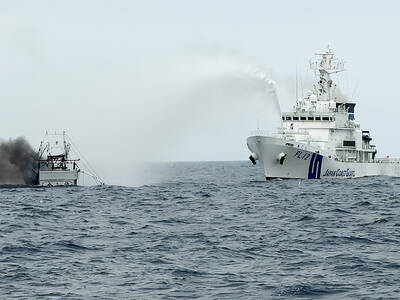
CREDIT-GRABBER: China said its coast guard rescued the crew of a fishing vessel that caught fire, who were actually rescued by a nearby Taiwanese boat and the CGA Maritime search and rescue operations do not have borders, and China should not use a shipwreck to infringe upon Taiwanese sovereignty, the Coast Guard Administration (CGA) said yesterday. The coast guard made the statement in response to the China Coast Guard (CCG) saying it saved a Taiwanese fishing boat. The Chuan Yu No. 6 (全漁6號), a fishing vessel registered in Keelung, on Thursday caught fire and sank in waters northeast of Diaoyutai Islands (釣魚台). The vessel left Keelung’s Badouzih Fishing Harbor (八斗子漁港) at 3:35pm on Sunday last week, with seven people on board — a 62-year-old Taiwanese captain surnamed Chang (張) and six
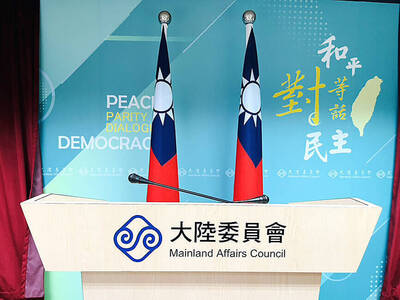
RISKY BUSINESS: The ‘incentives’ include initiatives that get suspended for no reason, creating uncertainty and resulting in considerable losses for Taiwanese, the MAC said China’s “incentives” failed to sway sentiment in Taiwan, as willingness to work in China hit a record low of 1.6 percent, a Ministry of Labor survey showed. The Directorate-General of Budget, Accounting and Statistics (DGBAS) also reported that the number of Taiwanese workers in China has nearly halved from a peak of 430,000 in 2012 to an estimated 231,000 in 2024. That marked a new low in the proportion of Taiwanese going abroad to work. The ministry’s annual survey on “Labor Life and Employment Status” includes questions respondents’ willingness to seek employment overseas. Willingness to work in China has steadily declined from

The Legislative Yuan’s Finance Committee yesterday approved proposed amendments to the Amusement Tax Act (娛樂稅法) that would abolish taxes on films, cultural activities and competitive sporting events, retaining the fee only for dance halls and golf courses. The proposed changes would set the maximum tax rate for dance halls and golf courses at 50 and 20 percent respectively, with local governments authorized to suspend the levies. Article 2 of the act says that “amusement tax shall be levied on tickets sold or fees charged by amusement places, facilities or activities” in six categories: “Cinema; professional singing, story-telling, dancing, circus, magic show, acrobatics
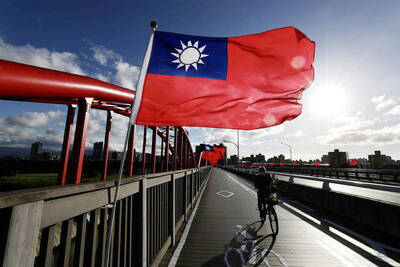
INFLATION UP? The IMF said CPI would increase to 1.5 percent this year, while the DGBAS projected it would rise to 1.68 percent, with GDP per capita of US$44,181 The IMF projected Taiwan’s real GDP would grow 5.2 percent this year, up from its 2.1 percent outlook in January, despite fears of global economic disruptions sparked by the US-Iran conflict. Taiwan’s consumer price index (CPI) is projected to increase to 1.5 percent, while unemployment would be 3.4 percent, roughly in line with estimates for Asia as a whole, the international body wrote in its Global Economic Outlook Report published in the US on Monday. The figures are comparatively better than the IMF outlook for the rest of the world, which pegged real GDP growth at 3.1 percent, down from 3.3 percent


 RSS
RSS