


Chang Chi-yuan (張啟元) last month hacked Taiwan High Speed Rail Corp’s (台灣高鐵) online ticketing system, tweaking the refund process to return NT$200,000, police said yesterday.
Chang used his cellphone to purchase a NT$40 ticket from Nangang Station to Taipei Railway Station, then immediately requested a refund, police said.
A company employee noticed the abnormal refund amount and reported the incident to the Taipei office of the Ministry of Justice Investigation Bureau, police said.
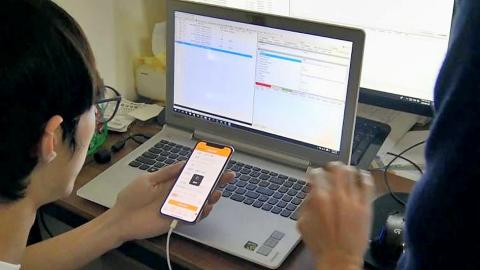
Photo courtesy of Ministry of Justice Investigation Bureau
An affidavit on Wednesday said that Chang admitted to making the changes and seeking the altered refund, but added that he hacked the system to prove that it was vulnerable.
“Had I received the NT$200,000, I would have returned it to the company,” the affidavit read.
Chang was released on bail of NT$100,000 after the office charged him with alleged breaches of the Criminal Code, police said.
Chang is a self-proclaimed “white hat” hacker, a computer security expert who specializes in testing systems for vulnerabilities.
Chang last year reportedly hacked the Apple Pay system and purchased 502 iPhones for NT$1, while in 2013 he drew the attention of Facebook after using a loophole to delete posts by Facebook creator Mark Zuckerberg.
In 2015, Chang was sued by a local bus operator after infiltrating its online system and buying a ticket for NT$1. While Chang returned the ticket and warned the company of the weakness in its system, the company pressed charges.
Chang was sentenced to 60 days in prison, which was commuted to a NT$60,000 fine.
Chang yesterday wrote on Facebook that he despaired of being Taiwanese after his most recent run-in with law enforcement.
He said that he did not want to admit to being Taiwanese.
“I have already given up on Taiwan,” he wrote.

South Korea has adjusted its electronic arrival card system to no longer list Taiwan as a part of China, a move that the Ministry of Foreign Affairs said would help facilitate exchanges between the two sides. South Korea previously listed “Taiwan” as “Taiwan (China)” in the drop-down menus of its online arrival card system, where people had to fill out where they came from and their next destination. The ministry had requested South Korea make a revision and said it would change South Korea’s name on Taiwan’s online immigration system from “Republic of Korea” to “Korea (South),” should the issue not be

Tainan, Taipei and New Taipei City recorded the highest fines nationwide for illegal accommodations in the first quarter of this year, with fines issued in the three cities each exceeding NT$7 million (US$220,639), Tourism Administration data showed. Among them, Taipei had the highest number of illegal short-term rental units, with 410. There were 3,280 legally registered hotels nationwide in the first quarter, down by 14 properties, or 0.43 percent, from a year earlier, likely indicating operators exiting the market, the agency said. However, the number of unregistered properties rose to 1,174, including 314 illegal hotels and 860 illegal short-term rental

ECONOMIC COERCION: Such actions are often inconsistently applied, sometimes resumed, and sometimes just halted, the Presidential Office spokeswoman said The government backs healthy and orderly cross-strait exchanges, but such arrangements should not be made with political conditions attached and never be used as leverage for political maneuvering or partisan agendas, Presidential Office spokeswoman Karen Kuo (郭雅慧) said yesterday. Kuo made the remarks after China earlier in the day announced 10 new “incentive measures” for Taiwan, following a landmark meeting between Chinese President Xi Jinping (習近平) and Chinese Nationalist Party (KMT) Chairwoman Cheng Li-wun (鄭麗文) in Beijing on Friday. The measures, unveiled by China’s Xinhua news agency, include plans to resume individual travel by residents of Shanghai and China’s Fujian

Chinese President Xi Jinping (習近平) and Chinese Nationalist Party (KMT) Chairwoman Cheng Li-wun (鄭麗文) met in Beijing yesterday, where they vowed to bring people on both sides of the Taiwan Strait closer to facilitate the “great rejuvenation of the Chinese nation.” The meeting was held in the East Hall of the Great Hall of the People, a venue typically reserved for meetings between Xi and foreign heads of state. In public remarks prior to a closed-door meeting, Xi, in his role as head of the Chinese Communist Party (CCP), said that Taiwan is historically part of China, and remains an “inalienable” and


 RSS
RSS