


The Taipei City Government yesterday presented the city’s first iTrash station, which has a “smart” trash can with 24-hour self-service that allows residents to dispose of trash around-the-clock while earning reward points on EasyCards for recycling aluminum cans or PET bottles.
The Taipei Department of Information Technology said it collaborated with the Department of Environmental Protection, Haoyang Environment Technology Ltd (晧揚環境科技) and Chunghwa Telecom Co (中華電信) to set up the first iTrash station in August in a parking lot on Linyi Street.
The station is equipped with Internet of Things and cloud technology, providing trash disposal and recycling while collecting data on trash disposal and automatically notifying agencies to collect trash or fix malfunctions.
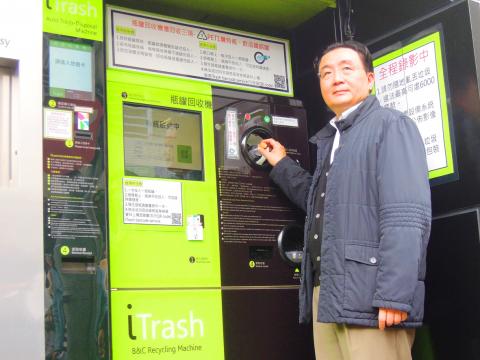
Photo: CNA
City residents currently take their trash bags out to the street when they hear city garbage trucks signal their arrival by playing Ludwig van Beethoven’s Fur Elise or Tekla Badarzewska-Baranowska’s A Maiden’s Prayer.
The iTrash station is more convenient for people whose schedules do not coincide with trash collection times.
Using the station, residents can earn reward points on their EasyCards. By inserting the EasyCard into a slot, users can earn NT$1 for disposing of up to 0.2kg of trash, NT$4 for up to 0.5kg and NT$8 for up to 1kg.
Users can also earn NT$1 for every 10 PET bottles or eight aluminum cans.
During the three-month trial, the Linyi Street iTrash station was used more than 800 times, collecting more than 2 tonnes of trash, 20,000 PET bottles and 8,000 aluminum cans.
The statistics highlight the good results, but so does the approval of nearby residents, borough wardens and city councilors, Taipei Department of Information Technology Commissioner Lee Wei-bin (李維斌) said.
Haoyang is working on iTrash stations that can also collect kitchen waste and other materials, chief executive officer Yang Chen (楊琛) said, adding that data from the station would help city officials improve the program.

‘NO SECURITY RISK’: The Railway Bureau reassured the public that the technicians’ activities were limited to technical guidance and did not involve sensitive systems The Railway Bureau yesterday said it had invited eight Chinese technicians to assist with an airport MRT construction project. The bureau issued the confirmation after an Internet user said Chinese nationals had entered the construction zone of Taiwan Taoyuan International Airport’s Terminal 3 project. They asked why “individuals from an enemy state” were allowed access to such a major national infrastructure project, which raised serious concerns over Taiwan’s industrial safety, sensitive systems and information security. The bureau’s Northern Region Engineering Branch Office said subcontractor Taiwan Handle Industrial Co (台灣手把工業) of the Taoyuan airport MRT’s “Contract No. CU05 Project A14 Station Civil, MEP &

The National Chungshan Institute of Science and Technology yesterday showcased its locally developed variants of the Vision 60 robotic patrol dog, which it plans to deploy on the nation’s outlying territories in the South China Sea. The variants were produced under the Joint Lab project — created by the institute and domestic companies — and assembled with domestically produced motors, lenses and artificial intelligence (AI) systems alongside licensed tech from the US, Missile and Rocket Systems Research Division deputy director Jen Kuo-kang (任國光) told the media event at a military base in Taipei’s Dazhi (大直) area. Taiwan has built up its strengths
NOT IMMEDIATE: Taiwan has a chance to appeal the proposed 10 percent tariff before it starts, while other countries face a 12.5 percent tariff from the trade office Taiwan is among 60 economies determined by the US to have failed to impose or enforce a ban on the importation of goods produced with forced labor, according to a notice released on Tuesday by the Office of the US Trade Representative (USTR), which proposed imposing an additional 10 percent or more tariff on them. The USTR in a statement said that following an investigation, it had determined under Section 301 of the Trade Act of 1974 that the failure of the 60 economies to impose and effectively enforce a prohibition on the importation of goods produced with forced labor is

TIT-FOR-TAT: The US allegedly revoked the visa of a Chinese national working at Xinhua News Agency in the US in response to Beijing’s expulsion of Vivian Wang The Presidential Office yesterday condemned China for expelling a New York Times correspondent from Beijing following the newspaper’s interview with President William Lai (賴清德), saying the move highlighted Beijing’s suppression of press freedom and its threat to international news media. Taiwan has noted a series of recent incidents in which Beijing used similar tactics to “threaten and pressure international media outlets and journalists,” Presidential Office spokeswoman Karen Kuo (郭雅慧) said in a statement. “This concerns not only press freedom and freedom of expression, but also the safety of journalists, and Taiwan and relevant partners are paying close attention to the situation,” she


 RSS
RSS