


Taiwanese actress Vivian Sung (宋芸樺) on Thursday said she was “proud to be Chinese” in an apology after Chinese netizens uncovered a 2015 interview in which she said her favorite country was Taiwan.
Just as the Chinese-produced movie Hello Mr Billionaire (西虹市首富) starring Sung became a box-office hit in China, the actress was labeled an advocate of Taiwanese independence after the video interview was posted on the Internet.
In the brief interview, Sung was asked which is her favorite country and with whom she would like to visit it, to which she replied Taiwan, saying that she would like to stay in Taiwan with her family.
Screen grab from the Internet
The video stirred controversy among Chinese netizens.
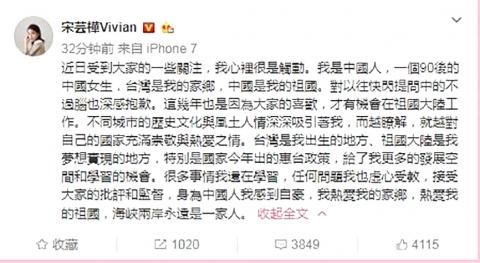
Sung late on Thursday posted an apology on her Sina Weibo microblog.
“I am very much shaken by the attention I have been getting lately,” Sung wrote.
“I am a Chinese girl born in the 1990s. Taiwan is my hometown, China is my home country,” she wrote. “I am deeply sorry for my mindlessness during the interview.”
“I owe my opportunity to work in my home country of China to people’s fondness of me in recent years,” she added.
“I have been deeply fascinated by the histories and peoples of different cities,” Sung said. “The more I learn, the more respectful and passionate I have become toward my home country.”
“Taiwan was where I was born, but my home country of China is where my dreams came true,” she said. “The 31 incentives for Taiwanese in particular catapulted my career and gave me many learning opportunities.”
“I am proud to be Chinese. I love my hometown and my home country. People on both sides of the Taiwan Strait will forever be one family,” she added.
The apology was reportedly issued less than 24 hours after the video was posted.
However, Sung’s swift apology has backfired, as it apparently failed to win her the hearts of Taiwanese — and even Chinese netizens, some of whom said the statement was “too contrived.”
“Do you think Chinese are retarded?” one Chinese netizen said.
“That is money talking,” another said.
Meanwhile, Sung’s Facebook page has been inundated with angry comments from Taiwanese netizens. At least 10,000 people have “unliked” the page, which as of press time last night had just more than 990,000 “likes.”
“The only thing you were shaken by is the renminbi,” one Taiwanese netizen wrote.
“Taiwanese movies gave you the popularity you now enjoy, but you have lost your dignity for money,” another wrote.
Many called on Sung to renounce her Republic of China citizenship.
Presidential Office spokesman Alex Huang (黃重諺) yesterday said that the act of suppressing artists and coercing them into making political statement does not befit a modern, civilized society.
Separately, President Tsai Ing-wen (蔡英文) last night said that, in view of China’s suppression, "now is the time we need to demonstrate our firm will and loudly proclaim that our favorite country is Taiwan."
Sung’s case was the latest in a string of incidents in which Taiwanese entertainers have been pressured to pledge allegiance to China.
In December last year, My Dear Boy, a TV series produced and starring Taiwanese actress Ruby Lin (林心如), was pulled by Chinese censors from an online video streaming platform over reports that Lin supported Taiwanese independence.
The show was allowed back on the platform in January after Lin issued a statement saying that she “never supported and will never support any pro-independence discourse or actions.”
On the eve of the 2016 presidential election, Taiwanese K-pop idol Chou Tzu-yu (周子瑜) apologized in a video for briefly holding up a Republic of China flag in an episode of a South Korean variety show.
The video showed a visibly saddened Chou bowing and saying: “There is only one China... I have always felt proud of being Chinese.”
Taiwanese singer Crowd Lu (盧廣仲) and actor Leon Dai (戴立忍) have been blacklisted by Chinese authorities over their support of the 2014 Sunflower movement.
Additional reporting by Lee Hsin-fang and CNA

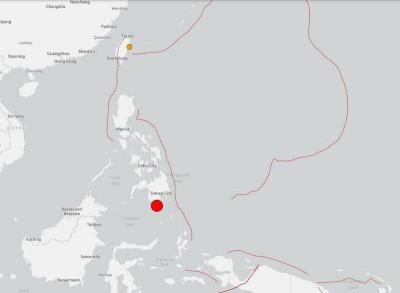
A magnitude 7.8 earthquake struck off the southern coast of Mindanao in the Philippines at 7:38am today, prompting the US Tsunami Warning System to issue an alert for neighboring countries, including Taiwan. The system issued a purple alert indicating a "tsunami threat." The potential threat zone includes Taiwan, the Philippines, Papua New Guinea, Yap and Palau. Philippine authorities were assessing the damage from the quake, with the office of civil defense seeking to verifying initial reports that 15 people had been killed and 129 injured in the region, mostly from falling debris. Arlene Hollero, disaster chief of Maasim town in the Philippines' Sarangani Province,

RESILIENCE: Taiwan plays a key role in semiconductors, energy, information infrastructure and advanced manufacturing, AIT Director Raymond Greene said Taiwan’s continued investment in deterrence and resilience remains vital, especially in uncrewed systems and other emerging technologies, American Institute in Taiwan (AIT) Director Raymond Greene said yesterday. Greene made the remarks at the annual National Strategic Summit on Supply Chain Resilience held by the Research Institute for Democracy, Society and Emerging Technology (DSET), a government-backed think tank. As Taiwan last year became the US’ fourth-largest trading partner and supply chain security is becoming more important, cooperation in emerging technologies continues to deepen between the two countries, he said. The US is committed to accelerating innovation, building key infrastructure, strengthening cooperation

The National Chungshan Institute of Science and Technology yesterday showcased its locally developed variants of the Vision 60 robotic patrol dog, which it plans to deploy on the nation’s outlying territories in the South China Sea. The variants were produced under the Joint Lab project — created by the institute and domestic companies — and assembled with domestically produced motors, lenses and artificial intelligence (AI) systems alongside licensed tech from the US, Missile and Rocket Systems Research Division deputy director Jen Kuo-kang (任國光) told the media event at a military base in Taipei’s Dazhi (大直) area. Taiwan has built up its strengths

RIGHT DIRECTION: Taiwan’s efforts to prevent forced labor include a proposal to ‘fully prohibit’ employers from withholding workers’ documents, an official said Taiwan is to establish a mechanism to restrict imports of goods linked to forced labor, the Executive Yuan said yesterday, after the US proposed imposing additional tariffs on Taiwanese goods over labor concerns. “The Ministry of Labor and the Ministry of Economic Affairs are to establish an interministerial review procedure,” Executive Yuan spokesperson Michelle Lee (李慧芝) said at a news briefing in Taipei. “The government is to use the Foreign Trade Act [貿易法] as the legal basis to restrict imports of goods produced with forced labor” and bring its supply chain governance more in line with international standards on human rights, resilience


 RSS
RSS