


Hong Kong’s leading independence activist was yesterday jailed for six years for his involvement in some of the territory’s worst protest violence for decades.
Edward Leung (梁天琦) was convicted last month of rioting during the 2016 running battles with police, when demonstrators hurled bricks torn up from pavements and set rubbish alight in Mong Kok district.
Handing down his jail term, High Court Judge Anthea Pang (彭寶琴) said Leung actively participated in the riots and described his actions as “wanton and vicious.”
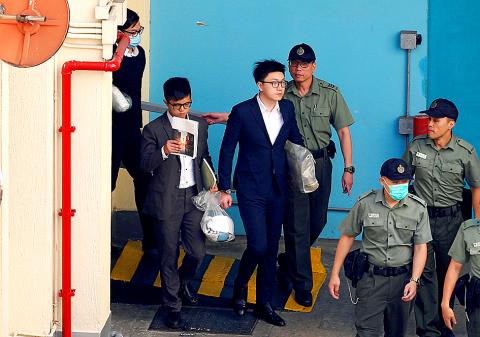
Photo: Reuters
The 27-year-old was already in custody after pleading guilty in January to a separate charge of assaulting a police officer during the clashes. He was sentenced to one year in jail on that count, with the two terms to be served concurrently.
The 2016 protest began as a seemingly innocuous rally to protect illegal hawkers from health inspectors, but it quickly morphed into an outpouring of anger against authorities in Hong Kong and Beijing.
At the forefront of the clashes were young “localists,” a term coined for radical groups promoting a split from China, which grew out of the failure of massive pro-democracy rallies in 2014 to win concessions from Beijing on political reform.
At the time, Leung was the head of Hong Kong Indigenous and a rising star on the political scene as the fledgling independence movement gathered momentum.
Pang said the protesters appeared to be “sincere, earnest, but wrong-headed people” with strong convictions.
They “will stop at nothing to impose those views” on society, she said, which Hong Kong cannot tolerate, as it poses “extremely great danger,” she said.
Two other protesters, Wong Ka-kui (黃家駒) and Lo Kin-man (盧建民), were sentenced alongside Leung to seven years and three-and-a-half years in prison respectively.
Veteran democracy advocate, former lawmaker and lawyer Alan Leong (梁家傑) criticized the judgement, saying that political reasons could not be admitted as a mitigating factor.
“How can you say that Edward Leung’s motives ... not for personal selfish gain, just to pursue his ideals... don’t matter? They must be relevant,” Leong said.
Leung’s jail term felt “way too heavy” especially when compared with the lesser sentences handed down during the 1967 anti-colonial riots that left 51 dead, he said.
At least 16 people have already been jailed over the clashes, with terms of up to four years and nine months for a man convicted of rioting and arson. None were known activists.
It was later dubbed the “fishball revolution” after one of the territory’s best-loved street snacks.
The defense said Leung, who pleaded not guilty, had no intention to riot, but wanted to “protect Hong Kong culture.”
Media reports said Leung testified his activism was inspired by the pro-democracy slogan “Without resistance, how is there change?”


RESILIENCE: Taiwan plays a key role in semiconductors, energy, information infrastructure and advanced manufacturing, AIT Director Raymond Greene said Taiwan’s continued investment in deterrence and resilience remains vital, especially in uncrewed systems and other emerging technologies, American Institute in Taiwan (AIT) Director Raymond Greene said yesterday. Greene made the remarks at the annual National Strategic Summit on Supply Chain Resilience held by the Research Institute for Democracy, Society and Emerging Technology (DSET), a government-backed think tank. As Taiwan last year became the US’ fourth-largest trading partner and supply chain security is becoming more important, cooperation in emerging technologies continues to deepen between the two countries, he said. The US is committed to accelerating innovation, building key infrastructure, strengthening cooperation

The National Chungshan Institute of Science and Technology yesterday showcased its locally developed variants of the Vision 60 robotic patrol dog, which it plans to deploy on the nation’s outlying territories in the South China Sea. The variants were produced under the Joint Lab project — created by the institute and domestic companies — and assembled with domestically produced motors, lenses and artificial intelligence (AI) systems alongside licensed tech from the US, Missile and Rocket Systems Research Division deputy director Jen Kuo-kang (任國光) told the media event at a military base in Taipei’s Dazhi (大直) area. Taiwan has built up its strengths

RIGHT DIRECTION: Taiwan’s efforts to prevent forced labor include a proposal to ‘fully prohibit’ employers from withholding workers’ documents, an official said Taiwan is to establish a mechanism to restrict imports of goods linked to forced labor, the Executive Yuan said yesterday, after the US proposed imposing additional tariffs on Taiwanese goods over labor concerns. “The Ministry of Labor and the Ministry of Economic Affairs are to establish an interministerial review procedure,” Executive Yuan spokesperson Michelle Lee (李慧芝) said at a news briefing in Taipei. “The government is to use the Foreign Trade Act [貿易法] as the legal basis to restrict imports of goods produced with forced labor” and bring its supply chain governance more in line with international standards on human rights, resilience

NOT IMMEDIATE: Taiwan has a chance to appeal the proposed 10 percent tariff before it starts, while other countries face a 12.5 percent tariff from the trade office Taiwan is among 60 economies determined by the US to have failed to impose or enforce a ban on the importation of goods produced with forced labor, according to a notice released on Tuesday by the Office of the US Trade Representative (USTR), which proposed imposing an additional 10 percent or more tariff on them. The USTR in a statement said that following an investigation, it had determined under Section 301 of the Trade Act of 1974 that the failure of the 60 economies to impose and effectively enforce a prohibition on the importation of goods produced with forced labor is


 RSS
RSS