


Author, politician and historian Li Ao (李敖) yesterday passed away peacefully after a battle with brain cancer, Taipei Veterans General Hospital said.
Li was 83 years old.
He had sought treatment at the hospital in July 2015, saying he had an unsteady gait, and was later diagnosed with brainstem gliomas.
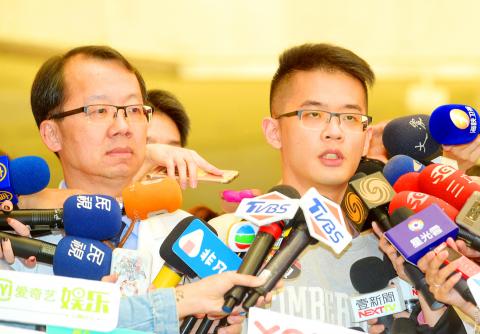
Photo: Chang Chia-ming, Taipei Times
His condition had stabilized after initial treatment, but he was readmitted to hospital several times last year.
In October last year, he was hospitalized for pneumonia, but a subsequent magnetic resonance imaging brain scan showed that his tumors had worsened.
Li began receiving targeted therapy in November and his condition improved.
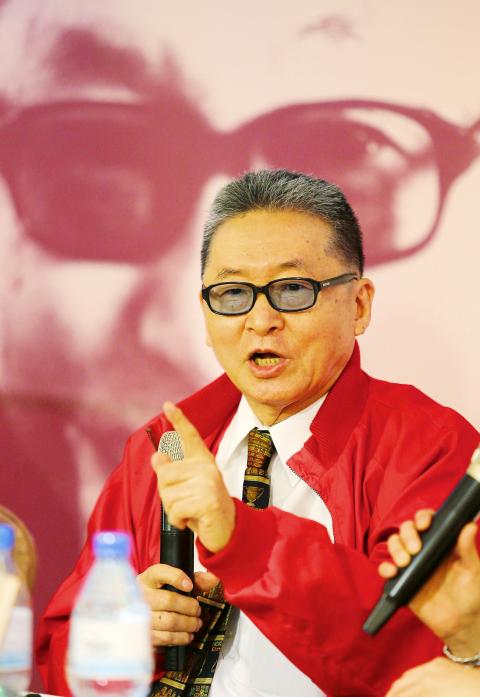
Photo: CNA
However, the therapy started to lose effect in January and his overall condition began to deteriorate, the hospital said.
His son, Li Kan (李戡), yesterday said his father had remained strong and resilient during his illness, adding that he discussed his disease with medical personnel jokingly.
Li Ao’s family would make his funeral as simple as possible and does not plan to hold any public remembrance activities, Li Kan said.
As a versatile writer with a piercing and critical style, Li Ao was best known for his studies on history, in addition to his political commentaries, biographies and literary works.
During the Chinese Nationalist Party’s (KMT) authoritarian regime, he was regarded as an intellectual heretic who fought for freedom of speech and publication.
His 96 works were banned by the KMT during the Martial Law period.
“Li Ao epitomizes a wish, an action, a symbol of rebellion for people in that era,” said Chen Fang-ming (陳芳明), a professor at National Chengchi University’s Graduate Institute of Taiwanese Literature.
“The era’s intellectuals were eager to watch his performance, but none dared to join his company,” Chen said. “He was more critical and radical than any self-esteemed leftists.”
“Without Li Ao, Taiwan under [the KMT’s] authoritarian regime might have had a harder time,” he added.
Li Ao worked for a while in real estate, served as editor-in-chief of Wen Hsing (文星) magazine, founded a publishing house named after himself, was a TV host and taught history at Soochow University.
He ran for president in the 2000 election on the New Party ticket, and was elected as a lawmaker in 2004.
Li Ao is a legend among his contemporaries, former legislative speaker Wang Jin-pyng (王金平) said yesterday, adding that he had “lost a good friend.”
Democratic Progressive Party caucus whip Ker Chien-ming (柯建銘) said he admired Li Ao’s polished, critical and solid writing, and that he inspired rebellious movements against the government.
People First Party caucus whip Lee Hung-chun (李鴻鈞) expressed his sorrow over Li Ao’s death.
The Executive Yuan offered its condolences to Li Ao’s family.
Executive Yuan spokesman Hsu Kuo-yung (徐國勇) said he and Premier William Lai (賴清德) served at the Legislative Yuan with Li Ao in 2004, and expressed sadness over his death.

PROVOCATIVE: Chinese Deputy Ambassador to the UN Sun Lei accused Japan of sending military vessels to deliberately provoke tensions in the Taiwan Strait China denounced remarks by Japan and the EU about the South China Sea at a UN Security Council meeting on Monday, and accused Tokyo of provocative behavior in the Taiwan Strait and planning military expansion. Ayano Kunimitsu, a Japanese vice foreign minister, told the Council meeting on maritime security that Tokyo was seriously concerned about the situation in the East China and South China seas, and reiterated Japan’s opposition to any attempt to change the “status quo” by force, and obstruction of freedom of navigation and overflight. Stavros Lambrinidis, head of the EU delegation to the UN, also highlighted South China Sea
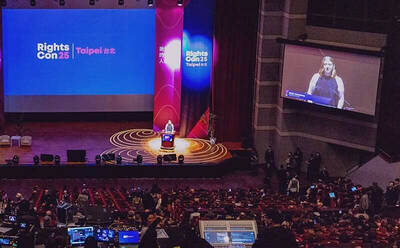
SILENCING CRITICS: In addition to blocking Taiwan, China aimed to prevent rights activists from speaking out against authoritarian states, a Cabinet department said The Ministry of Foreign Affairs (MOFA) yesterday condemned transnational repression by Beijing after RightsCon, a major digital human rights conference scheduled to be held in Zambia this week, was abruptly canceled due to Chinese pressure over Taiwanese participation. This year’s RightsCon, the world’s largest conference discussing issues “at the intersection of human rights and technology,” was scheduled to take place from tomorrow to Friday in Lusaka, and expected to draw 2,600 in-person attendees from 150 countries, along with 1,100 online participants. However, organizers were forced to cancel the event due to behind-the-scenes pressure from China, the ministry said, expressing its “strongest condemnation”
Taiwan Semiconductor Manufacturing Co (TSMC, 台積電), the world’s largest contract chipmaker, said it expects its 2-nanometer (2nm) chip capacity to grow at a compound annual rate of 70 percent from this year to 2028. The projection comes as five fabs begin volume production of 2-nanometer chips this year — two in Hsinchu and three in Kaohsiung — TSMC senior vice president and deputy cochief operating officer Cliff Hou (侯永清) said at the company’s annual technology symposium in Silicon Valley, California, last week. Output in the first year of 2-nanometer production, which began in the fourth quarter of last year, is expected to
Taiwan’s economy grew far faster than expected in the first quarter, as booming demand for artificial intelligence (AI) applications drove a surge in exports, spilling over into investment and consumption, the Directorate-General of Budget, Accounting and Statistics (DGBAS) said yesterday. GDP growth was 13.69 percent year-on-year during the January-to-March period, beating the DGBAS’ February forecast by 2.23 percentage points and marking the most robust growth in nearly four decades, DGBAS senior official Chiang Hsin-yi (江心怡) told a news conference in Taipei. The result was powered by exports, which remain the backbone of Taiwan’s economy, Chiang said. Outbound shipments jumped 51.12 percent year-on-year to


 RSS
RSS