


South Korea brought the curtain down on its “Peace Games” yesterday, with athletes dancing and singing together at a vibrant closing ceremony, although there was little warmth between dignitaries from the US and North Korea.
South Korea President Moon Jae-in, who hopes to use these Games as an opportunity to engage with the North, warmly greeted US President Donald Trump’s daughter Ivanka before offering a brief handshake to North Korean delegation leader Kim Yong-chol.
Trump sat front and center, beside Moon’s wife, while Kim was seated a row behind, decked out in a long black jacket and furry hat. Sitting two seats along from him was General Vincent Brooks, the commander of US Forces Korea.
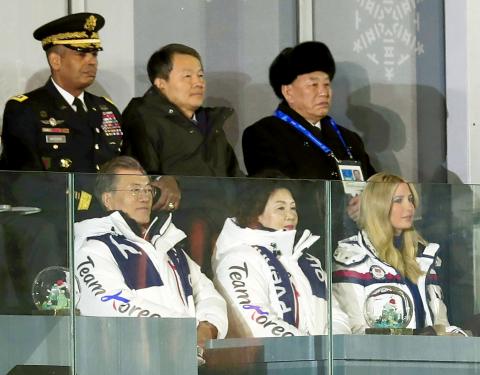
Photo: AP
International Olympic Committee (IOC) president Thomas Bach paid tribute to the athletes, saying they were an example to the world.
“You have shown how sport brings people together in our fragile world; you have shown how sport builds bridges,” he said. “The IOC will continue this Olympic dialogue, even after we extinguish the Olympic flame. In this, we are driven by our faith in the future.”
During his speech, Bach invited several athletes to join him on stage, including South Korea’s gold medalist skeleton rider Yun Sung-bin, North Korean figure skater Ryom Tae-ok, US skier Lindsey Vonn and Tongan flag carrier Pita Taufatofua.
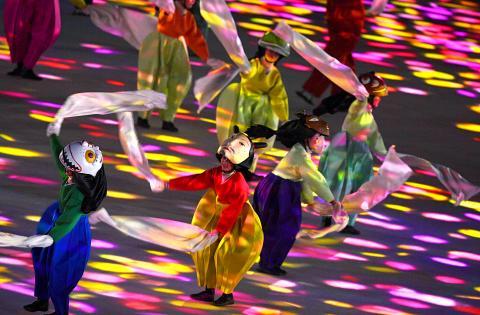
Photo: EPA-EFE
Bach signed off by calling upon the youth of the world to gather in Beijing in four years’ time for the 2022 Winter Games.
With the ceremony showcasing cutting-edge South Korean technology and a remarkable drone show that dotted out the image of the Games mascot Soohorang, a white tiger, in the night sky, athletes marched into the stadium, many wearing their medals.
The Russian flag, absent at the opening ceremony, was again nowhere to be seen after the IOC decided not to lift the suspension on their country.
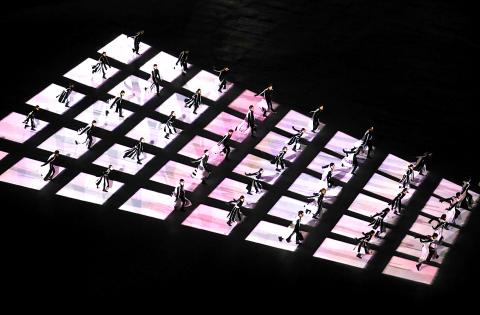
Photo: EPA-EFE
It was a bitter-sweet day for Russian athletes, who, after savoring the high of winning a nail-biting men’s ice hockey final yesterday, then had to march without their flag.
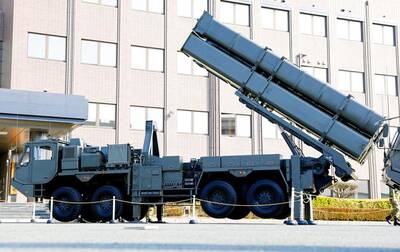
Japan has deployed long-range missiles in a southwestern region near China, the Japanese defense minister said yesterday, at a time when ties with Beijing are at their lowest in recent years. The missiles were installed in Kumamoto in the southern region of Kyushu, as Japan is attempting to shore up its military capacity as China steps up naval activity in the East China Sea. “Standoff defense capabilities enable us to counter the threat of enemy forces attempting to invade our country ... while ensuring the safety of our personnel,” Japanese Minister of Defense Shinjiro Koizumi said. “This is an extremely important initiative for
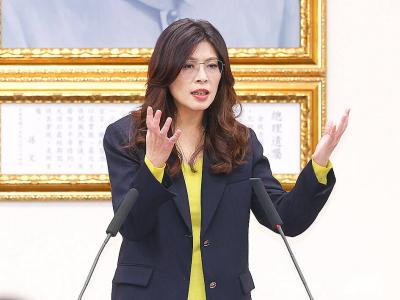
Chinese Nationalist Party (KMT) Chairwoman Cheng Li-wun (鄭麗文) today accepted an invitation from Chinese President Xi Jinping (習近平) to lead a delegation to China next month, saying she hopes to promote the peaceful development of cross-strait relations and bring stability to the Taiwan Strait. “I am grateful and happy to accept this invitation,” Cheng said in a statement from the KMT chairperson’s office. Cheng said she hopes both sides can work together to promote the peaceful development of cross-strait relations, enhance exchange and cooperation, bring stability to the Taiwan Strait and improve people’s livelihoods. At today's news conference, Cheng said any efforts to
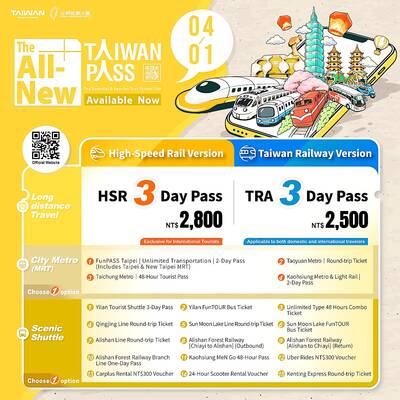
MORE POPULAR: Taiwan Pass sales increased by 59 percent during the first quarter compared with the same period last year, the Tourism Administration said The Tourism Administration yesterday said that it has streamlined the Taiwan Pass, with two versions available for purchase beginning today. The tourism agency has made the pass available to international tourists since 2024, allowing them to access the high-speed rail, Taiwan Railway Corp services, four MRT systems and four Taiwan Tourist Shuttles. Previously, five types of Taiwan Pass were available, but some tourists have said that the offerings were too complicated. The agency said only two types of Taiwan Pass would be available, starting from a three-day pass with the high-speed rail and a three-day pass with Taiwan Railway Corp. The former costs NT$2,800

The nation’s fastest supercomputer, Nano 4 (晶創26), is scheduled to be launched in the third quarter, and would be used to train large language models in finance and national defense sectors, the National Center for High-Performance Computing (NCHC) said. The supercomputer, which would operate at about 86.05 petaflops, is being tested at a new cloud computing center in the Southern Taiwan Science Park in Tainan. The exterior of the server cabinet features chip circuitry patterns overlaid with a map of Taiwan, highlighting the nation’s central position in the semiconductor industry. The center also houses Taiwania 2, Taiwania 3, Forerunner 1 and


 RSS
RSS