


The Taiwan High Court on Monday filed a request for a constitutional interpretation by the Council of Grand Justices on desecration of the flag, saying the Criminal Code penalizing such actions might infringe on freedom of speech, freedom of thought and proportionality.
The request was prompted by the case of independence advocates Chen Yi-ting (陳儀庭), Chen Miao-ting (陳妙婷) and three others, whose conviction for cutting up a dozen flags in 2015 was overturned on appeal by the New Taipei City District Court.
New Taipei City prosecutors appealed the overturned conviction.
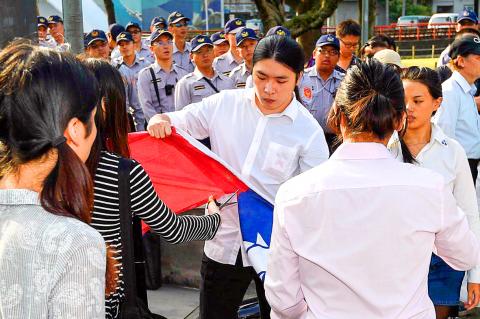
Photo: George Tsorng, Taipei Times
High Court judges Chou Ying-wen (周盈文), Lin Meng-huang (林孟皇) and Lin Hai-hsiang (林海祥) decided to suspend the appeal trial to allow time for a constitutional interpretation.
The Criminal Code’s prohibition of purposeful and public vandalism of the flag under Article 160 could be an infringement on the right to free speech and thought that is stipulated by Article 11 of the Constitution, the judges said.
The penalty of less than one year in prison might also clash with the principle of proportionality guaranteed by Article 23 of the Constitution, they said.
Although the flag should be honored as the nation’s symbol, its meaning to each citizen might vary and the spirit of liberty, equality and fraternity is better preserved via the toleration of dissent, not its punishment, they said.
On Oct. 10, 2015, the two Chens and three other members of the Taiwan Nationalist Party cut up flags that were displayed along Zhongzheng Bridge (中正橋) in New Taipei City. There were arrested and in their first trial were sentenced to 20 days imprisonment, commutable to a NT$20,000 fine.
The two Chens and fellow defendant Wu Hsin-en (吳馨恩) appealed the conviction, arguing that their action was a legitimate form of expression and damaging the flag was an expression of criticism on the Republic of China’s colonial repression of Taiwanese.
The New Taipei City District Court ruled in the defendants’ favor at the retrial, adding that political speech should be afforded the highest level of constitutional protection, prompting the prosecutors to appeal to the High Court.
Chen Yi-ting on Monday said that decriminalizing flag desecration would allow activists more freedom to criticize the political order.
National Taiwan University professor of law Chen Chih-lung (陳志龍) said that desecrating the flag was made a crime under the Republic of China’s Criminal Code during the 1930s due to the influence on China of Nazi Germany and other fascist states.
Most Western countries have decriminalized flag burning and other forms of protest targeting the national flag, he said.
Protesters who vandalize the flag do not cause real harm or damage and their actions are often motivated by deep and sincerely held convictions, which should be protected as a matter of conscience, he said.
“The Taiwan High Court did not need to suspend the trial or file for a constitutional interpretation, because it is already empowered to rule out the applicability of the Criminal Code to this case,” the professor said.
National Chengchi University associate professor of law Bruce Liao (廖元豪) said the US Supreme Court had struck down state laws penalizing flag desecration as violating free speech in the case Johnson v Texas.
For this reason, he would like to see the Council of Grand Justices rule on the issue, Liao said.
Charging protesters with damaging public property to the actual cash value of the flag would be more appropriate recompense for their actions, he added.

South Korea has adjusted its electronic arrival card system to no longer list Taiwan as a part of China, a move that the Ministry of Foreign Affairs said would help facilitate exchanges between the two sides. South Korea previously listed “Taiwan” as “Taiwan (China)” in the drop-down menus of its online arrival card system, where people had to fill out where they came from and their next destination. The ministry had requested South Korea make a revision and said it would change South Korea’s name on Taiwan’s online immigration system from “Republic of Korea” to “Korea (South),” should the issue not be

Tainan, Taipei and New Taipei City recorded the highest fines nationwide for illegal accommodations in the first quarter of this year, with fines issued in the three cities each exceeding NT$7 million (US$220,639), Tourism Administration data showed. Among them, Taipei had the highest number of illegal short-term rental units, with 410. There were 3,280 legally registered hotels nationwide in the first quarter, down by 14 properties, or 0.43 percent, from a year earlier, likely indicating operators exiting the market, the agency said. However, the number of unregistered properties rose to 1,174, including 314 illegal hotels and 860 illegal short-term rental
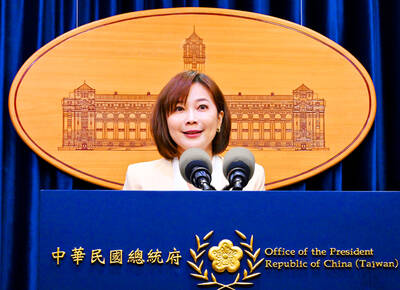
ECONOMIC COERCION: Such actions are often inconsistently applied, sometimes resumed, and sometimes just halted, the Presidential Office spokeswoman said The government backs healthy and orderly cross-strait exchanges, but such arrangements should not be made with political conditions attached and never be used as leverage for political maneuvering or partisan agendas, Presidential Office spokeswoman Karen Kuo (郭雅慧) said yesterday. Kuo made the remarks after China earlier in the day announced 10 new “incentive measures” for Taiwan, following a landmark meeting between Chinese President Xi Jinping (習近平) and Chinese Nationalist Party (KMT) Chairwoman Cheng Li-wun (鄭麗文) in Beijing on Friday. The measures, unveiled by China’s Xinhua news agency, include plans to resume individual travel by residents of Shanghai and China’s Fujian

Chinese President Xi Jinping (習近平) and Chinese Nationalist Party (KMT) Chairwoman Cheng Li-wun (鄭麗文) met in Beijing yesterday, where they vowed to bring people on both sides of the Taiwan Strait closer to facilitate the “great rejuvenation of the Chinese nation.” The meeting was held in the East Hall of the Great Hall of the People, a venue typically reserved for meetings between Xi and foreign heads of state. In public remarks prior to a closed-door meeting, Xi, in his role as head of the Chinese Communist Party (CCP), said that Taiwan is historically part of China, and remains an “inalienable” and


 RSS
RSS