


Any disorderly or illegal conduct that could affect the public’s rights or the operation of the Summer Universiade will not be tolerated, and will be dealt with stringently in accordance with the law, Minister of the Interior Yeh Jiunn-rong (葉俊榮) said yesterday.
Yeh also doubles as security commander-in-chief during the Games.
The Universiade is to formally begin today and runs through Aug. 30. Athletes from 142 nations are to compete in 22 disciplines at the largest sports event ever held in Taiwan.
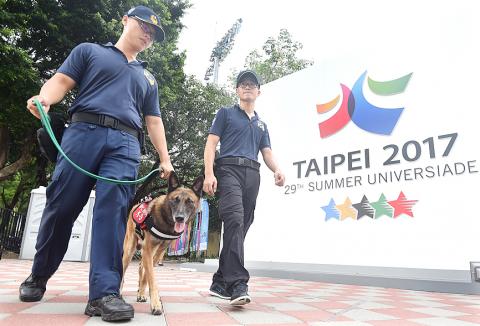
Photo: Liao Chen-huei, Taipei Times
The opening ceremony is to begin at 6pm tonight at the Taipei Municipal Stadium in Songshan District (松山).
The Taipei Universiade Organizing Committee has said that 2,500 entertainers will perform in the three-hour opening show, which is also to be broadcast on screens in six outdoor locations: Taipei City Hall plaza, Taipei Railway Station, the intersection of Xinyi and Keelung roads, Ming Yao Department Store, Pacific Sogo Department Store’s Fuxing branch and Zhongzheng Park in Taoyuan.
People will not be allowed to bring prohibited items, such as scissors, nail clippers, selfie sticks or long umbrellas, into the stadium, Yeh said.
Trucks and tractor-trailers are prohibited from passing through the vicinity of the stadium today, Yeh said, adding that police will erect roadblocks and deploy aerial drones.
Traffic will be regulated near sports venues, as well as at the Athletes’ Village in New Taipei City’s Linkou District (林口), he added.
The Universiade’s central security command center coordinates 12 units made up of personnel from the Police Special Services Commando Unit, Military Police Command, National Chungshan Institute of Science and Technology, the army’s Chemical Corps Division, Atomic Energy Council and other agencies, Yeh said.
The center is to operate at the highest threat level during the opening and closing ceremonies, and one notch lower during the Games, he said.
The Taipei District Prosecutors’ Office said it would also station four prosecutors at the stadium and Songshan police station during the opening ceremony to respond to any emergencies.
While some groups said they would stage protests at the opening, Yeh said the government respects people’s freedom of speech, but added that he hopes the protesters would express their opinions rationally and peacefully.
Additional reporting by CNA

RESILIENCE: Taiwan plays a key role in semiconductors, energy, information infrastructure and advanced manufacturing, AIT Director Raymond Greene said Taiwan’s continued investment in deterrence and resilience remains vital, especially in uncrewed systems and other emerging technologies, American Institute in Taiwan (AIT) Director Raymond Greene said yesterday. Greene made the remarks at the annual National Strategic Summit on Supply Chain Resilience held by the Research Institute for Democracy, Society and Emerging Technology (DSET), a government-backed think tank. As Taiwan last year became the US’ fourth-largest trading partner and supply chain security is becoming more important, cooperation in emerging technologies continues to deepen between the two countries, he said. The US is committed to accelerating innovation, building key infrastructure, strengthening cooperation

The National Chungshan Institute of Science and Technology yesterday showcased its locally developed variants of the Vision 60 robotic patrol dog, which it plans to deploy on the nation’s outlying territories in the South China Sea. The variants were produced under the Joint Lab project — created by the institute and domestic companies — and assembled with domestically produced motors, lenses and artificial intelligence (AI) systems alongside licensed tech from the US, Missile and Rocket Systems Research Division deputy director Jen Kuo-kang (任國光) told the media event at a military base in Taipei’s Dazhi (大直) area. Taiwan has built up its strengths

RIGHT DIRECTION: Taiwan’s efforts to prevent forced labor include a proposal to ‘fully prohibit’ employers from withholding workers’ documents, an official said Taiwan is to establish a mechanism to restrict imports of goods linked to forced labor, the Executive Yuan said yesterday, after the US proposed imposing additional tariffs on Taiwanese goods over labor concerns. “The Ministry of Labor and the Ministry of Economic Affairs are to establish an interministerial review procedure,” Executive Yuan spokesperson Michelle Lee (李慧芝) said at a news briefing in Taipei. “The government is to use the Foreign Trade Act [貿易法] as the legal basis to restrict imports of goods produced with forced labor” and bring its supply chain governance more in line with international standards on human rights, resilience

NOT IMMEDIATE: Taiwan has a chance to appeal the proposed 10 percent tariff before it starts, while other countries face a 12.5 percent tariff from the trade office Taiwan is among 60 economies determined by the US to have failed to impose or enforce a ban on the importation of goods produced with forced labor, according to a notice released on Tuesday by the Office of the US Trade Representative (USTR), which proposed imposing an additional 10 percent or more tariff on them. The USTR in a statement said that following an investigation, it had determined under Section 301 of the Trade Act of 1974 that the failure of the 60 economies to impose and effectively enforce a prohibition on the importation of goods produced with forced labor is


 RSS
RSS