


The Council of Grand Justices yesterday ruled that the Civil Code, which says an agreement to marry can only be made between a man and a woman, “violated” constitutional guarantees of freedom of marriage and equality.
The landmark Constitutional Interpretation No. 748 rules in favor of allowing homosexual couples to register for marriage, and grand justices have asked the legislature to amend relevant laws within two years to protect the interests of homosexuals.
If the government has not changed the law in two years, same-sex couples will be allowed to register their union at household registration offices, Judicial Yuan Secretary-General Lu Tai-lang (呂太郎) said.
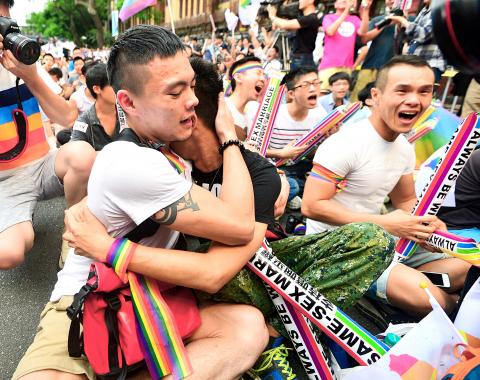
Photo: Wang Yi-sung, Taipei Times
The Civil Code violates the freedom of marriage and equal rights for all citizens as guaranteed by the Constitution, Lu said.
The grand justices made the ruling after receiving two requests for a constitutional interpretation of the issue.
One request was filed by veteran gay rights advocate Chi Chia-wei (祁家威) in 2015 after his attempt to register his same-sex marriage was rejected by Taipei’s Wanhua District (萬華) household registration office in 2013 and subsequent court appeals failed.
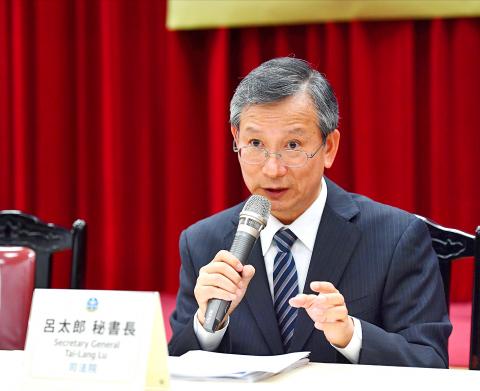
Photo: CNA
The other request was filed by the Taipei Department of Civil Affairs in 2015, after three same-sex couples filed an administrative lawsuit against the government after their marriage registrations were rejected by the department.
Justice Huang Jui-ming (黃瑞明) abstained from the vote and took no part in deliberations, the ruling said.
Dissenting opinions were filed by Justice Huang Horng-shya (黃虹霞) and Justice Wu Chen-huan (吳陳鐶).
“Marriage is a union between a man and a woman, who live life together as an institution, which is protected by the Constitution. Making changes would involve altering social and cultural values, which should not be made by merely copying developments in other nations... Therefore, the decision to legalize same-sex marriage should be made by a referendum,” Wu said.
It is a fallacy to rule that Civil Code provisions are unconstitutional, Huang Horng-shya said.
Same-sex marriage is not a fundamental human right to be universally protected, she said.
She said that she supports legislating legal protections of civil unions for same-sex adults, but does not view a homosexual union the same way as a marriage between a man and a woman.
Among the main reasons cited for the majority decision were that prior interpretations mentioning “husband and wife” or “a man and a woman” were made within the context of heterosexual marriage.
“This court has not made any interpretation on the issue of whether two people of the same sex are allowed to marry,” the ruling said.
The Civil Code does not require the ability to procreate as a requirement for marriage and reproduction is not an essential element of marriage, the ruling said, adding that procreation should not be an essential element of marriage.
Opposition to same-sex marriage based on safeguarding social and ethical values is incompatible with the spirit and meaning of equal rights as protected by the Constitution, the ruling said.
The Judicial Yuan also issued a three-page abstract on the ruling in Chinese and English, to accompany Constitutional Interpretation No. 748, which is 24 pages long.
Legal experts said it was rare for the Judicial Yuan to issue an English-language statement of a constitutional interpretation. They see the move as an official declaration to the international media of the decision that has made Taiwan the first Asian nation to recognize same-sex unions.
In response to media queries over whether same-sex foreign nationals could register their marriage in Taiwan, Lu did not give a direct answer, but said they would have to abide by provisions in the Act Governing the Choice of Law in Civil Matters Involving Foreign Elements (涉外民事法律適用法).
additional reporting by CNA

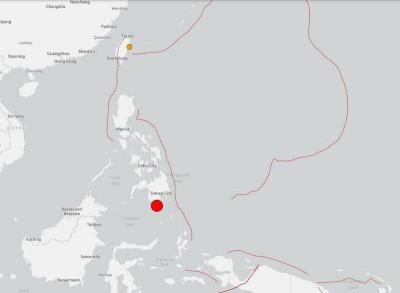
A magnitude 7.8 earthquake struck off the southern coast of Mindanao in the Philippines at 7:38am today, prompting the US Tsunami Warning System to issue an alert for neighboring countries, including Taiwan. The system issued a purple alert indicating a "tsunami threat." The potential threat zone includes Taiwan, the Philippines, Papua New Guinea, Yap and Palau. A spokesperson for Indonesia disaster mitigation agency said there were no reports of damage so far. Arlene Hollero, disaster chief of Maasim town in the Philippines' Sarangani Province, said their evacuation was underway in coastal villages and there were no reported casualties so far. DZBB radio, broadcasting from the

RESILIENCE: Taiwan plays a key role in semiconductors, energy, information infrastructure and advanced manufacturing, AIT Director Raymond Greene said Taiwan’s continued investment in deterrence and resilience remains vital, especially in uncrewed systems and other emerging technologies, American Institute in Taiwan (AIT) Director Raymond Greene said yesterday. Greene made the remarks at the annual National Strategic Summit on Supply Chain Resilience held by the Research Institute for Democracy, Society and Emerging Technology (DSET), a government-backed think tank. As Taiwan last year became the US’ fourth-largest trading partner and supply chain security is becoming more important, cooperation in emerging technologies continues to deepen between the two countries, he said. The US is committed to accelerating innovation, building key infrastructure, strengthening cooperation

The National Chungshan Institute of Science and Technology yesterday showcased its locally developed variants of the Vision 60 robotic patrol dog, which it plans to deploy on the nation’s outlying territories in the South China Sea. The variants were produced under the Joint Lab project — created by the institute and domestic companies — and assembled with domestically produced motors, lenses and artificial intelligence (AI) systems alongside licensed tech from the US, Missile and Rocket Systems Research Division deputy director Jen Kuo-kang (任國光) told the media event at a military base in Taipei’s Dazhi (大直) area. Taiwan has built up its strengths

RIGHT DIRECTION: Taiwan’s efforts to prevent forced labor include a proposal to ‘fully prohibit’ employers from withholding workers’ documents, an official said Taiwan is to establish a mechanism to restrict imports of goods linked to forced labor, the Executive Yuan said yesterday, after the US proposed imposing additional tariffs on Taiwanese goods over labor concerns. “The Ministry of Labor and the Ministry of Economic Affairs are to establish an interministerial review procedure,” Executive Yuan spokesperson Michelle Lee (李慧芝) said at a news briefing in Taipei. “The government is to use the Foreign Trade Act [貿易法] as the legal basis to restrict imports of goods produced with forced labor” and bring its supply chain governance more in line with international standards on human rights, resilience


 RSS
RSS