


A worldwide ransomware cyberattack yesterday spread to thousands more computers as people logged in at work, disrupting businesses, schools, hospitals and daily life, although no new large-scale breakdowns were reported.
The full extent of the damage from the cyberattack felt in 150 nations was unclear and could worsen if more malicious variations of the online extortion scheme appear.
The initial attack, known as “WannaCry,” paralyzed computers running factories, banks, government agencies and transport systems in scores of countries, including Taiwan, Russia, Ukraine, Brazil, Spain, India and Japan.
Among those hit were the Russian Ministry of Internal Affairs and companies including Spain’s Telefonica SA and FedEx Corp in the US.
About 770 computers at Taiwan Power Co’s (Taipower, 台電) offices were infected by WannaCry in Friday’s attack, but most have been repaired, the state-run utility said yesterday.
The incident has not affected electricity supply because the infected computers were used mainly for administrative work, Taipower spokesman Lin Te-fu (林德福) said.
As soon as the infection was detected on Saturday, the company disconnected the computers from the Internet, updated them and began repairing them, Lin said.
As of yesterday afternoon, only 152 computers had not yet been repaired, he said, adding that the work was expected to be completed by the end of the day.
Although the ransomware continued to spread at a more subdued pace yesterday, many companies and government agencies were still struggling to recover from the first attack.
In Asia, where Friday’s attack occurred after business hours, thousands of new cases were reported yesterday as people went back to work.
The nonprofit Japan Computer Emergency Response Team Coordination Center said 2,000 computers at 600 locations in Japan were affected.
Companies including Hitachi Ltd and Nissan Motor Co reported problems, but said they had not seriously affected their business operations.
State media said 29,372 institutions in China had been infected, along with hundreds of thousands of devices.
Universities and other educational institutions in China were among the hardest hit, possibly because schools tend to have old computers and are slow to update operating systems and security, Internet strategy think tank ChinaLabs founder Fang Xingdong (方興東) said.
Experts urged organizations and companies to immediately update older Microsoft operating systems, such as Windows XP, with a patch the firm released two months ago to limit vulnerability to a more powerful version — and future versions — of the malware.
Microsoft’s top lawyer is laying some of the blame at the feet of the US government.
Brad Smith criticized US intelligence agencies, including the CIA and the National Security Agency (NSA), for “stockpiling” software code that can be used by hackers.
Cybersecurity experts have said the unknown hackers who launched this weekend’s cyberattacks used a vulnerability that was exposed in NSA documents leaked online.

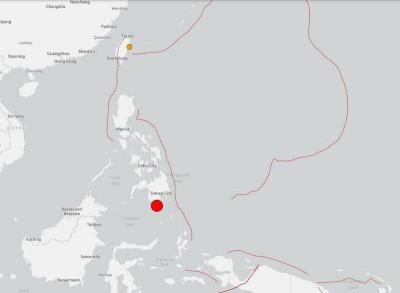
A magnitude 7.8 earthquake struck off the southern coast of Mindanao in the Philippines at 7:38am today, prompting the US Tsunami Warning System to issue an alert for neighboring countries, including Taiwan. The system issued a purple alert indicating a "tsunami threat." The potential threat zone includes Taiwan, the Philippines, Papua New Guinea, Yap and Palau. Philippine authorities were assessing the damage from the quake, with the office of civil defense seeking to verifying initial reports that 15 people had been killed and 129 injured in the region, mostly from falling debris. Arlene Hollero, disaster chief of Maasim town in the Philippines' Sarangani Province,

RESILIENCE: Taiwan plays a key role in semiconductors, energy, information infrastructure and advanced manufacturing, AIT Director Raymond Greene said Taiwan’s continued investment in deterrence and resilience remains vital, especially in uncrewed systems and other emerging technologies, American Institute in Taiwan (AIT) Director Raymond Greene said yesterday. Greene made the remarks at the annual National Strategic Summit on Supply Chain Resilience held by the Research Institute for Democracy, Society and Emerging Technology (DSET), a government-backed think tank. As Taiwan last year became the US’ fourth-largest trading partner and supply chain security is becoming more important, cooperation in emerging technologies continues to deepen between the two countries, he said. The US is committed to accelerating innovation, building key infrastructure, strengthening cooperation

The National Chungshan Institute of Science and Technology yesterday showcased its locally developed variants of the Vision 60 robotic patrol dog, which it plans to deploy on the nation’s outlying territories in the South China Sea. The variants were produced under the Joint Lab project — created by the institute and domestic companies — and assembled with domestically produced motors, lenses and artificial intelligence (AI) systems alongside licensed tech from the US, Missile and Rocket Systems Research Division deputy director Jen Kuo-kang (任國光) told the media event at a military base in Taipei’s Dazhi (大直) area. Taiwan has built up its strengths

RIGHT DIRECTION: Taiwan’s efforts to prevent forced labor include a proposal to ‘fully prohibit’ employers from withholding workers’ documents, an official said Taiwan is to establish a mechanism to restrict imports of goods linked to forced labor, the Executive Yuan said yesterday, after the US proposed imposing additional tariffs on Taiwanese goods over labor concerns. “The Ministry of Labor and the Ministry of Economic Affairs are to establish an interministerial review procedure,” Executive Yuan spokesperson Michelle Lee (李慧芝) said at a news briefing in Taipei. “The government is to use the Foreign Trade Act [貿易法] as the legal basis to restrict imports of goods produced with forced labor” and bring its supply chain governance more in line with international standards on human rights, resilience


 RSS
RSS