


Hundreds of campaigners marched in Taipei yesterday to commemorate the 228 Incident, calling for the government to officially assign responsibility for the massacre which followed a 1947 protest.
Escalating protests swept Taiwan on Feb. 28, 1947, after Tobacco Monopoly Bureau agents confiscated contraband cigarettes from a woman outside Taipei’s Tianma Tea House (天馬茶房) on Nanjing W Road on Feb. 27. When the woman was hit on the head by an officer holding a gun, the crowd surrounded the agents, who responded by fleeing with one agent shooting into the crowd and killing a bystander.
A subsequent bloody crackdown by the then-Chinese Nationalist Party (KMT) regime systematically killed many Taiwanese.
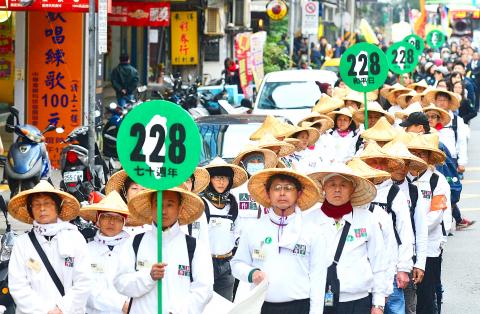
Photo: Wang Yi-song, Taipei Times
Only partial documentation of the events and victims has been recovered, with the government-funded 228 Memorial Foundation officially recognizing more than 2,200 victims.
More than 26 groups were represented at yesterday’s march through key historic sites, but no individual banners were raised.
Campaigners solemnly read out the names of those who were killed or went missing in the Incident.
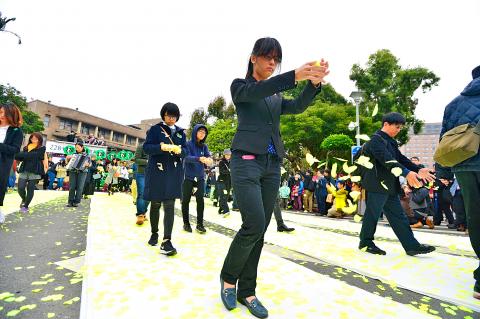
Photo: Wang Yi-song, Taipei Times
“As the victims are gradually forgotten, Feb. 28 has diminished into a holiday lacking emotion,” Nylon Cheng Liberty Foundation managing director Cheng Tsing-hua (鄭清華) said. “We are still at the starting line in terms of discovering the truth, because the identities of many victims and perpetrators are unknown.”
He called for the government to hasten passage of transitional justice legislation, which would establish a special committee with powers to investigate the Incident and other injustices under the then-KMT authoritarian rule.
Government discussions over the fate of the National Chiang Kai-shek (蔣介石) Memorial Hall were “more symbolic than substantial,” he said.
“The victims of the 228 Incident are not just those listed, its greatest victim was Taiwan itself, including the descendants of the perpetrators,” he said. “Without the truth, we do not have the preconditions for forgiveness.”
Cheng is a brother of democracy movement pioneer Deng Nan-jung (鄭南榕), who in 1987 spearheaded a national campaign for Feb. 28 to be designated a national holiday shortly after the lifting of martial law.
Veteran activists Chen Yung-hsing (陳永興) and Lee Sheng-hsiung (李勝雄), who collaborated with Deng, led yesterday’s procession as it wound its way from Nanjing W Road to the Executive Yuan, where troops fired into a crowd of protesters during the massacre. The building served as the headquarters of then-Taiwan Governor Chen Yi (陳儀).
The march also passed the former site of a Tobacco Monopoly Bureau office which was sacked the same day, and a radio station building which was occupied and used to spread word of the protests.
The procession concluded with a prayer and singing while participants scattered satin flower petals over white cloth to symbolize mourning.

PROVOCATIVE: Chinese Deputy Ambassador to the UN Sun Lei accused Japan of sending military vessels to deliberately provoke tensions in the Taiwan Strait China denounced remarks by Japan and the EU about the South China Sea at a UN Security Council meeting on Monday, and accused Tokyo of provocative behavior in the Taiwan Strait and planning military expansion. Ayano Kunimitsu, a Japanese vice foreign minister, told the Council meeting on maritime security that Tokyo was seriously concerned about the situation in the East China and South China seas, and reiterated Japan’s opposition to any attempt to change the “status quo” by force, and obstruction of freedom of navigation and overflight. Stavros Lambrinidis, head of the EU delegation to the UN, also highlighted South China Sea

SILENCING CRITICS: In addition to blocking Taiwan, China aimed to prevent rights activists from speaking out against authoritarian states, a Cabinet department said The Ministry of Foreign Affairs (MOFA) yesterday condemned transnational repression by Beijing after RightsCon, a major digital human rights conference scheduled to be held in Zambia this week, was abruptly canceled due to Chinese pressure over Taiwanese participation. This year’s RightsCon, the world’s largest conference discussing issues “at the intersection of human rights and technology,” was scheduled to take place from tomorrow to Friday in Lusaka, and expected to draw 2,600 in-person attendees from 150 countries, along with 1,100 online participants. However, organizers were forced to cancel the event due to behind-the-scenes pressure from China, the ministry said, expressing its “strongest condemnation”
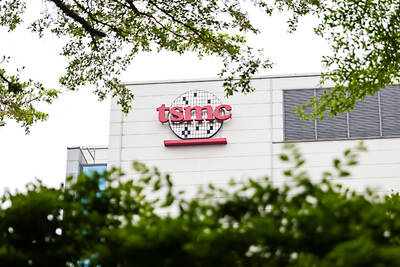
Taiwan Semiconductor Manufacturing Co (TSMC, 台積電), the world’s largest contract chipmaker, said it expects its 2-nanometer (2nm) chip capacity to grow at a compound annual rate of 70 percent from this year to 2028. The projection comes as five fabs begin volume production of 2-nanometer chips this year — two in Hsinchu and three in Kaohsiung — TSMC senior vice president and deputy cochief operating officer Cliff Hou (侯永清) said at the company’s annual technology symposium in Silicon Valley, California, last week. Output in the first year of 2-nanometer production, which began in the fourth quarter of last year, is expected to
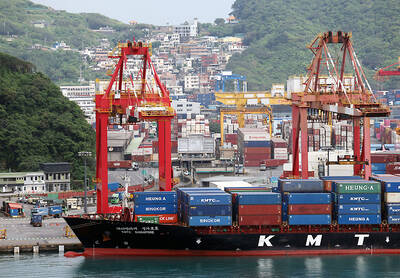
Taiwan’s economy grew far faster than expected in the first quarter, as booming demand for artificial intelligence (AI) applications drove a surge in exports, spilling over into investment and consumption, the Directorate-General of Budget, Accounting and Statistics (DGBAS) said yesterday. GDP growth was 13.69 percent year-on-year during the January-to-March period, beating the DGBAS’ February forecast by 2.23 percentage points and marking the most robust growth in nearly four decades, DGBAS senior official Chiang Hsin-yi (江心怡) told a news conference in Taipei. The result was powered by exports, which remain the backbone of Taiwan’s economy, Chiang said. Outbound shipments jumped 51.12 percent year-on-year to


 RSS
RSS