


Hundreds of thousands of women filled the streets of major US cities to lead an unprecedented wave of international protests against US President Donald Trump, mocking and denouncing the new US leader the day after his inauguration.
Women activists, outraged by Trump’s campaign rhetoric and behavior they found to be especially misogynistic, on Saturday spearheaded scores of marches in the US and sympathy rallies around the world.
Organizers said they drew about 5 million protesters in all, far surpassing crowd expectations.
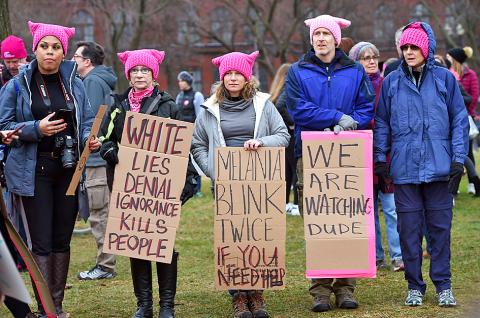
Photo: AFP
The demonstrations also highlighted strong discontent over Trump’s comments and policy positions toward a wide range of groups, including Mexican immigrants, Muslims, the disabled and environmentalists.
In contrast to the heated, often shrill tone of the presidential campaign, and the grim imagery of “American carnage” Trump evoked in his inaugural address, the mood during Saturday’s protests was largely upbeat, even festive.
Chanting such slogans as, “We need a real leader, not a creepy tweeter,” and “Hey-hey, ho-ho, Donald Trump has got to go,” many marchers wore knitted pink cat-eared “pussy hats” in a reference to Trump’s boast, in a 2005 video made public weeks before the election, about grabbing women by the genitals.
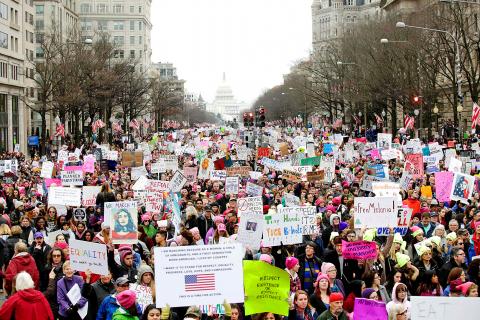
Photo: AFP
While women constituted the bulk of the demonstrators, many were accompanied by husbands, boyfriends and children.
The planned centerpiece of the protests, a Women’s March on Washington, appeared to draw larger crowds than turned out a day earlier to witness Trump’s swearing-in on the steps of the US Capitol.
No official estimates of the turnout were available, but it clearly exceeded the 200,000 marchers projected in advance by organizers, filling long stretches of downtown Washington around the White House and the National Mall.
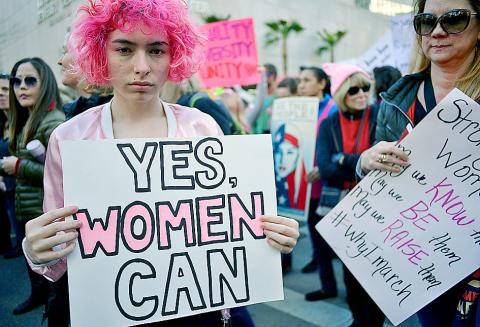
Photo: AFP
Hundreds of thousands more women thronged New York, Los Angeles, Chicago, Denver and Boston, adding to a public outpouring of mass dissent against Trump unmatched in modern US politics for a new president’s first full day in office.
So-called Sister March organizers estimated 750,000 demonstrators swarmed the streets of Los Angeles, one of the largest of Saturday’s gatherings.
Police said the turnout there was as big or bigger than a 2006 pro-immigration march that drew 500,000.
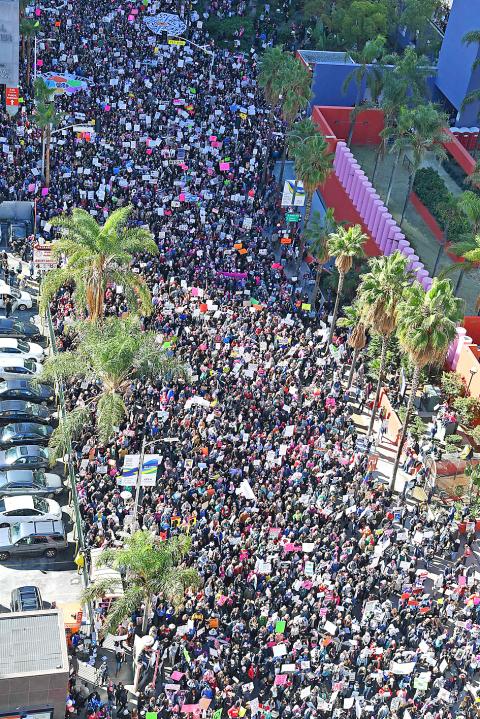
Photo: AFP
About 400,000 marchers assembled in New York City, according to New York Mayor Bill de Blasio, though organizers put the number there at 600,000.
The Chicago event grew so large that organizers staged a rally rather than trying to parade through the city. Police said more than 125,000 people attended, while sponsors estimated the crowd at 200,000, the same tally they reported for Boston and Denver.
Smaller protests were held in such cities as Seattle, Portland, Oregon, Madison, Wisconsin and Bismarck, North Dakota.
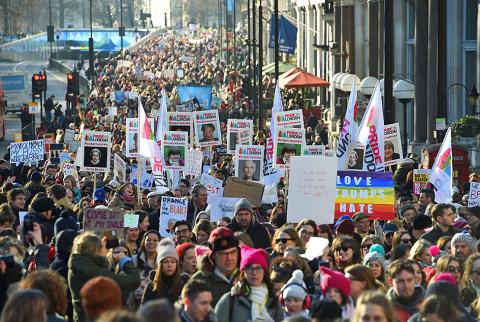
Photo: EPA
The protests, mostly peaceful, illustrated the depth of division in a country still reeling from the bitterly fought election campaign. Trump stunned the world by defeating Democrat Hillary Rodham Clinton, a former US secretary of state and first lady who made history as the first woman nominated for president by a major US political party.
Pam Foster, a resident of Ridgway, Colorado, said the atmosphere in Washington reminded her of mass protests during the 1960s and 1970s against the Vietnam War and in favor of civil rights and women’s rights.
“I’m 58 years old and I can’t believe we have to do this again,” Foster said.
Although Republicans now control the White House and both houses of the US Congress, Trump faces entrenched opposition from wide segments of the public, in contrast with the honeymoon period new presidents typically experience when first taking office.
A recent ABC News/Washington Post poll found Trump had the lowest favorability rating of any incoming US president since the 1970s.
Women-led protests against Trump, who has vowed that US policy would be based on the principle of “America first,” also were staged in Sydney, London, Tokyo and other cities across Europe and Asia.
“This is only the beginning,” Evvie Harmon, global coordinator for the Women’s March, told the Guardian. “We are not going away.”
“This is a mass mobilization and we are going to take this network of people and we are going to get them to lobby their members of Congress, call their governors — it’s going on from here,” she said.
Sister March sponsors boasted about 670 gatherings around the world in solidarity with the Washington event, including Berlin, Paris, Rome, Amsterdam and Cape Town, estimating a global turnout of more than 4.6 million participants tallied through online march registrations, although those numbers could not be independently verified.
In the UK, from 80,000 to 100,000 people joined the Women’s March on London, with another 14 marches in towns and cities across Britain, including Manchester, Cardiff, Edinburgh, Liverpool, Leeds and Belfast.
The London march began at the US embassy in London at noon, before snaking its way around the streets of the capital and finishing with a rally in Trafalgar Square.
Protesters waved banners with slogans like “Special relationship, just say no” and “Nasty women unite,” and were joined by London Mayor Sadiqi Khan and several Labour Party MPs.
Trump on Saturday in a Twitter post wrote: “I am honored to serve you, the great American People, as your 45th President of the United States!”
Attending an interfaith service at Washington National Cathedral before visiting the CIA headquarters, Trump made no mention of the protests, but he angrily attacked media reports, including photographs, showing that crowds at Friday’s inaugural were smaller than those seen in 2009 and 2013.
Saturday’s march in Washington overwhelmed the city’s Metro subway system, with enormous crowds reported and some stations temporarily forced to turn away riders.
The Metro reported 275,000 rides as of 11am on Saturday, 82,000 more than the 193,000 reported at the same time on Friday’s Inauguration Day, and eight times the normal Saturday volume.
The peaceful atmosphere of Saturday’s march contrasted sharply with unrest the day before, when groups of black-clad anti-establishment activists, among hundreds of anti-Trump protesters, smashed windows, set vehicles on fire and fought with riot police, who responded with stun grenades.
Washington prosecutors said about US$100,000 in damage had been done and 230 adults and five minors had been arrested.
Clinton won the popular vote in the Nov. 8 presidential election by about 2.9 million votes and exceeded Trump’s support among women voters by more than 10 percentage points. Trump, however, easily prevailed in the state-by-state Electoral College vote that actually determines the outcome of the race.
Trump offered few if any olive branches to his opponents in his inauguration speech.
“He has never seemed particularly concerned about people who oppose him,” said Neil Levesque, executive director of the New Hampshire Institute of Politics at Saint Anselm College.
However, the lawmakers who Trump needs onside to achieve his policy goals may be more sensitive to the show of mass opposition demonstrated by the anti-Trump rallies, Levesque said.
“Members of Congress are very sensitive to the public mood, and many of them are down here this week to see him,” Levesque said.
Additional reporting by the Guardian
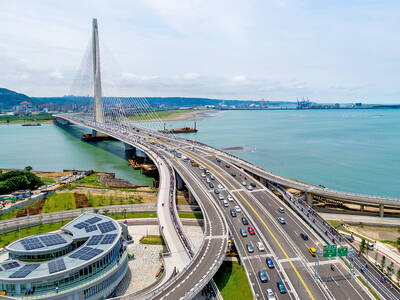
The Ministry of Transportation and Communications yesterday inaugurated the Danjiang Bridge across the Tamsui River in New Taipei City, saying that the structure would be an architectural icon and traffic artery for Taiwan. Feted as a major engineering achievement, the Danjiang Bridge is 920m long, 211m tall at the top of its pylon, and is the longest single-pylon asymmetric cable-stayed bridge in the world, the government’s Web site for the structure said. It was designed by late Iraqi-British architect Zaha Hadid. The structure, with a maximum deck of 70m, accommodates road and light rail traffic, and affords a 200m navigation channel for boats,
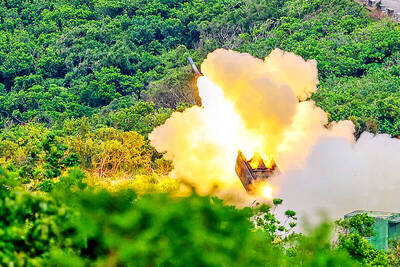
PRECISION STRIKES: The most significant reason to deploy HIMARS to outlying islands is to establish a ‘dead zone’ that the PLA would not dare enter, a source said A High Mobility Artillery Rocket System (HIMARS) would be deployed to Penghu County and Dongyin Island (東引) in Lienchiang County (Matsu) to force the Chinese military to retreat at least 100km from the coastline, a military source said yesterday. Taiwan has been procuring HIMARS and Army Tactical Missile Systems (ATACMS) from the US in batches. Once all batches have been delivered, Taiwan would possess 111 HIMARS units and 504 ATACMS, which have a range of 300km. Considering that “offense is the best defense,” the military plans to forward-deploy the systems to outlying islands such as Penghu and Dongyin so that

Taiwan Semiconductor Manufacturing Co (TSMC, 台積電), the world’s largest foundry service provider, yesterday said that global semiconductor revenue is projected to hit US$1.5 trillion in 2030, after the figure exceeds US$1 trillion this year, as artificial intelligence (AI) demand boosts consumption of token and compute power. “We are still at the beginning of the AI revolution, but we already see a significant impact across the whole semiconductor ecosystem,” TSMC deputy cochief operating officer Kevin Zhang (張曉強) said at the company’s annual technology symposium in Hsinchu City. “It is fair to say that in the past decade, smartphones and other mobile devices were

‘CLEAR MESSAGE’: The bill would set up an interagency ‘tiger team’ to review sanctions tools and other economic options to help deter any Chinese aggression toward Taiwan US Representative Young Kim has introduced a bill to deter Chinese aggression against Taiwan, calling for an interagency “tiger team” to preplan coordinated sanctions and economic measures in response to possible Chinese military or political action against Taiwan. “[Chinese President] Xi Jinping [習近平] has directed the People’s Liberation Army to be ready to invade Taiwan by 2027. China has a plan. America should have one too,” Kim said in a news release on Thursday last week. She introduced the “Deter PRC [People’s Republic of China] aggression against Taiwan act” to “ensure the US has a coordinated sanctions strategy ready should


 RSS
RSS